Imagine walking through a dark amusement-park funhouse filled with fake skeletons, painted monsters, and worn-out props. Nothing seems unusual. Then someone reaches for one of the figures hanging inside, part of its arm breaks away, and what appears underneath is unmistakably real.
That unsettling moment reportedly unfolded in Long Beach, California, in December 1976, while a television crew was preparing a location for an episode of The Six Million Dollar Man.
The figure looked like an old amusement-park mannequin. Its skin had been painted a reddish color, years of handling had damaged its body, and few people had any reason to suspect it was anything more than another inexpensive prop.
It was not.
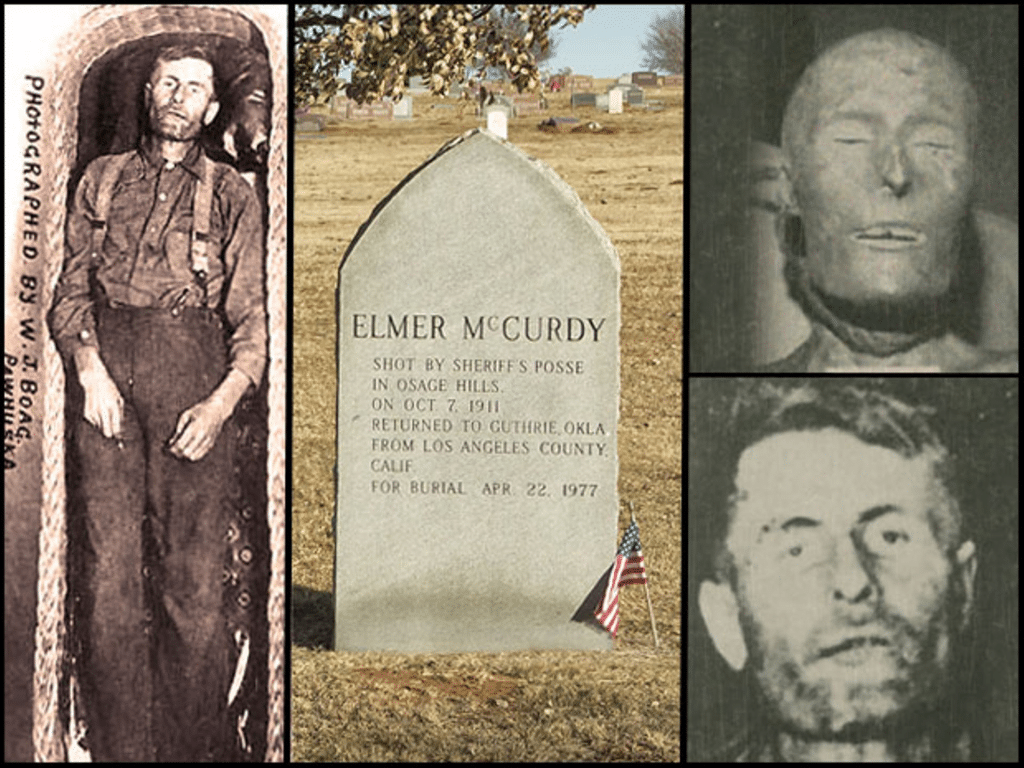
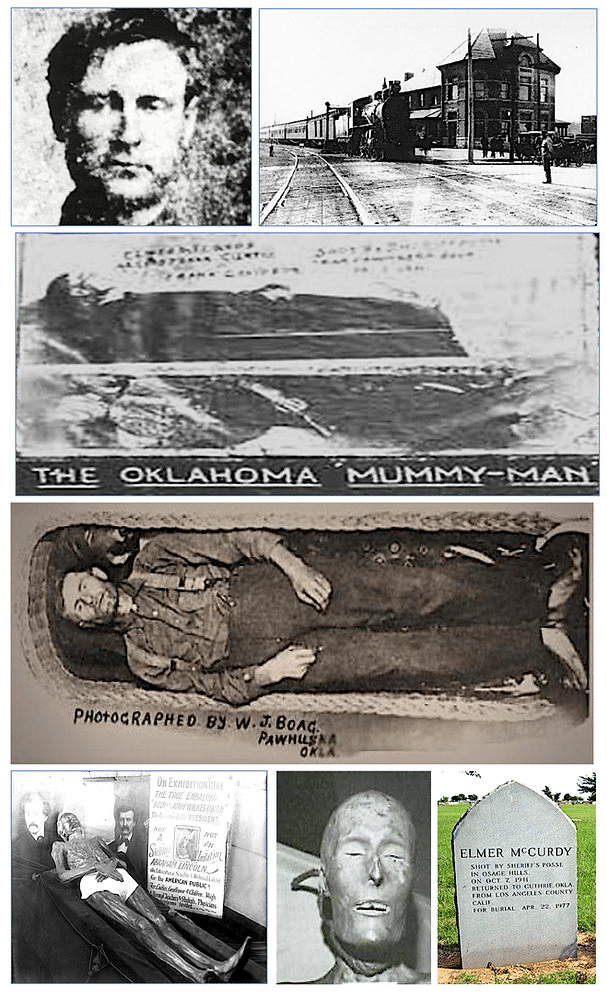
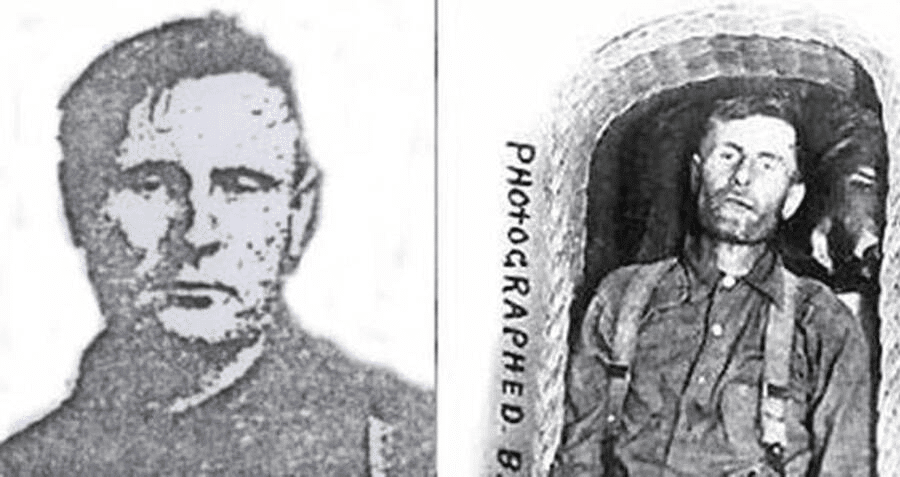
The figure was the preserved body of Elmer McCurdy, a little-known outlaw who had died in Oklahoma in 1911. Somehow, his remains had spent roughly six decades moving through funeral homes, carnivals, sideshows, crime exhibits, and amusement attractions.
His strange journey after death became far more remarkable than his brief criminal career ever was.
The Shocking Discovery at a California Funhouse
The discovery took place inside Laff in the Dark, an attraction at the Nu-Pike amusement park in Long Beach.
On December 8, 1976, a production crew was working there while preparing scenes for an episode called “Carnival of Spies.” Among the hanging decorations was a human-shaped figure that seemed perfectly suited to the eerie surroundings.
A crew member tried to move it.
Exactly what broke first varies depending on the account. Some versions mention an arm, while others refer to a finger or part of the limb. What matters is what appeared beneath the damaged exterior.
There seemed to be actual human tissue and bone.
Authorities were contacted, and the mysterious figure was taken to the Los Angeles County coroner’s office.
Investigators quickly realized they were not dealing with a recent death. The body had been preserved long ago and had apparently been repeatedly coated, repaired, and altered for display.
The obvious question was almost unbelievable: How could a real human body remain in public view for decades while being mistaken for a prop?
Who Was Elmer McCurdy?
Elmer McCurdy was born in Maine in 1880. Before becoming associated with crime, he worked ordinary jobs, including plumbing, and later served in the United States Army.
His military experience reportedly introduced him to explosives. Unfortunately for McCurdy, knowing something about explosives and using them successfully were two very different things.
His criminal career began in Oklahoma and quickly earned a reputation for failure rather than fortune.
During one robbery attempt, McCurdy and his associates reportedly used explosives to open a safe containing silver. The blast worked a little too well. Instead of producing an easy payday, the explosion damaged the contents so severely that much of the silver became difficult or impossible to carry away.
That episode almost reads like a scene from a dark comedy, but McCurdy’s next crimes did not improve his luck.
The Robbery That Brought Almost Nothing
In another robbery, McCurdy reportedly targeted what he believed was a train carrying a valuable cash shipment.
He and his partners stopped the wrong train.
Instead of walking away with a fortune, they escaped with only a small amount of money and containers of alcohol.
Authorities soon tracked him to a barn near Bartlesville, Oklahoma.
On October 7, 1911, law-enforcement officers surrounded the building and demanded his surrender. McCurdy refused.
After an exchange of gunfire, officers entered the barn and found him dead.
At that point, his life as an outlaw was over.
His much stranger second life was just beginning.
An Undertaker Turned His Body Into an Attraction
McCurdy’s remains were taken to an undertaker named Joseph Johnson in Pawhuska, Oklahoma.
Johnson embalmed the body using preservation methods of the era. Historical accounts often describe the embalming mixture as containing arsenic, a substance used in some early embalming preparations.
Johnson expected someone to claim the body and pay the funeral expenses.
Nobody did.
Because the embalming had preserved McCurdy unusually well, Johnson eventually began showing the body to visitors.
The dead outlaw was dressed, posed upright, and promoted under dramatic names such as the “Embalmed Bandit.”
People reportedly paid a small fee to see him.
Video: Lost and Found: The Chilling Tale of a Real Corpse in the Funhouse
From Forgotten Criminal to Local Curiosity
The transformation was extraordinary.
McCurdy had never been one of America’s legendary outlaws. He had not built a massive criminal empire or escaped from authorities for decades.
Yet after his death, promoters could present him as something larger than life.
A real preserved outlaw was an irresistible attraction in an era when audiences were fascinated by stories of the Old West, gunfighters, criminals, and frontier legends.
For several years, carnival operators reportedly tried to obtain McCurdy’s body.
Johnson refused.
Then, in 1916, two men arrived claiming to be McCurdy’s brothers. They convinced the funeral home that they intended to take him away for burial.
They were not relatives.
They were connected to the carnival business.
His Body Spent Decades Traveling With Carnivals
Once the promoters obtained McCurdy’s remains, the body became part of America’s traveling entertainment industry.
Video: The Sad Fate of Elmer McCurdy
Over the following decades, it reportedly appeared in carnivals, sideshows, crime exhibitions, and haunted attractions.
The truth about McCurdy became increasingly flexible.
Promoters could change the name of an exhibit, exaggerate his crimes, or invent dramatic stories designed to sell tickets.
To an audience, he was not simply Elmer McCurdy anymore.
He became whatever the attraction needed him to be.
That gradual loss of identity may be the most fascinating part of the story.
How a Real Body Became Mistaken for a Mannequin
Years of transportation and public display took a toll on McCurdy’s remains.
Parts of the body deteriorated. Paint, wax, and other materials were reportedly added over time to preserve or improve its appearance.
Eventually, the figure looked less like a preserved human being and more like a crude artificial prop.
Documentation also disappeared as the attraction changed hands.
Some owners may have known the body was genuine. Others may have inherited it without understanding its history.
By the time McCurdy reached Southern California, his identity had become little more than a faded memory.
Inside a dark amusement-park funhouse surrounded by artificial skeletons and monsters, he blended in perfectly.
Investigators Began Solving a 65-Year Mystery
At the coroner’s office, investigators searched for anything that could explain who the man had been.
The body contained clues.
Investigators reportedly found evidence related to an old gunshot wound, along with items connected to the body’s long history as an attraction. Accounts describe old ticket stubs and even a coin dating from the 1920s among the materials associated with the remains.
Those discoveries suggested that the body had spent many years in public exhibitions.
The preservation technique provided another important clue. The embalming methods were consistent with practices from much earlier in the century.
Authorities began tracing the history of carnival exhibits and contacting people who might remember the body.
That investigation eventually led to individuals connected with former owners of the attraction.
Historical records, photographs, and physical evidence helped establish the man’s identity.
The supposed funhouse mannequin was Elmer McCurdy.
Elmer McCurdy Finally Received a Permanent Burial
Once investigators knew who he was, officials faced a question that had remained unresolved for more than six decades.
Where should Elmer McCurdy finally be buried?
His body was returned to Oklahoma.
On April 22, 1977, approximately 66 years after his death, McCurdy was laid to rest in the Boot Hill section of Summit View Cemetery in Guthrie, Oklahoma.
His grave was placed near other figures connected with the state’s outlaw history.
After decades of being shipped, displayed, photographed, handled, painted, and passed from one attraction to another, McCurdy finally had a permanent resting place.
According to widely repeated accounts, concrete was poured over his casket.
The reason was grimly practical.
Authorities wanted to make sure nobody could dig him up and turn him into an attraction again.
Why the Elmer McCurdy Story Still Fascinates People
At first glance, this story sounds like a bizarre Hollywood legend: a television crew discovers that a creepy mannequin is actually a corpse.
But the truth is far more interesting.
The unsettling part is not simply that a real body appeared inside an amusement attraction. It is that McCurdy had reportedly been displayed openly for decades.
Thousands of people may have seen him.
Some may even have been told he was real.
Yet as the years passed, the truth became easier to dismiss. Paint covered his skin. His appearance deteriorated. His identity faded. Eventually, a genuine human body became indistinguishable from the fake monsters surrounding it.
There is something almost symbolic about that transformation.
McCurdy spent his life trying unsuccessfully to become an outlaw worth remembering. In death, promoters turned him into exactly that kind of legend—only the legend barely resembled the real man.
Conclusion: The Funhouse Prop That Wasn’t a Prop
Elmer McCurdy’s story remains one of the strangest intersections of American crime history, carnival culture, and television production.
He died after a short and unsuccessful criminal career in 1911. His preserved remains then passed through undertakers, carnival promoters, sideshows, exhibits, and amusement attractions for decades.
By 1976, almost nobody around him seemed to know that the battered figure hanging inside a California funhouse had once been a living person.
It took an accidental break during television production to expose the truth.
That discovery finally restored McCurdy’s name and ended a journey that had lasted more than 65 years.
In life, Elmer McCurdy never became the legendary outlaw he apparently hoped to be.
In death, however, he became part of one of America’s most unforgettable—and unsettling—historical mysteries.