Imagine cleaning out an old attic and discovering a strange gray video game console you had almost forgotten about.
It has two logos on the front.
One belongs to Nintendo.
The other belongs to Sony.
For most people, that might seem like an unusual piece of old electronics. For video game historians, however, those two names together tell an extraordinary story.
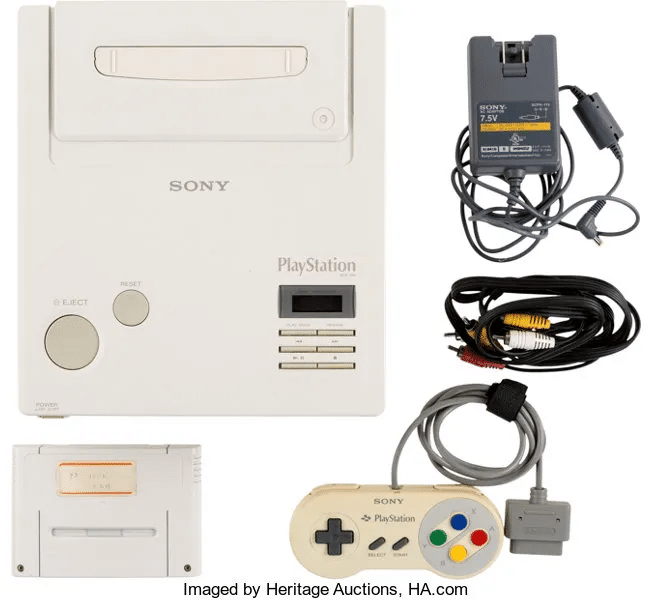
The machine was eventually identified as the Nintendo PlayStation prototype, a rare piece of hardware created during a short-lived partnership between Nintendo and Sony in the early 1990s.
The partnership collapsed before the console could reach consumers. The system disappeared from the public eye, and most prototypes were believed to have been destroyed or retained privately.
Then one surviving unit surfaced after spending years in an attic.
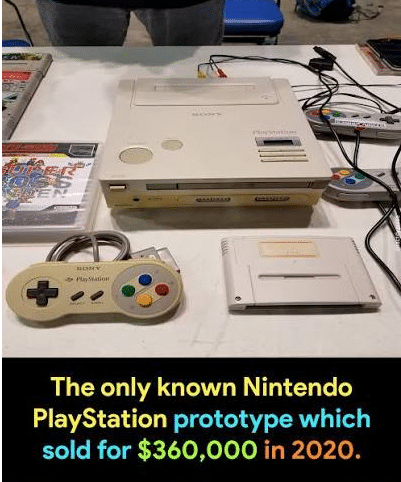
And when it eventually went to auction, it sold for an astonishing $360,000.
The Strange Console That Was Never Supposed to Reach the Public
The story begins before Sony’s PlayStation became one of the biggest names in gaming.
In the late 1980s and early 1990s, Nintendo dominated the home console market. The Super Nintendo Entertainment System was becoming a major success, but the industry was changing quickly.
Compact discs were becoming increasingly important.
Sony already had extensive experience with CD technology, so the two companies began working together on a system that could combine Nintendo’s cartridge technology with Sony’s emerging disc format.
The proposed machine became known informally as the Nintendo PlayStation or SNES-CD.
It was an unusual marriage of two companies that would later become fierce competitors.
Nintendo brought its gaming expertise.
Sony brought its audio and optical-disc technology.
On paper, it looked like a promising partnership.
But behind the scenes, the relationship was becoming increasingly complicated.
Video: Why The Nintendo PlayStation Was Never Released – Dark History: Episode 1
The Console That Existed Between Two Eras
The prototype represented an idea that never reached store shelves.
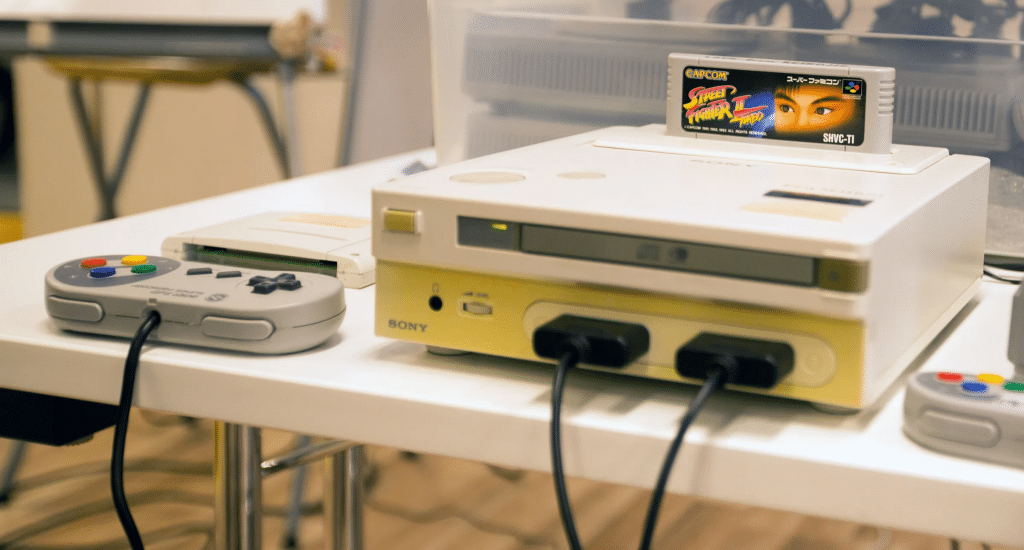
The system was designed to accept Super Nintendo cartridges while also incorporating a CD-ROM drive. That combination was significant because it suggested a future in which Nintendo’s existing game library could coexist with a new disc-based format.
In other words, the machine stood between two generations of gaming technology.
It was part Super Nintendo.
It was part Sony experiment.
And it was the physical result of a partnership that would soon disappear.
Nintendo and Sony Suddenly Went Their Separate Ways
The collaboration became public in 1991 when Sony demonstrated its version of the proposed hardware at the Consumer Electronics Show.
Then came the shock.
Nintendo announced that it would work with Philips instead of Sony on its CD-ROM plans.
The partnership with Sony effectively collapsed.
The decision became one of the most consequential moments in video game history.
Sony had already invested engineering resources into developing the technology. Rather than simply abandoning its work, the company eventually moved toward creating a standalone video game console.
That project became the original Sony PlayStation, which launched in Japan in 1994 and later became a global phenomenon.
It is one of those fascinating historical “what if?” moments.
What if Nintendo and Sony had stayed together?
Would Sony have created the PlayStation?
Would Nintendo have entered the CD era differently?
Would the console wars of the 1990s have looked completely different?
We can never know.
But one forgotten piece of hardware gives us a glimpse of the road that was never taken.
How the Prototype Ended Up in an Attic
After the Nintendo-Sony relationship ended, the prototype hardware disappeared from public view.
For years, there was no widely recognized surviving example.
Then Terry Diebold discovered the unusual machine among his family’s belongings.
His father had reportedly obtained the console through a business connection during the period when the Nintendo-Sony relationship was active.
The family did not initially understand exactly what they had.
And why would they?
At the time, it was simply an old piece of electronics.
Nobody could have predicted that the strange gray box sitting in storage would eventually become one of the most valuable pieces of video game hardware ever publicly sold.
A Forgotten Box Became a Gaming Time Capsule
The prototype remained in private hands for years.
It wasn’t sitting behind museum glass.
It wasn’t carefully displayed in a corporate archive.
It was simply stored away.
That detail makes the discovery especially remarkable.
Attics and garages are full of objects that once seemed important but gradually became forgotten. Old cameras, toys, electronics and paperwork can sit untouched for decades.
Most are eventually thrown away.
This one survived.
And inside that ordinary-looking gray casing was a piece of gaming history.
The Two Logos Revealed the Real Story
The first major clue was impossible to miss.
The machine carried both the Nintendo and Sony names.
That combination immediately raised questions because the two companies had become competitors after their partnership ended.
The hardware also featured a Super Nintendo cartridge slot along with a CD-ROM drive.
That combination matched the concept behind the abandoned Nintendo-Sony project.
The more experts examined the machine, the more convincing its history became.
It wasn’t simply a custom-built curiosity.
Its physical characteristics fit the development period and the technology associated with the failed collaboration.
The discovery attracted enormous interest from gaming enthusiasts.
Eventually, Terry Diebold brought the prototype into the public eye, including an appearance at the Portland Retro Gaming Expo in 2015.
Photographs and videos spread quickly.
For longtime gamers who remembered the Nintendo-Sony story, seeing the actual hardware was almost like finding a missing page from history.
The Prototype Could Still Do Something Remarkable
Finding an old prototype would have been impressive enough.
But this particular machine had another surprise.
It still worked, at least in part.
Tests demonstrated that the prototype could run Super Nintendo cartridges.
Think about that for a moment.
A machine created during an abandoned partnership in the early 1990s had spent decades in private storage and could still perform its basic gaming function when tested.
The CD-ROM side was much harder to evaluate because compatible prototype-era software was extremely rare.
Still, the functioning cartridge hardware provided important evidence that the machine was not merely a hollow demonstration shell.
It was genuine working development hardware.
That distinction mattered enormously to collectors.
Why the Nintendo PlayStation Prototype Was So Valuable
Rare doesn’t automatically mean valuable.
Collectors usually care about several things at once: authenticity, condition, historical importance, provenance and scarcity.
The Nintendo PlayStation prototype checked nearly every box.
First, there was the history.
This was physical evidence of the Nintendo-Sony collaboration that existed before the PlayStation became a separate Sony product.
Then came the rarity.
The unit that surfaced publicly was widely described as the only known surviving Nintendo PlayStation prototype.
Its condition also added to its appeal.
The machine had survived decades without being destroyed, heavily modified or reduced to a collection of loose components.
And then there was the story.
A mysterious console with two competing corporate names had spent years hidden away in an attic before being rediscovered.
For collectors, that kind of provenance is almost irresistible.
Heritage Auctions Put the Prototype on the Market
The extraordinary machine eventually reached Heritage Auctions, where its history and characteristics were documented for potential buyers.
Video: The Nintendo Playstation was ALMOST a thing! A prototype was found in an attic and sold for BIG $$!
The auction attracted considerable attention from collectors, gaming historians and technology enthusiasts.
This wasn’t simply another vintage console.
It was a physical reminder of a partnership that had helped shape the future of the industry, even though the partnership itself failed.
The machine represented the moment immediately before Sony went in a completely different direction.
That historical context made the auction especially significant.
The $360,000 Sale That Made Gaming History
When the auction concluded in 2020, the Nintendo PlayStation prototype sold for $360,000, including the buyer’s premium.
The result demonstrated just how much collectors were willing to pay for a genuinely unique piece of gaming history.
The buyer’s identity was not publicly disclosed.
But the price immediately turned the prototype into one of the most talked-about pieces of vintage gaming hardware ever sold at auction.
And suddenly, that old attic didn’t seem quite so ordinary.
Why Collectors Wanted This Particular Console
The $360,000 price wasn’t simply about nostalgia.
The prototype connected several important chapters of technology history.
It represented Nintendo’s dominance during the cartridge era.
It represented Sony’s early experimentation with optical media.
It represented the collapse of a partnership.
And, perhaps most importantly, it represented the beginning of a completely different future for Sony.
Without the failed Nintendo partnership, the story of the PlayStation might have unfolded very differently.
That makes the prototype more than a rare console.
It is a physical “what if?” from one of gaming’s most important turning points.
The Console That Changed History Without Ever Reaching Stores
The strangest thing about the Nintendo PlayStation is that it never became a commercial product.
Gamers never walked into a store and bought one.
There were no launch-day crowds.
No official game library developed around it.
No television commercials introduced it to families.
Yet decades later, the machine became enormously valuable precisely because it represented a future that never arrived.
The gray console sitting in an attic captured a moment when two future competitors were still trying to build something together.
Soon afterward, everything changed.
Sony created its own console.
The PlayStation became a global gaming powerhouse.
Nintendo continued along its own path.
The industry moved forward.
But one prototype remained behind, quietly preserving the moment before the split.
Conclusion: A Forgotten Attic Discovery Became a Piece of Gaming History
The Nintendo PlayStation prototype is a remarkable reminder that history doesn’t always survive in museums.
Sometimes it sits in a forgotten box.
Sometimes it gathers dust in an attic.
And sometimes, nobody realizes what it is until decades later.
Terry Diebold’s discovery revealed a rare piece of hardware created during Nintendo and Sony’s short-lived collaboration. The machine combined Super Nintendo cartridge technology with a CD-ROM drive and carried both companies’ names—a combination that would soon become impossible to find on any official consumer console.
After years in private storage, the prototype was publicly demonstrated, examined and eventually offered through Heritage Auctions.
It sold for $360,000.
But the money is only part of the story.
The real value of the machine lies in what it represents: a road gaming history could have taken but didn’t.
One partnership ended.
One company built its own console.
An entirely new era began.
And remarkably, one gray prototype survived long enough to tell the story from an attic shelf.