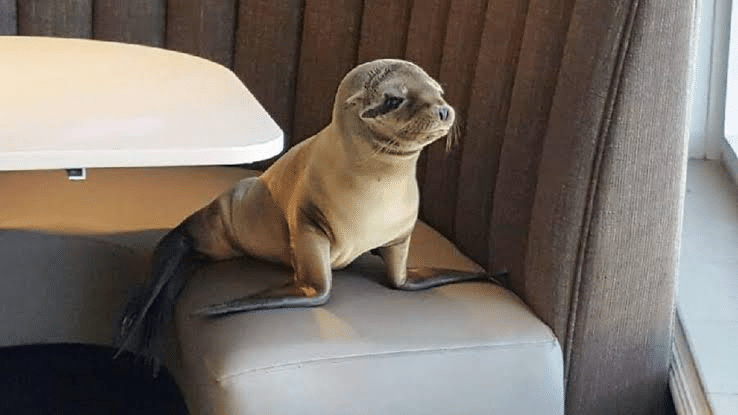
The morning at a beachfront restaurant in Southern California began with an astonishing discovery.
Employees arrived expecting the usual routine: unlock the doors, prepare the dining room, check the kitchen and get ready for another busy day overlooking the Pacific.
Instead, they found an unexpected guest already waiting inside.
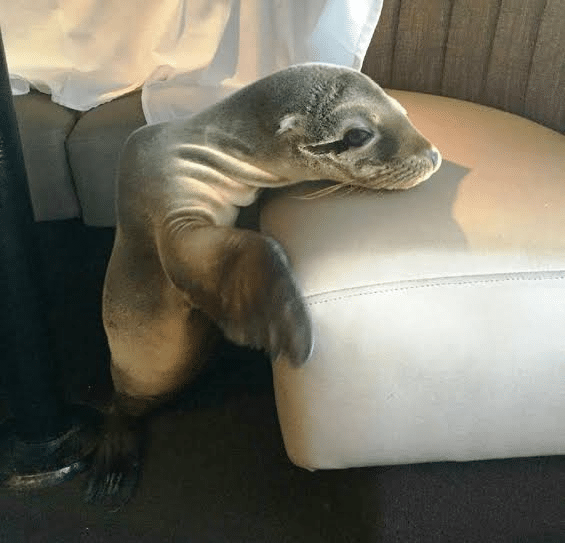
Curled up comfortably in one of the restaurant booths was a young California sea lion.
The tiny visitor had somehow left the ocean, crossed the beach and made its way into the dining room. But this wasn’t simply a curious animal looking for a strange new place to explore. The pup was visibly exhausted and severely underweight.
Fortunately, the restaurant staff knew exactly what to do.
They contacted a professional marine mammal rescue team, and help arrived soon afterward.
What followed turned an unbelievable restaurant encounter into a story about wildlife distress, responsible human intervention and a second chance.
The Strange Discovery Inside the Restaurant
The unexpected visitor was found at The Marine Room, a well-known restaurant overlooking La Jolla Shores in San Diego.
Its location made the animal’s journey slightly less mysterious.
The restaurant sits extremely close to the Pacific Ocean, with the beach directly outside. Marine wildlife is a familiar part of the surrounding environment, but finding a sea lion inside the dining area was certainly not part of the daily routine.
When employees discovered the pup, it was resting quietly inside a booth.
The animal wasn’t behaving aggressively or attempting to cause damage. Instead, it appeared tired and weak.
That detail immediately changed the situation.
A healthy wild sea lion normally has little reason to wander into a restaurant. An exhausted pup sitting motionless in an unfamiliar environment can be a warning sign that something is wrong.
Video: STARVING SEA LION | Sea lion pup rescued in restaurant san diego video
Why the Pup’s Behavior Was Concerning
Young sea lions depend heavily on their mothers during their early development.
A pup that becomes separated, struggles to nurse or cannot obtain enough food can rapidly lose body condition. As its energy reserves disappear, normal caution around people and buildings may also diminish.
That can lead to unusual encounters.
Instead of remaining near the shoreline or returning to the water, a distressed animal may simply look for somewhere quiet to rest.
For this pup, that happened to be a restaurant booth.
The cushioned seat probably offered something the exhausted animal desperately needed: a sheltered, relatively quiet place to stop moving.
How Did a Sea Lion Get Into a Restaurant?
At first, the question sounds almost comical.
How does a sea lion go from the Pacific Ocean to a dining booth?
The answer probably involves the restaurant’s unusual proximity to the beach.
The Marine Room is positioned directly along La Jolla Shores. From the water, the distance to the building is relatively short, particularly for a marine mammal accustomed to moving between the ocean and land.
The pup may have hauled itself onto the beach, wandered toward the building and encountered an accessible entrance before employees arrived.
There was no need for an elaborate explanation.
A weak animal searching for somewhere to rest may simply follow the easiest available route.
The Ocean Was Only Steps Away
This is what made the incident unusual but not entirely impossible.
Video: SeaWorld Rescues Seal Pup from Seaside Restaurant in San Diego
California sea lions routinely come ashore to rest. They can move surprisingly well on land despite spending most of their lives in the water.
The problem wasn’t that the pup left the ocean.
The problem was where it ended up—and why it appeared too exhausted to leave.
A healthy animal would generally avoid spending unnecessary time around humans. A young, malnourished sea lion may behave very differently.
That distinction became important when rescuers arrived.
Rescuers Quickly Realized the Pup Needed Help
Restaurant employees did not try to chase the animal back toward the beach.
That was an important decision.
Wild marine mammals can become stressed when people crowd around them, and an animal that appears weak can still be unpredictable.
Instead, the staff contacted SeaWorld San Diego’s marine mammal rescue team.
Professional rescuers arrived and assessed the pup before transporting it for veterinary care.
Their examination confirmed what the animal’s unusual behavior had already suggested.
The sea lion was significantly underweight and needed rehabilitation.
What Severe Malnutrition Can Look Like in a Sea Lion
California sea lions normally carry substantial energy reserves, particularly when they are healthy and developing normally.
A severely underweight pup can look noticeably different.
Its body may appear thin through the torso, with less visible blubber around the neck and other areas. Its energy level can also drop dramatically.
That weakness explains why the restaurant visitor did not immediately flee.
It wasn’t necessarily calm because it enjoyed its unexpected surroundings.
It may simply have lacked the energy to do much else.
For rescuers, that made rapid intervention particularly important.
How the Sea Lion Pup Was Transported Safely
Once the rescue team determined that the animal needed professional care, they carefully secured and transported it to a rehabilitation facility.
Moving a distressed marine mammal requires more than simply picking it up and carrying it away.
Rescuers need to minimize stress, avoid unnecessary handling and keep the animal in an appropriate position during transport.
Once the pup reached professional care, veterinary specialists could conduct a much more thorough assessment.
That typically includes evaluating hydration, body condition and overall health, while looking for injuries or illnesses that may have contributed to the animal’s decline.
Recovery Requires More Than Food
One might assume that the obvious solution to a starving animal is simply to feed it.
Wildlife rehabilitation isn’t quite that simple.
A severely malnourished animal may need food reintroduced carefully rather than receiving a large meal immediately. Veterinary teams monitor the animal’s condition and gradually increase nutrition according to its needs.
The goal is not merely to make the pup heavier.
The goal is to restore enough strength and health for it to survive independently in the ocean.
Why Young Sea Lions Sometimes End Up on Shore
Stranded sea lions have become a familiar sight along parts of the California coastline.
Several factors can contribute to unusual stranding events.
A pup may become separated from its mother. It may struggle to obtain enough nourishment. Environmental conditions can also affect the availability and distribution of the fish that marine mammals depend on.
When a young sea lion loses too much weight, it can become increasingly vulnerable.
That vulnerability can produce strange scenes like the one at the San Diego restaurant.
The animal isn’t necessarily looking for human companionship.
It may simply be exhausted and searching for a place where it can stop and conserve whatever energy it has left.
The Restaurant Staff Made the Right Call
The most important part of the story wasn’t the unusual location.
It was the response.
Video: Sick Sea Lion Grabs a Booth For Lunch At Seafood Restaurant
The employees could have tried to push the animal outside. They could have approached it repeatedly or attempted to guide it toward the water.
Instead, they recognized that a wild animal behaving unusually might need professional attention.
They called specialists.
That decision gave the pup a far better chance of receiving appropriate care.
For anyone who encounters marine wildlife in an unexpected place, the lesson is straightforward: keep your distance and contact qualified wildlife professionals rather than attempting a rescue yourself.
What Happened to the Pup Afterward?
After entering professional rehabilitation, the sea lion became part of a larger effort to restore stranded marine mammals to health.
The ultimate objective for a recoverable animal is rehabilitation followed by release.
Before a sea lion can return to the ocean, veterinary and animal-care teams need to determine whether it has regained sufficient weight, strength and independence.
It must be capable of functioning without human assistance.
That process can take time.
The encouraging part of this particular encounter was that the pup reached professional care after restaurant employees noticed something was wrong.
Instead of remaining alone on a beach or continuing to wander farther inland, it received medical attention.
The Sea Lion That Chose a Booth
There is something almost storybook-like about the image.
A young sea lion leaves the Pacific, crosses a beach and somehow finds its way into a restaurant.
Then, rather than causing chaos, it simply curls up in a booth and rests.
But beneath the amusing image was a more serious reality.
The pup’s unusual behavior was connected to its poor physical condition. What looked like an adorable restaurant visit was actually a wildlife rescue situation.
The story also demonstrates how quickly an ordinary morning can turn into something completely unexpected when humans live alongside wild animals.
A Strange Visit With a Hopeful Ending
The Marine Room eventually returned to its normal routine.
The tables were cleared. The dining room became a restaurant again. The unusual guest was no longer occupying the booth.
But the encounter left behind something far more meaningful than a viral photograph.
It showed what can happen when people recognize that an unusual wildlife encounter may signal distress.
The staff didn’t try to become rescuers themselves.
They called people who knew what to do.
Conclusion: From a Restaurant Booth to a Second Chance
A starving California sea lion pup somehow made its way from the Pacific Ocean into a San Diego restaurant and settled into a booth before the morning shift began.
The scene was strange, almost unbelievable.
But the reason behind it was much more serious.
The young animal appeared severely underweight and exhausted, suggesting that its unexpected journey onto land was connected to a deeper problem. Restaurant employees responded responsibly by contacting professional marine mammal rescuers rather than attempting to handle the pup themselves.
The rescue team transported the animal for veterinary evaluation and rehabilitation, giving it an opportunity to regain the strength it needed.
In the end, the most memorable part of the story wasn’t that a sea lion wandered into a restaurant.
It was that someone noticed.
Sometimes, the difference between an animal disappearing into the wrong place and getting a second chance is simply having the right person recognize that something isn’t quite right—and make the right call.