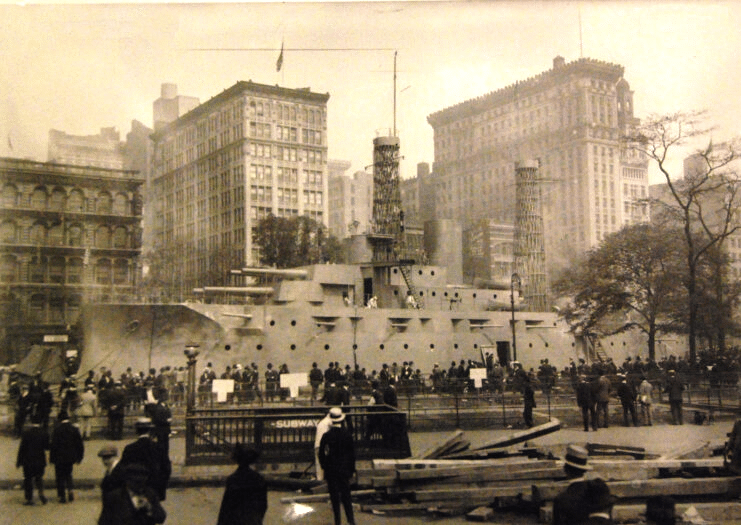
In 1917, New Yorkers walking through Union Square encountered something that seemed completely out of place.
A battleship.
Not in the harbor. Not sailing along the Hudson River. Not even sitting on a shipyard dock.
It stood directly in the middle of Manhattan.
The vessel had a battleship-shaped hull, guns, decks, railings and uniformed sailors moving across it. Crowds could approach it, climb aboard and see what looked like a genuine naval vessel.
There was just one small problem.
The ship had no water beneath it.
The strange vessel was USS Recruit, a full-scale wooden “landship” created by the U.S. Navy during World War I. It served as a recruiting station, public attraction and Liberty Bond promotional center.
For three years, the unusual ship turned one of New York City’s busiest public spaces into a miniature naval base.
Why Did the Navy Build a Battleship in Manhattan?
The timing explains almost everything.
The United States entered World War I in April 1917. Suddenly, the Navy needed more sailors, more public support and more money to expand the nation’s wartime effort.
Traditional recruiting offices had an obvious weakness: people could simply walk past them.
The Navy wanted something impossible to ignore.
What could attract attention more effectively than a battleship sitting in a city park?
Union Square was an ideal location. Thousands of people passed through the area, which was already famous for rallies, speeches, demonstrations and public gatherings.
Instead of asking young men to visit a quiet office and imagine military life, the Navy brought the experience directly to them.
The idea was remarkably simple.
Build a warship where nobody expected to see one.
A Battleship Without a Harbor
USS Recruit was not intended to sail.
It was a land-based structure constructed primarily from wood and designed to resemble a full-size battleship. The vessel measured roughly 200 feet long and rose several stories above the surrounding streets.
From a distance, it looked remarkably convincing.
The Navy gave the ship a proper naval appearance, including a large hull, superstructure, deck equipment and guns. It even had a crew of actual sailors.
That last detail mattered.
The Navy wasn’t creating a movie set.
It wanted visitors to feel as though they had stepped aboard a real warship.
How USS Recruit Was Designed to Look Like a Real Warship
The Navy paid close attention to appearances.
The landship included replica guns, deck railings, ladders and other features associated with naval vessels of the period. The weapons were not operational artillery, but they gave the structure the imposing appearance of a military ship.
The interior was also arranged to provide visitors with an impression of life aboard a battleship.
For young Americans who had never traveled to a naval port, this could be their first close encounter with the physical world of the U.S. Navy.
The experience was intentionally hands-on.
Visitors could see sailors in uniform, walk around portions of the ship and watch naval personnel performing their duties.
It was recruitment through experience rather than simply advertising.
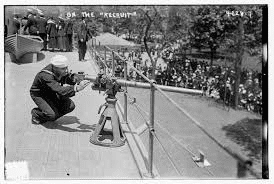
And in an era before television or social media, that kind of spectacle had enormous value.
Real Sailors Served on the Landship
One of the most fascinating details about USS Recruit was its crew.
The sailors aboard weren’t actors hired to create an illusion.
They were members of the U.S. Navy.
They maintained the vessel, interacted with visitors and helped operate the recruiting station.
Naval officers also handled enlistment activities aboard the ship.
In other words, USS Recruit looked like a battleship from the outside, but it also functioned as a genuine Navy facility.
That combination made the attraction particularly effective.
A curious pedestrian could approach the ship expecting nothing more than an unusual sight and suddenly find himself speaking with actual sailors about joining the service.
The Ship Was Also Part of the Liberty Bond Campaign
Recruitment wasn’t USS Recruit’s only job.
The ship also helped promote Liberty Bonds, which the federal government sold to finance America’s participation in World War I.
Liberty Bond campaigns relied heavily on public enthusiasm.
Cities hosted rallies, celebrities appeared at events and patriotic displays encouraged ordinary Americans to contribute financially to the war effort.
USS Recruit fit perfectly into that strategy.
A full-size battleship sitting in Union Square naturally became a gathering point for patriotic events.
People came to see the strange ship.
Video: That Time the Navy Built a Battleship in Union Square
While they were there, they encountered sailors, recruitment information and Liberty Bond activities.
It was clever wartime marketing long before anyone used the term “experiential marketing.”
Why Union Square Was the Perfect Location
Location was everything.
The Navy could have constructed the landship somewhere quiet, but that would have defeated much of its purpose.
Union Square placed it directly in the path of everyday New Yorkers.
Workers passed by.
Families visited.
Tourists stopped to take photographs.
Young men curious about military service could approach without making a formal commitment.
The ship essentially turned curiosity into an opportunity.
Think of it as an enormous three-dimensional recruiting poster.
A normal poster might tell someone that the Navy needed sailors.
USS Recruit showed them what the Navy looked like.
That difference made the attraction difficult to overlook.
What Happened When Visitors Stepped Aboard?
Once people approached USS Recruit, the experience became even more convincing.
Uniformed sailors were visible throughout the structure. The ship had the atmosphere of an active naval installation, despite being permanently attached to Manhattan.
Visitors could examine the deck and see the replica armament.
Potential recruits could learn about naval service directly from sailors who were already wearing the uniform.
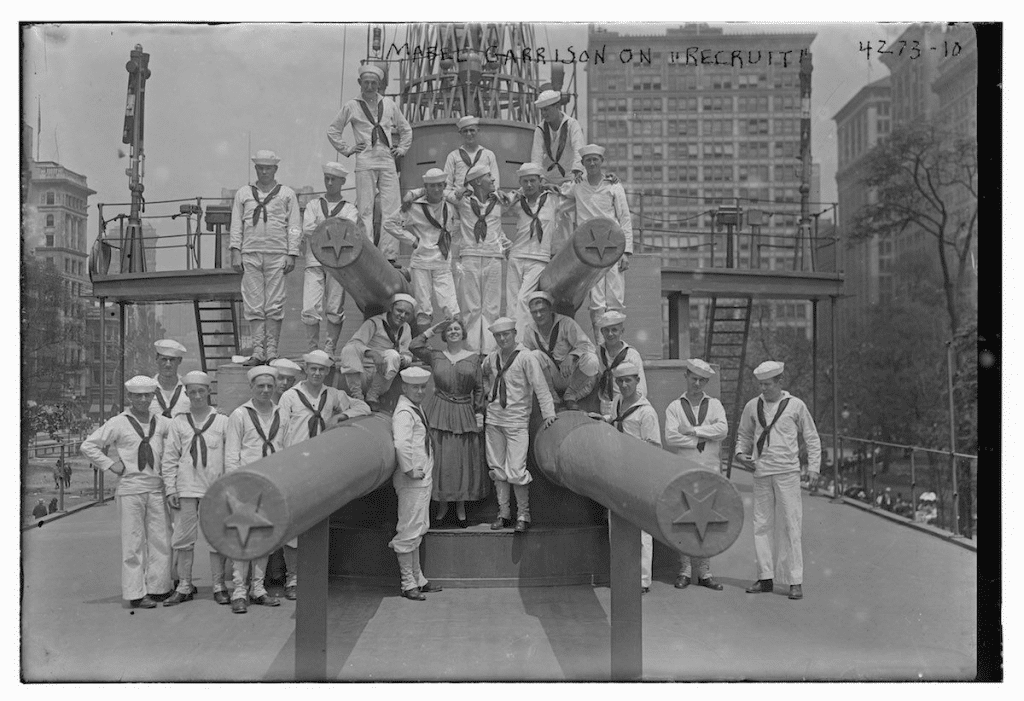
For a young man considering enlistment, the psychological effect must have been powerful.
Instead of imagining military life from a newspaper advertisement, he could stand on a battleship-like deck and see sailors carrying out their duties.
The Landship Became a Manhattan Spectacle
The ship quickly became more than a recruiting office.
It became a landmark.
Photographs from the period show pedestrians surrounding the unusual vessel and buildings rising behind it. The contrast is almost surreal: a battleship standing where one would normally expect trees, sidewalks and city crowds.
Imagine walking through Manhattan in 1918 and suddenly seeing a warship towering over Union Square.
You would probably stop too.
That was exactly the reaction the Navy wanted.
The structure created its own publicity simply by existing.
Newspapers could photograph it.
Visitors could talk about it.
Families could visit it.
And every curious person became a potential audience for the Navy’s message.
Did the Wooden Battleship Actually Help the Navy?
By the Navy’s objectives, USS Recruit proved useful.
It operated through the final years of World War I and remained in service after the war before being dismantled in 1920.
During that period, it supported recruiting activities, public demonstrations and Liberty Bond campaigns.
Its greatest advantage was visibility.
A conventional recruitment office depended on people deciding to walk through the door.
USS Recruit brought the door to them.
The strategy was especially effective because the ship created an emotional reaction before anyone had said a word.
The structure communicated strength, adventure and military service visually.
For a wartime recruiting campaign, that was powerful.
Why Were the Guns on the Ship Not Real?
The ship’s armament looked serious, but the guns were replicas.
Video: C-SPAN’s “The Library of Congress” – Preview Clip 1
That distinction was important.
USS Recruit was designed to represent a battleship, not function as one.
Its purpose was recruitment and public engagement rather than combat.
The replica guns nevertheless contributed enormously to the visual illusion.
From street level, pedestrians saw a ship that appeared ready for battle.
The Navy understood that authenticity did not require every component to be functional.
It required the right details to create the right impression.
That principle helped transform a wooden structure into something that felt unmistakably naval.
What Happened to USS Recruit After the War?
The unusual experiment eventually came to an end.
World War I ended in November 1918, reducing the urgent need for wartime recruiting and Liberty Bond promotion.
USS Recruit remained in Union Square for a period afterward, but its purpose gradually faded.
In 1920, the Navy dismantled the landship.
The enormous wooden structure disappeared from Manhattan almost as quickly as it had arrived.
Union Square returned to normal.
No battleship stood among the pedestrians.
No sailors staffed a naval station in the park.
And one of the strangest sights in New York’s history became a memory preserved mostly through photographs.
The Photographs That Keep Manhattan’s Landship Alive
Fortunately, extensive photographs of USS Recruit survived.
They show the ship from different angles and capture its remarkable relationship with the surrounding city.
The images reveal just how enormous the structure appeared beside pedestrians and buildings.
They also provide an important historical record of how the Navy used public space during World War I.
Today, it is easy to imagine such a spectacle as something created for a film.
But USS Recruit was real.
It was built, staffed and operated by the U.S. Navy.
It stood in one of Manhattan’s busiest public spaces and performed an actual wartime function.
A Strange Chapter in American Military History
USS Recruit represents a fascinating moment when military recruitment, public entertainment and civic life collided.
The Navy needed sailors.
The government needed financial support.
New Yorkers needed reasons to connect with a distant war.
So the Navy built something almost impossible to ignore.
A battleship without a sea.
A naval station without a harbor.
A recruiting office disguised as one of the most imposing machines of war.
Conclusion: The Battleship That Never Needed Water
The story of USS Recruit sounds almost like a historical curiosity invented for a movie.
Yet the evidence shows that the U.S. Navy really did construct a full-size wooden battleship in the heart of Manhattan.
The ship served as a recruiting station and helped promote Liberty Bonds during World War I. Actual Navy sailors staffed it, replica guns gave it the appearance of a working warship, and thousands of New Yorkers visited the unusual attraction.
Its greatest weapon was not its guns.
It was attention.
In a crowded city where advertisements could easily disappear into the background, a giant battleship standing in Union Square demanded to be noticed.
Eventually, the war ended, the recruitment campaign faded and USS Recruit was dismantled.
But the photographs remain.
And they preserve one of the strangest sights New York City has ever seen: a full-size Navy battleship standing firmly on dry land, surrounded by Manhattan streets instead of an ocean.