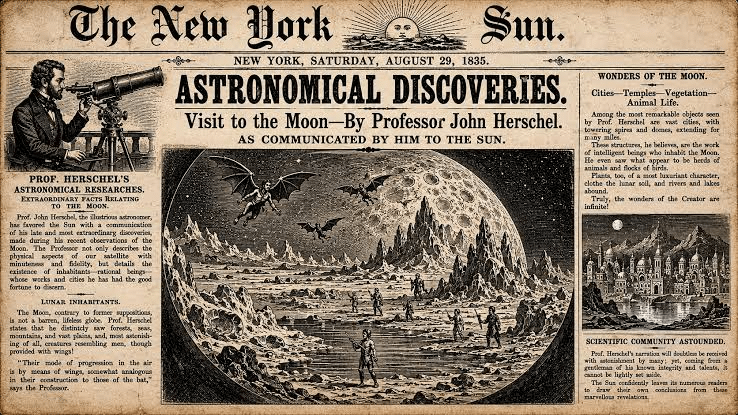
On August 25, 1835, readers of a New York newspaper were given an extraordinary piece of news: a famous astronomer had supposedly made a discovery that could change everything people knew about the Moon.
The report claimed that Sir John Herschel, one of the most respected astronomers of his generation, had developed an astonishing new telescope while working in South Africa. With it, he had supposedly observed a lunar landscape filled with forests, beaches, strange animals and enormous crystal formations.
And then things became even stranger.
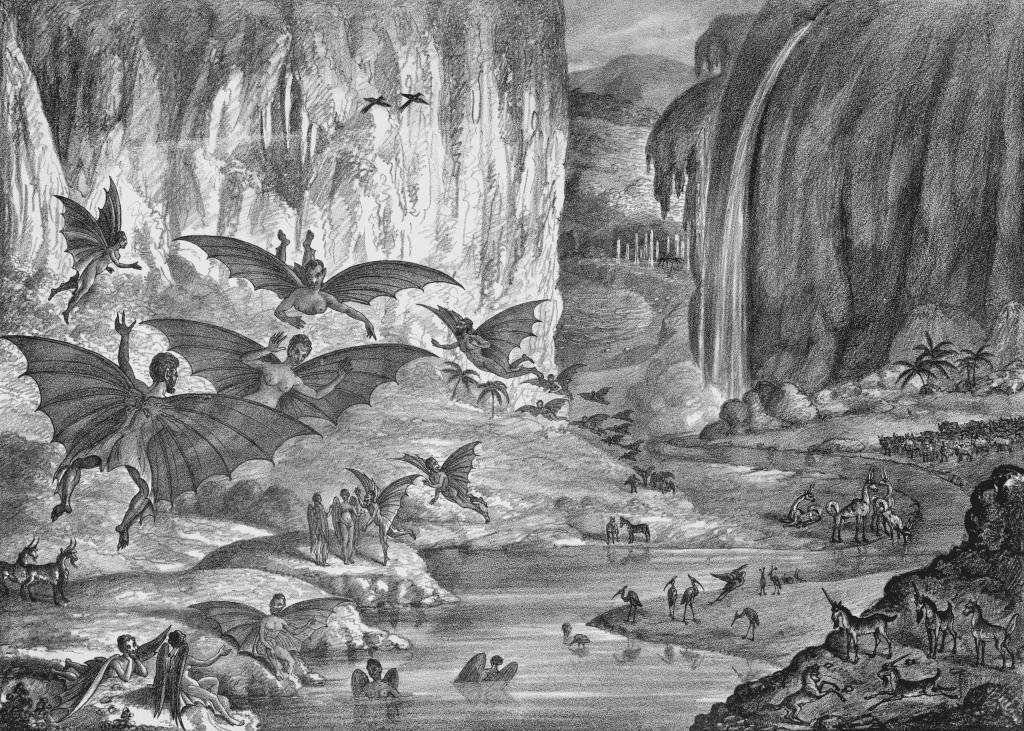
The telescope had allegedly revealed intelligent creatures living on the Moon—winged, human-like beings with bodies covered in fur.
The story sounds almost comical today. Yet in 1835, it became a genuine newspaper sensation.
Known as the Great Moon Hoax, the six-part series became one of the most famous examples of fictional journalism in American history. Its success was not based on one outrageous claim. Instead, it carefully blended real people, genuine scientific developments and convincing technical language with an entirely imaginary lunar world.
That combination proved remarkably effective.
A Newspaper Story That Looked Like a Scientific Discovery
The story appeared in The Sun, a New York penny newspaper that had been founded only a few years earlier. The first installment was published on August 25, and five additional reports followed during the next several days.
The timing and structure mattered.
The newspaper did not immediately tell readers that strange creatures were walking around on the Moon. Instead, the story unfolded gradually, much like a scientific expedition revealing one discovery after another.
First came the extraordinary telescope.
Then came descriptions of the Moon’s geography.
Next came unfamiliar animals.
Finally, readers were introduced to intelligent lunar inhabitants.
That progression gave the story an unusual sense of credibility. Every new installment seemed to build on information that readers had already accepted.
The Fictional Scientist Behind the Supposed Discovery
The reports claimed that the information had originally appeared in a supplement to the Edinburgh Journal of Science. They attributed the observations to a fictional scientist named Dr. Andrew Grant, who was supposedly connected with Sir John Herschel.
Those details sounded impressive, but none of them was genuine.
The supposed scientific supplement did not exist, and Dr. Andrew Grant was not a real scientist. The articles had actually been written by Richard Adams Locke, a journalist working for The Sun.
Locke understood that technical language could make an extraordinary story feel respectable.
So instead of writing a simple fantasy about life on the Moon, he surrounded his fictional discoveries with measurements, scientific terminology and detailed descriptions of imaginary technology.
That was what made the story so clever.
The Incredible Telescope That Never Existed
At the heart of the story was an enormous telescope supposedly constructed for Herschel’s astronomical observations.
According to the newspaper, the instrument had a lens approximately 24 feet across and weighed more than seven tons. It was described as being powerful enough to reveal objects on the Moon that were only around 18 inches in size.
The reports went even further.
A fictional “hydro-oxygen microscope” was supposedly connected to the telescope, allowing observers to project enlarged images of the Moon onto a wall.
Readers were not simply told that the telescope was powerful. They were given measurements, descriptions and technical explanations.
That distinction mattered.
A reader might dismiss a statement such as “scientists discovered life on the Moon” as unbelievable. But when the same claim comes surrounded by detailed equipment specifications and scientific terminology, it can take on a very different appearance.
Locke was essentially giving fiction the clothing of science.
Real Astronomy Helped Make the Fiction Believable
The hoax worked particularly well because astronomy was advancing rapidly during the nineteenth century.
Telescopes were improving. Astronomers were making new observations. The public was fascinated by distant planets and the possibility of life beyond Earth.
The Moon was still mysterious enough that extraordinary claims could attract serious attention.
Locke took advantage of that curiosity.
He did not need readers to understand every technical detail. He only needed the details to sound plausible.
A Moon Filled With Forests, Beaches and Strange Animals
Once the fictional telescope had supposedly been pointed toward the Moon, the reports began describing what could be seen there.
The lunar surface was portrayed as surprisingly lively.
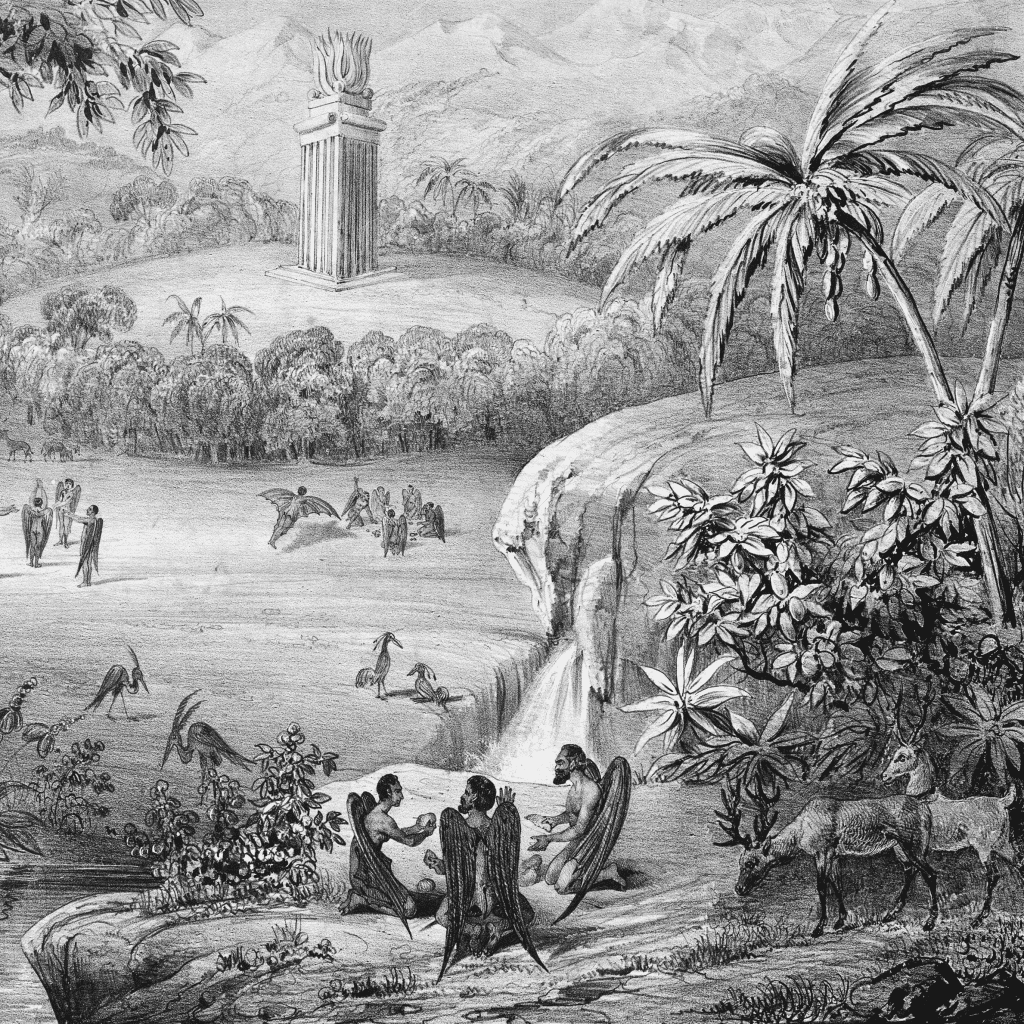
There were forests, valleys, lakes and beaches. The reports also mentioned unusual geological formations, including enormous crystals that appeared almost otherworldly.
Video: Today In History: The Great Moon Hoax
Then came the animals.
Some resembled creatures familiar to readers on Earth. There were descriptions of birds, bison-like animals and unusual beavers that supposedly moved on two legs.
This was another clever part of the story.
Instead of filling the Moon with completely incomprehensible monsters, Locke borrowed familiar animals and changed just enough about them to make them strange.
Readers could picture them immediately.
But the most memorable discovery was still waiting.
When the Newspaper Introduced the Famous Moon Bat-Men
As the reports continued, the fictional astronomers supposedly discovered creatures that were far more remarkable than anything they had seen before.
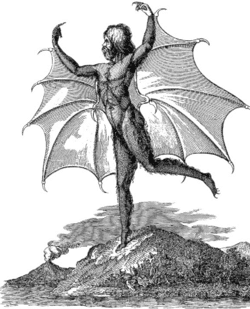
They were described as upright, intelligent beings with furry bodies and large wings resembling those of bats.
The creatures eventually became known as the “man-bats” of the Moon.
Video: The ‘Great Moon Hoax’ that fooled the world – BBC REEL
Locke gave them the scientific-sounding name Vespertilio-homo. Their behavior was described with the same confidence used elsewhere in the reports to discuss lunar geology and astronomy.
That detail made the creatures particularly memorable.
They were obviously fantastical, but the language used to describe them suggested that they were simply another newly discovered species.
The story had crossed from unusual science into outright fantasy—but it never abandoned its scientific tone.
Pictures Gave the Imaginary Creatures a Life of Their Own
The written reports were accompanied by illustrations in later editions and publications. One surviving 1835 lithograph depicts several of the fictional lunar creatures and landscapes.
Images were especially powerful in an era when newspapers and illustrated pamphlets were among the main ways ordinary people encountered information about distant places.
A strange creature described in several paragraphs might be forgotten.
A picture of a winged humanoid walking across the Moon was much harder to forget.
The illustrations helped turn the hoax into something visually recognizable, ensuring that the “man-bats” would remain associated with the story long after readers learned that the entire discovery had been invented.
Why Sir John Herschel Made the Story So Convincing
The cleverest element of the Great Moon Hoax may have been the use of Sir John Herschel’s real name.
Herschel was not a fictional character.
He was a highly respected British astronomer and mathematician who had traveled to the Cape of Good Hope to study the southern skies. He was genuinely conducting astronomical observations there during the period when The Sun published its reports.
That real-world connection gave Locke an ideal foundation.
Readers already knew that Herschel was a serious scientist. They also knew that he was working in a distant part of the world with sophisticated astronomical equipment.
So when the newspaper claimed that Herschel had made an extraordinary discovery in South Africa, the setting seemed perfectly reasonable.
The Hoax Was Built From Truth and Invention
This is what makes the story more interesting than a simple newspaper prank.
Much of the background was real.
Herschel existed. His expedition existed. His astronomical work existed. The scientific discussions surrounding the possibility of life elsewhere were real.
The fictional part began when Locke connected those facts to discoveries that had never happened.
It was a remarkably effective formula.
Take something readers already recognize as true, add something extraordinary, and surround the new claim with enough detail to make the whole story feel consistent.
In other words, Locke did not build his hoax from nothing.
He built it on a foundation of truth.
How the Moon Hoax Spread Beyond New York
The six-part format gave the story another advantage.
Readers had time to become invested in the unfolding discovery. Each new report promised something more fascinating than the previous one.
The first articles established the telescope and the supposed scientific breakthrough. Later reports expanded the lunar landscape. Then came animals. Finally came intelligent beings.
That steady escalation created anticipation.
People had a reason to look for the next issue.
The story also moved beyond the pages of The Sun. It was reprinted and discussed in other places, eventually appearing in pamphlets, translations and illustrated editions.
Not every reader believed it, and some people quickly suspected that something was wrong. Still, the sheer popularity of the story demonstrated how powerful a well-constructed newspaper narrative could be.
Why People Could Not Immediately Check the Claims
There was another important factor: communication was slow.
In 1835, readers in New York could not instantly contact an astronomer in South Africa or search a digital archive to verify a scientific claim.
News crossed the Atlantic by ship.
That meant a false report could circulate for days or weeks before someone in a position to challenge it could respond.
The distance between New York and Herschel’s actual observatory made the fictional story even easier to accept.
Richard Adams Locke Had a Larger Point in Mind
The Great Moon Hoax was not simply an attempt to fool readers.
Locke was also using the story as satire.
He was critical of speculative writing that presented extraordinary ideas with an excessive appearance of scientific authority. By pushing that style to an absurd extreme, he hoped readers would recognize how easily technical language could make questionable ideas appear credible.
But the joke did not unfold exactly as planned.
Instead of focusing entirely on the satire, many readers became fascinated by the fictional discoveries themselves.
The Moon’s forests were interesting.
The strange animals were memorable.
But the bat-men were unforgettable.
The story became famous for the very fantasy that had been created to make the satire work.
Why the Great Moon Hoax Still Matters Today
It is tempting to look back at the Great Moon Hoax and simply laugh at the idea that people once believed bat-men lived on the Moon.
But the deeper lesson is more complicated.
The readers of 1835 were not necessarily unusually naive. They were dealing with information in a world where verification was difficult and scientific discoveries were happening rapidly.
More importantly, the techniques used by Locke remain familiar.
A story becomes more convincing when it includes a recognizable authority.
Specific numbers can make a claim sound researched.
Technical vocabulary can create an impression of expertise.
Pictures can make an unfamiliar idea feel real.
And a story released in installments can encourage people to keep coming back for the next revelation.
The technology has changed dramatically since 1835, but human curiosity has not.
A Very Old Formula That Still Works
The Great Moon Hoax followed a surprisingly modern storytelling formula.
Start with something true.
Add an unusual claim.
Provide a believable explanation.
Introduce increasingly dramatic details.
Then leave readers wanting to know what comes next.
That structure works because people naturally look for patterns and authority when deciding whether information is trustworthy.
The lesson is not that every unusual story is false.
It is that confidence and detail are not the same thing as evidence.
The Strange Legacy of America’s Great Moon Hoax
The Moon’s supposed forests, crystal formations and strange animals were eventually exposed as inventions. There were no lunar civilizations, no winged humanoids and no gigantic telescope capable of observing tiny creatures on the Moon.
Sir John Herschel had never made the discoveries attributed to him.
Yet the story refused to disappear.
The Great Moon Hoax continued to be republished and remembered throughout the nineteenth century. Its imaginary creatures became part of the history of American journalism and one of the strangest stories ever attached to the Moon.
Perhaps that is why the episode remains so fascinating.
The hoax was not successful simply because someone wrote a believable lie. It succeeded because the lie was carefully constructed around pieces of reality that readers already trusted.
Conclusion: The Moon Was Never Home to Bat-Men
The Great Moon Hoax of 1835 began as a newspaper experiment that combined satire, science and sensational storytelling. Richard Adams Locke took a real astronomer, a genuine expedition and the public’s growing fascination with astronomy, then transformed them into a fictional journey across an imaginary Moon.
For a brief moment, readers were invited to believe that Earth’s nearest neighbor was filled with forests, strange animals and intelligent winged beings.
The bat-men were never there.
But the story itself became a lasting part of American history.
Nearly two centuries later, its greatest lesson may be surprisingly simple: a story does not become true merely because it sounds scientific, comes from an impressive source or contains an abundance of details.
Sometimes the most convincing stories are the ones that begin with a little truth.