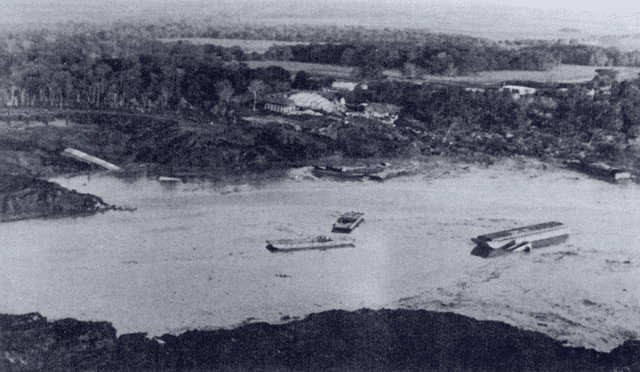
On November 20, 1980, workers on Lake Peigneur, Louisiana, were facing what seemed like an ordinary drilling problem.
An oil rig sitting on barges had encountered something below the lakebed. The drill was stuck, and the crew tried to free it.
Then the rig began to tilt.
Within minutes, the workers abandoned the platform and made it safely to shore. What they witnessed next was almost impossible to believe: the lake itself appeared to open beneath the rig, pulling the massive structure into the water.
The accident would become one of the strangest industrial disasters in Louisiana history.
A Shallow Lake With a Huge Secret Beneath It
Before the accident, Lake Peigneur was a relatively shallow freshwater lake near Jefferson Island in Iberia Parish. It covered roughly 1,300 acres and was only about 10 feet deep in many areas.
But beneath the lake was something much larger.
A massive underground salt mine operated beneath Jefferson Island, with tunnels and chambers extending deep into the salt dome. At the same time, oil companies were drilling through the area in search of petroleum.
Two industries were operating almost on top of each other, separated by layers of rock and salt.
As long as that underground barrier remained intact, there was no obvious problem.
Then a drill broke through it.
The Drilling Error That Changed Everything
The drilling operation, conducted for Texaco, encountered resistance at a relatively shallow depth. Investigators later determined that the well had entered the salt mine.
Once the connection opened, water from the lake began rushing downward.
That created a dangerous chain reaction.
Salt dissolves in water. As the lake water entered the mine, it dissolved the surrounding salt and enlarged the opening. More water followed, which dissolved even more salt.
It was like pulling one loose thread from a sweater—except the sweater was an enormous underground salt formation.
The Oil Rig Began Disappearing
The drilling crew quickly realized that something was seriously wrong.
The platform tilted, and the workers evacuated before the situation became even more dangerous.
Then the lake began forming a gigantic whirlpool.
The 150-foot drilling derrick was pulled toward the growing opening and disappeared beneath the surface. Other equipment followed, including another drilling platform and numerous barges.
In total, 11 barges were swallowed, along with a tugboat and portions of the surrounding landscape.
The transformation was astonishing. A lake that had once been shallow was suddenly draining into an underground mine.
The Ground Around the Lake Started Collapsing
As the underground mine flooded, parts of the surrounding land became unstable.
Video: The Lake Peigneur Giant Sinkhole Disaster 1980
Trees, equipment and sections of shoreline were pulled toward the expanding sinkhole. The disaster did not behave like an ordinary flood. Instead of water spreading outward, the lake was effectively draining downward.
And there was still another surprise waiting.
The Canal Suddenly Started Flowing Backward
Lake Peigneur was connected to the Delcambre Canal, which normally carried water toward Vermilion Bay and the Gulf of Mexico.
But as the lake drained, its water level dropped dramatically.
The difference in water levels caused the flow to reverse.
Salt water from the Gulf began rushing inland toward the lake, creating a powerful current and temporarily producing a spectacular waterfall-like flow into the newly deepened basin.
The lake that had once been shallow and freshwater was being transformed before everyone’s eyes.
Miners Had to Escape Underground
The most frightening part of the disaster happened beneath the surface.
Workers inside the salt mine suddenly found water entering areas that had previously been dry. They had to make their way toward the mine’s elevator and reach the surface as quickly as possible.
The situation could easily have become a tragedy.
Yet, remarkably, the miners escaped.
The drilling crew had also reached safety, and everyone working around the lake was able to get away from the collapsing shoreline.
Despite the enormous destruction, no one was killed in the disaster.
That remains one of the most extraordinary details of the entire story.
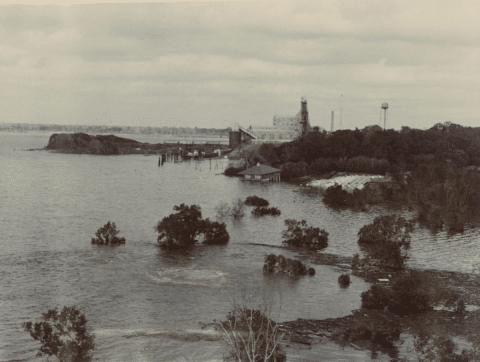
Lake Peigneur Was Never the Same Again
Once the flooding and whirlpool subsided, Lake Peigneur began to refill with water from the canal.
But it was no longer the lake people remembered.
The accident dramatically changed its depth, shoreline and water chemistry. Areas that had once been only around 10 or 11 feet deep eventually reached depths of roughly 200 feet.
The freshwater lake also became influenced by salt water flowing in from the Gulf.
Deep beneath the new lake, the flooded remains of the salt mine became a permanent reminder of what had happened.
The Legal Battle That Followed
The physical chain of events was clear, but determining responsibility proved much more complicated.
Diamond Crystal Salt Company argued that the drilling operation had breached the mine and caused its destruction. Texaco and its contractors disputed aspects of the responsibility, leading to years of legal claims and negotiations.
A later settlement reportedly resulted in $32 million being paid to Diamond Crystal.
The mine could not simply be reopened. Its underground chambers had been flooded, and much of the evidence was now buried beneath the transformed lake.
Conclusion: A Lake Changed by One Drilling Mistake
The Lake Peigneur disaster sounds almost unbelievable: an oil rig disappeared into a lake, 11 barges were swallowed, an underground salt mine flooded, and a canal suddenly reversed direction.
Video: The Lake Peigneur Drilling Disaster 1980
Yet the basic chain of events was remarkably simple.
A drilling operation accidentally opened a path between the lake and the salt mine below. Water rushed underground, dissolved the surrounding salt and rapidly enlarged the opening. The lake drained, the land collapsed and the entire landscape changed.
What makes the story even more remarkable is that everyone escaped.
Lake Peigneur eventually settled into its new shape, but the shallow freshwater lake that existed on the morning of November 20, 1980, was gone forever.
Sometimes the biggest disasters begin with something that looks almost ordinary—a stuck drill, a small mistake and a problem that seems manageable.
In this case, that mistake gave an entire lake a new identity.