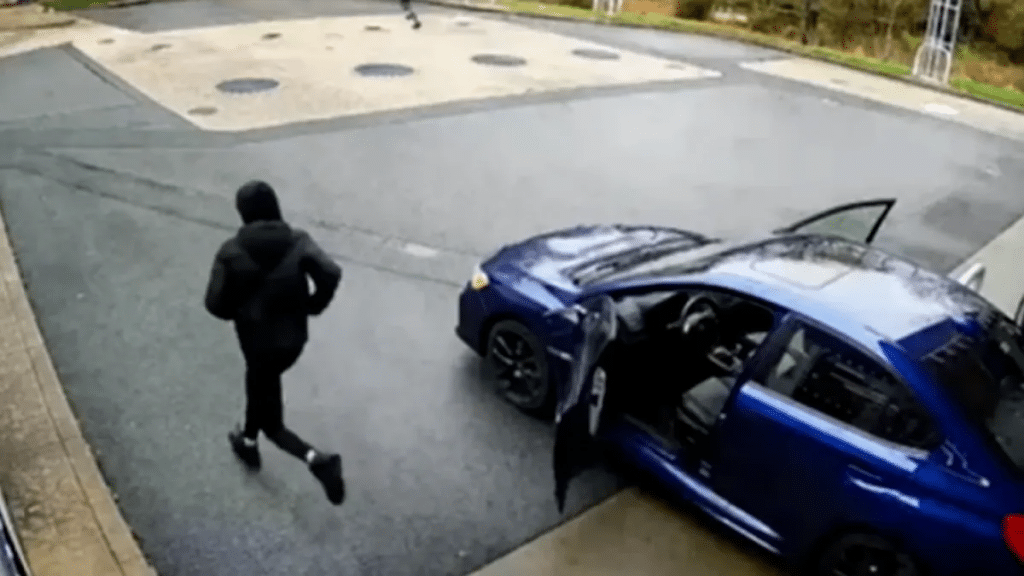
The carjacking appeared to be going exactly as planned.
A suspect confronted the occupants of a vehicle on a San Diego street, forced them out and climbed behind the wheel. He had the keys, the engine started, and for a moment, there seemed to be nothing standing between him and a getaway.
Then the car refused to move.
The engine roared. The suspect tried again.
Still, the vehicle stayed where it was.
The problem was surprisingly simple: the car had a manual transmission, and the carjacker did not know how to drive a stick shift.
The Carjacking Went Wrong at the Worst Possible Moment
According to reporting on the San Diego incident, the suspect successfully took control of the vehicle but could not get it moving.
That distinction mattered.
Getting inside the car was only the first step. To actually escape, the suspect needed to operate a clutch, select the correct gear and coordinate the pedals.
He apparently could not.
For someone accustomed to an automatic transmission, a manual car can feel completely unfamiliar. Instead of simply pressing the accelerator and shifting into Drive, the driver has to coordinate the clutch, gear lever and gas pedal.
Under normal circumstances, learning that process takes practice.
Inside a stolen car, with police potentially responding and the clock working against you, there is little room for experimentation.
The Engine Made Plenty of Noise
The suspect reportedly tried to make the vehicle move, but the engine revved without producing the getaway he expected.
That is one of the classic problems inexperienced manual drivers encounter.
Release the clutch incorrectly and the engine can stall. Apply the accelerator without properly engaging the drivetrain and the engine can simply become louder while the car remains stationary.
For the suspect, the noise accomplished nothing.
Eventually, he abandoned the vehicle and fled on foot.
Why a Manual Transmission Can Be a Major Obstacle
Manual transmissions have become far less common among American drivers than they once were.
Many people who learned to drive in recent decades have spent their entire lives behind the wheel of automatic vehicles. They may understand what a clutch does in theory but have never actually coordinated one while driving.
That difference can become surprisingly important in an emergency.
A person can know how to start a manual car and still have no idea how to move it smoothly.
Three Pedals Changed the Entire Situation

A manual transmission requires the driver to coordinate three pedals rather than two.
The clutch controls the connection between the engine and transmission. The gear lever determines the selected gear, while the accelerator controls engine speed.
Those actions have to happen in the right sequence.
For an experienced driver, it becomes almost automatic.
For someone who has never learned, the process can feel like trying to operate a machine with half the instructions missing.
That appears to have been the problem facing the San Diego carjacker.
The Getaway Ended Without a High-Speed Chase
The strangest part of the incident may be what did not happen.
There was no dramatic pursuit.
No sophisticated vehicle security system stopped the car.
The suspect simply could not make it leave.
After failing to drive away, he got out and ran from the scene on foot.
The vehicle remained behind, turning what could have become a prolonged carjacking investigation into a much more unusual story.
Video: Police: Teens who carjacked man at gas station couldn’t drive away due to manual transmission
The victims were forced from their car, but the attempted getaway ultimately failed because of something as basic as the transmission.
An Old-School Feature With an Unexpected Effect
Modern cars can contain sophisticated security technology, including electronic immobilizers and tracking systems.
A manual transmission is different.
It does not need an app, a signal or a remote monitoring service.
It simply requires the driver to know what to do.
That does not make a manual transmission a replacement for modern vehicle security, but the San Diego incident illustrates an interesting side effect of an older technology: a person who cannot operate the gearbox may not be able to drive the vehicle at all.
The Car Was Stolen, But It Wasn’t Going Anywhere
That is what makes the incident so memorable.
The suspect had overcome the most obvious obstacle. He had taken the car and gotten behind the wheel.
But the final step proved impossible.
The vehicle itself became the obstacle.
The engine could run. The keys worked. Nothing appeared mechanically wrong with the car.
The missing ingredient was simply the driver’s skill.
A Getaway Defeated by Three Pedals
Carjackings usually bring to mind alarms, police pursuits and sophisticated technology.
This one ended much more simply.
The suspect took the vehicle, climbed into the driver’s seat and discovered that the car demanded something he did not have: experience with a manual transmission.
After the failed attempt to drive away, he abandoned the car and fled on foot.
The story is a reminder that technology does not always have to be complicated to create an unexpected obstacle. Sometimes, an ordinary mechanical feature can make all the difference.
In this case, the carjacker had the keys.
He had the car.
He just couldn’t make it go.