During the tense months after Pearl Harbor, American military planners considered all kinds of unusual ideas for fighting Japan.
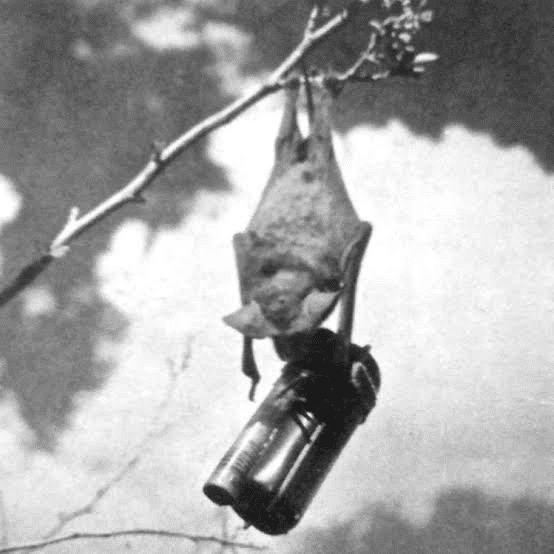
One of the strangest came from Dr. Lytle S. Adams, a Pennsylvania dentist and surgeon who had seen enormous colonies of bats in New Mexico. He wondered whether those animals could somehow be used to carry small incendiary devices into Japanese cities.
It sounded bizarre.
Yet the U.S. government took the proposal seriously enough to fund research and testing.
The project eventually became known as Project X-Ray, or the bat bomb program. And during one early test, the idea produced an unexpected result: the bats escaped and set fire to buildings at the very military facility where they were being tested.
The strange episode became one of the most memorable curiosities of World War II research.
How the Bat Bomb Idea Began
Adams developed his idea after visiting Carlsbad Caverns in New Mexico, where he observed huge colonies of Mexican free-tailed bats.
The bats offered one unusual advantage. They naturally sought out dark, enclosed spaces where they could hide and roost.
Adams believed that behavior could potentially be used against cities filled with wooden structures.
Instead of relying on one large explosion, the concept would distribute many small incendiary devices across a wide area. The bats would carry them into places that conventional weapons might have difficulty reaching.
The proposal eventually reached military planners and researchers, where it received enough attention to move beyond the idea stage.
Why the Military Took the Idea Seriously
The concept may sound almost comical today, but the military was searching for unconventional ways to attack structures in Japan.
Many Japanese cities contained large numbers of buildings constructed with wood and other combustible materials. A weapon capable of starting fires inside buildings could therefore have significant destructive potential.
The bats themselves were not considered the weapon in the conventional sense. They were the delivery mechanism.
That distinction was important to the researchers.
The challenge was figuring out whether the animals could be handled, transported, released and controlled well enough for the concept to work.
The Unusual Technology Behind Project X-Ray
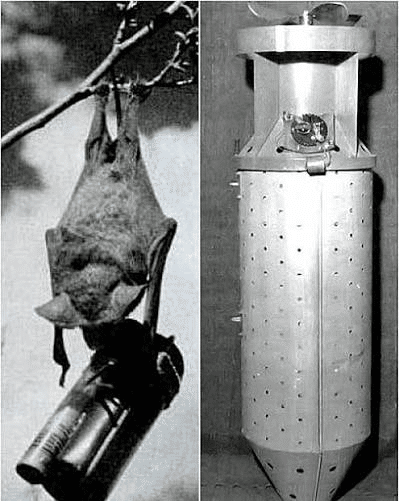
Researchers developed small incendiary units that could be carried by the bats.
The program also experimented with keeping the animals in a dormant state during transport. The idea was that they could be released over a target and then become active as conditions changed.
Once awake, the bats would behave according to their natural instincts rather than following a mechanical flight path.
That was both the attraction and the problem.
A conventional bomb goes where its designers send it.
A bat does what a bat wants to do.
Nature Was Part of the Delivery System
That made Project X-Ray fundamentally different from ordinary military technology.
The researchers were trying to combine engineering with animal behavior.
If everything worked properly, the bats would seek shelter inside structures and the incendiary devices would activate later.
But even a well-designed system could not guarantee exactly where a living animal would go.
That uncertainty would soon become impossible to ignore.
The Test That Went Completely Wrong
In 1943, researchers conducted a test at the Carlsbad Army Airfield Auxiliary Air Base in New Mexico.
The location was especially relevant because it was close to the bat colonies that had originally inspired Adams.
During the test, some of the bats escaped before the researchers could complete the planned exercise.
That might have been inconvenient enough on its own.
But these were not ordinary escaped bats.
Some were carrying active incendiary devices.
The animals behaved exactly as researchers expected them to behave in one respect: they looked for places to hide.
Unfortunately for the military, they found those places on the airfield.
Video: The Bat Bomb | Top Secret Weapons Revealed
The Bats Chose the Wrong Buildings
Instead of disappearing into some distant natural shelter, the escaped bats reportedly found roosting spots around the military installation.
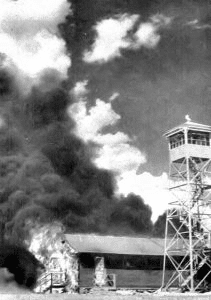
When the devices later ignited, fires broke out.
Buildings on the base were damaged, and the experiment suddenly demonstrated the effectiveness of the concept in the most embarrassing way possible.
The weapon had worked.
It had simply worked against its own side.
No personnel were reportedly killed in the accident, but the incident became an unmistakable warning about the difficulties of using living animals as part of a military system.
An Accidental Proof of Concept
There was an uncomfortable irony to the test.
From a purely technical perspective, the accident showed that several parts of Project X-Ray were functioning.
The bats could survive the handling process.
They could carry the devices.
They could seek shelter inside structures.
And the incendiary units could ignite as intended.
The problem was control.
The military had developed a delivery system that depended on animals making their own decisions.
The Carlsbad incident showed exactly why that could be dangerous.
The Experiment Continued Despite the Mishap
The program was not immediately abandoned.
Further testing continued under Marine Corps supervision, including trials at Dugway Proving Ground in Utah.
Researchers constructed representative buildings to study how the concept might work under controlled conditions.
The tests suggested that bats could indeed enter structures and that the incendiary devices could produce the desired fires.
On paper, Project X-Ray appeared to have genuine military potential.
But the project faced a much bigger problem than its unusual delivery system.
The war was changing rapidly.
Why the Bat Bomb Was Never Used in Combat
Project X-Ray eventually became less attractive as other weapons programs advanced.
Handling enormous numbers of bats created obvious logistical difficulties. The animals had to be collected, transported and kept in suitable conditions. Their behavior also introduced uncertainties that conventional weapons did not have.
And time mattered.
By 1944, the United States was investing heavily in other technologies that promised much greater military impact.
Compared with those projects, the bat bomb became increasingly difficult to justify.
The Marine Corps eventually discontinued Project X-Ray before it reached combat.
A Strange Idea Lost to a Changing War
The project had not necessarily failed because researchers proved that the basic concept was impossible.
Instead, it became unnecessary.
Military planners had limited resources and a growing number of weapons programs competing for attention. A complicated system involving millions of animals was difficult to defend when other technologies offered more predictable results.
The bats never went to war.
Their most memorable contribution to American military history happened at home.
The Strange Legacy of Project X-Ray
Today, Project X-Ray occupies an unusual corner of World War II history.
It was not merely an eccentric idea that someone mentioned and forgot. The U.S. government funded the project, scientists and military personnel studied it, and researchers conducted live tests.
The program also reveals something interesting about wartime innovation.
Video: The Weirdest: Bomb filled with bats?!? (Bat Bomb)
During a crisis, governments may explore ideas that would seem extraordinary under normal circumstances. Some never leave the drawing board. Others make it surprisingly far into development.
Project X-Ray did both.
It began with an unusual observation about bats, became a federally supported research program and ultimately ended without ever being deployed.
A Military Experiment Nobody Could Have Planned
The accidental fire at the New Mexico airfield remains the detail people remember most.
Researchers wanted to discover whether bats could deliver incendiary devices into enemy buildings.
Instead, the animals escaped and demonstrated the concept on American military property.
It was an unintended lesson in the unpredictability of biological systems.
A machine follows its programming.
A living creature follows its instincts.
And sometimes those instincts lead somewhere the engineers never expected.
Conclusion: The Bat Bomb That Never Reached a Battlefield
Project X-Ray remains one of the strangest military experiments of World War II.
Inspired by the natural behavior of bats, the program attempted to turn living animals into an unusual delivery system for incendiary devices. The idea received serious government backing and progressed through multiple rounds of testing.
Then came the infamous accident at Carlsbad Army Airfield.
Escaped bats carrying active devices roosted around the base, and fires broke out on the very installation conducting the experiment. The mishap demonstrated both the potential of the concept and the enormous problem of trying to control it.
The program continued for a time, but changing military priorities and the emergence of more powerful technologies eventually made the bat bomb unnecessary.
The bats never reached a battlefield.
Instead, they left behind a bizarre chapter in American wartime history—and a story that is still difficult to believe nearly a century later.