For most people, Niagara Falls seems permanent.
The water roars over the edge day after day, filling the air with mist and noise. It is one of those landmarks that feels as though it has always existed exactly as it does now.
But in the summer of 1969, something extraordinary happened.
The American Falls stopped.
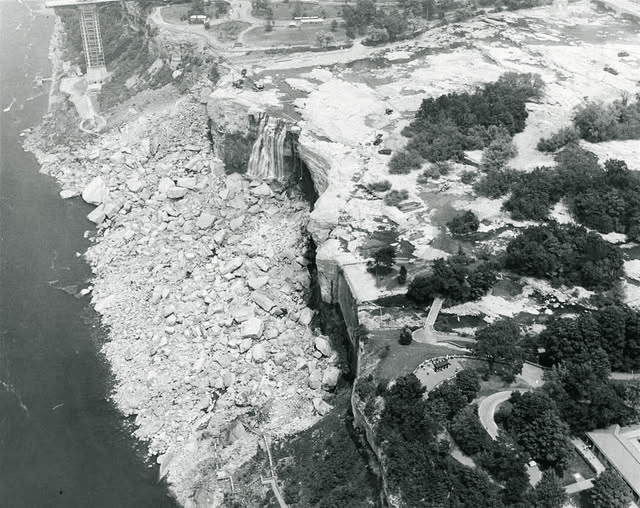
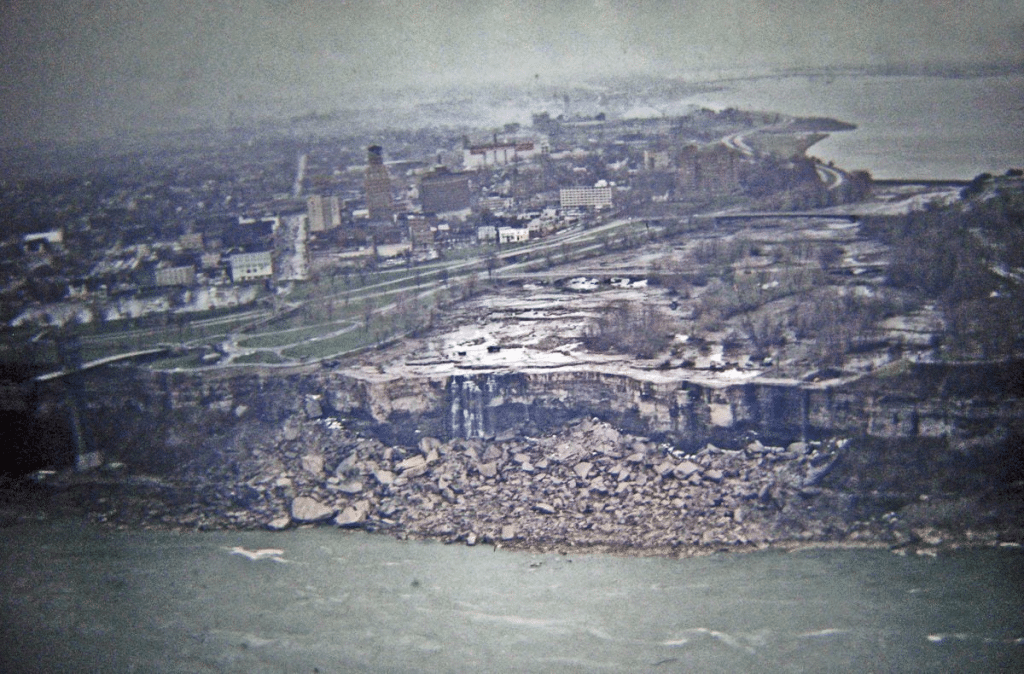
Visitors who arrived expecting the familiar wall of rushing water instead saw an enormous exposed cliff. The roar had disappeared. The mist was gone. In its place stood layers of brown and gray rock, suddenly visible beneath the waterfall.
It looked almost unreal.
Yet the silence was intentional. Engineers had temporarily diverted the Niagara River so they could examine the exposed falls and determine whether erosion was threatening its long-term stability.
For about five months, one of America’s most famous waterfalls became a giant geological work site.
Why Engineers Decided to Stop the American Falls
The project began with a concern that had been building for years.
Niagara Falls is constantly changing. Water wears away rock, fractures expand, and pieces of the cliff occasionally break loose. By the 1960s, scientists and engineers were particularly interested in the growing pile of broken rock, known as talus, at the base of the American Falls.
Some officials worried that the accumulation might eventually affect the appearance and structure of the waterfall.
How serious was the problem?
The only way to find out was to examine the falls without the water covering everything.
That meant doing something that sounds almost impossible: stopping the flow.
A Natural Wonder Became an Engineering Problem
The U.S. Army Corps of Engineers worked with the International Joint Commission, a body responsible for issues involving the shared U.S.-Canadian waterways.
The goal was not to permanently alter Niagara Falls.
Instead, engineers wanted a temporary opportunity to inspect the exposed rock, measure the talus and study cracks and other geological features.
They needed the river out of the way.
So they built a temporary barrier.
The Cofferdam That Diverted the Niagara River
The key to the operation was a massive cofferdam.
A cofferdam is a temporary structure designed to hold water away from an area where workers need to operate. In this case, the structure had to withstand the enormous flow of the Niagara River.
Construction began in 1969.
The barrier stretched roughly 600 feet across the river and used approximately 27,800 tons of rock and earth.
Once the cofferdam was sealed, water feeding the American Falls was redirected toward the Canadian Horseshoe Falls.
That meant the American Falls gradually lost its flow.
Video: Scientists Drained Niagara Falls in 1969 And Made an Amazing Discovery
Then, on June 12, 1969, the last significant water disappeared over the edge.
The waterfall was dry.
The Sight Was Almost Impossible to Recognize
Tourists continued visiting the area, but they were no longer looking at the Niagara Falls they knew.
Instead of a curtain of water, they saw exposed bedrock.
Without the constant spray, many details that had always been hidden suddenly became visible. Workers could walk across areas that normally disappeared beneath thousands of gallons of rushing water.
For visitors, it was like seeing the skeleton of a familiar landmark.
The waterfall had not vanished.
It had simply been stripped of the feature that made it look like a waterfall.
What Scientists Found Beneath the Water
Once the river had been diverted, engineers and geologists finally had direct access to the exposed face of the American Falls.
They surveyed the rock formations, photographed the cliff and examined the large piles of debris below.
The exposed landscape revealed just how much material erosion had removed over time.
Large pieces of rock had fallen from the cliff and accumulated at the base. Some blocks were enormous.
Scientists also examined the geological layers responsible for the shape of Niagara Falls.
The Rock Beneath Niagara Tells the Story
The structure of the falls includes harder dolomite near the upper edge and softer rock layers beneath it.
Video: Niagara Falls National Heritage Area Year-End Review
Water gradually attacks those weaker layers.
As the softer material erodes, the harder rock above loses support. Eventually, sections break away.
That process has shaped Niagara Falls for thousands of years.
The 1969 project gave scientists an unusually close look at the evidence.
They could study fractures, erosion patterns and the distribution of fallen rock without water obscuring the details.
The dry falls became a giant outdoor laboratory.
The Big Question: Should the Fallen Rock Be Removed?
The investigation produced plenty of information, but it also created a difficult decision.
Should engineers remove the accumulated talus?
At first glance, removing the debris might seem obvious. If erosion had caused rocks to pile up beneath the waterfall, perhaps clearing them away would restore a more dramatic appearance.
But nature is rarely that simple.
Removing the rock would have required an enormous and expensive operation. More importantly, engineers could not guarantee that such work would actually stop or significantly slow the geological processes responsible for the erosion.
There was another issue, too.
Should humans reshape a natural landmark simply because its appearance was changing?
Scientists Chose Restraint Over Reconstruction
After studying the exposed falls, the International Joint Commission recommended leaving the talus where it was.
The decision reflected both engineering caution and a broader respect for the natural landscape.
The fallen rock was itself part of Niagara’s geological history.
Removing it would not necessarily eliminate the underlying erosion. It might simply change the appearance of the falls temporarily.
So officials chose a simpler solution.
Put the water back.
The American Falls Came Back to Life
After nearly five months of investigation, the experiment was coming to an end.
On November 25, 1969, workers began dismantling the cofferdam.
They did not simply tear the entire structure apart at once. The process was carefully managed so the Niagara River could return to its normal route without creating unnecessary risks.
As the barrier disappeared, water began moving back toward the American Falls.
At first, the returning flow was modest.
Then it grew.
Gradually, the familiar waterfall reappeared.
The exposed rock vanished beneath the water again, and the roar returned to the landscape.
The Transformation Happened in Reverse
For months, visitors had watched Niagara without its defining feature.
Now they watched the opposite happen.
Water reclaimed the cliff.
Mist filled the air.
The familiar thunder returned.
Within a relatively short time, the American Falls looked much as it had before the experiment.
The temporary engineering project had disappeared almost as completely as it had arrived.
Why the 1969 Niagara Project Still Fascinates People
The most remarkable part of the story may not be the engineering itself.
It is the photographs.
Images from 1969 show something that most generations will never see again: Niagara Falls without water.
The exposed cliff reveals details normally hidden behind a constant sheet of rushing water. Workers appear tiny against the enormous rock face, walking through a landscape that looks strangely unfamiliar.
For people who have visited Niagara, the images can feel almost surreal.
It is the same place.
But remove the water, and the identity of the landmark changes completely.
A Five-Month Experiment Changed What Scientists Knew
The project also demonstrated how engineers can temporarily modify a powerful natural system without permanently destroying it.
The cofferdam redirected the river.
Scientists conducted their surveys.
Officials reviewed the evidence.
Then the barrier was removed and the river resumed its familiar course.
The talus remained, and the falls continued their natural geological evolution.
The project became an important chapter in the long history of studying Niagara Falls.
The Waterfall That Was Stopped—but Not Changed Forever
Stopping Niagara Falls sounds like something from a movie.
Yet in 1969, engineers actually did it.
For approximately five months, the American Falls stood dry while scientists examined the exposed rock and investigated concerns about erosion and accumulated debris.
The operation required a massive temporary cofferdam, careful river management and extensive geological surveys.
In the end, officials decided not to remove the talus.
Instead, they restored the river.
The water returned, the roar came back and the American Falls resumed its familiar appearance.
Conclusion: The Summer Niagara Falls Went Silent
The 1969 shutdown of the American Falls remains one of the most unusual engineering projects ever carried out at a major natural landmark.
For five months, tourists saw something almost unimaginable: Niagara Falls without its waterfall.
Engineers diverted the river using a huge temporary cofferdam, allowing scientists to examine the exposed cliff and study the erosion that had been shaping the landmark for centuries.
The investigation revealed extensive rock debris and provided valuable information about the geological structure of the falls. But rather than dramatically reshaping the landscape, officials chose to leave the talus in place and allow nature to continue its work.
Then the cofferdam came down.
The water returned.
And Niagara Falls became Niagara Falls again.
For a brief period, however, one of the world’s most recognizable landmarks revealed the hidden landscape beneath its rushing water—a view that remains frozen in history through photographs from that extraordinary summer.