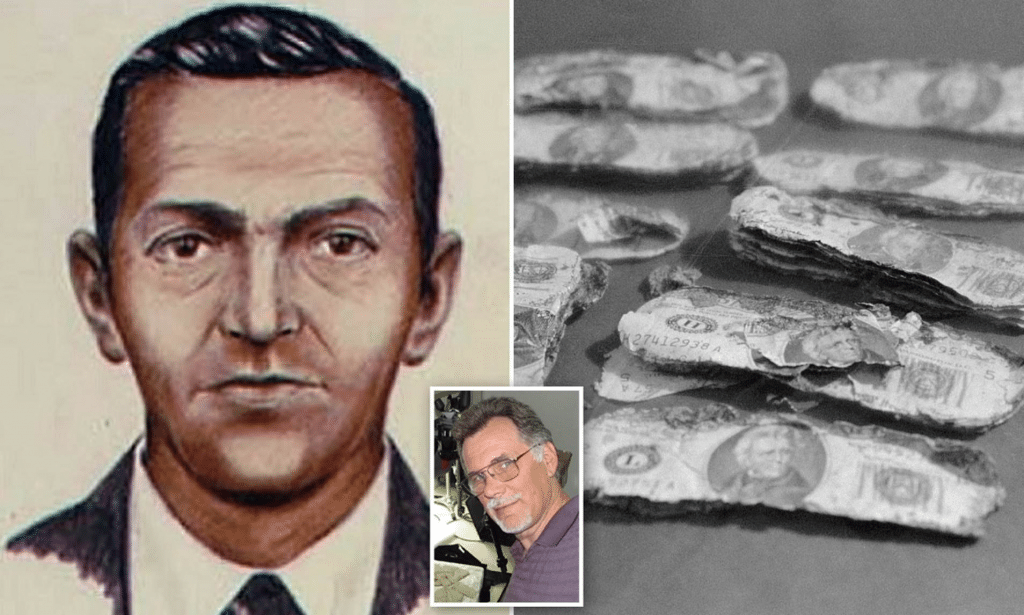
On November 24, 1971, a man dressed in a business suit boarded Northwest Orient Flight 305 in Portland, Oregon.
Nothing about him immediately suggested that he was about to become one of the most mysterious figures in American crime history.
He ordered a bourbon and soda. He took his seat. Then, after the Boeing 727 was airborne, he handed a flight attendant a note.
The message claimed he had a bomb.
Within hours, the quiet passenger had taken control of the flight, demanded $200,000 in ransom and obtained four parachutes. After releasing the passengers in Seattle, he ordered the aircraft back into the night.
Then he opened the rear staircase and disappeared.
The man called himself Dan Cooper.
The world came to know him as D.B. Cooper.
More than five decades later, nobody can say with certainty who he really was—or whether he survived the jump.
The Hijacking of Flight 305 Begins
Flight 305 was a short trip from Portland to Seattle, carrying 36 passengers and six crew members.
Cooper initially behaved like an ordinary traveler. He did not attract unusual attention, and witnesses later remembered him as calm and polite.
That changed when he passed a handwritten note to flight attendant Florence Schaffner.
At first, she reportedly put it aside without reading it. Cooper then leaned closer and told her that she should look at the message.
The note claimed that he had a bomb.
He demanded $200,000 in cash, four parachutes and a truck standing by at Seattle-Tacoma Airport.
The crew immediately notified the pilots, who contacted authorities on the ground.
The situation was unusual, but Cooper did not appear frantic. He waited while officials assembled the ransom and parachutes.
Video: The Skyjacker That Got Away: D.B. Cooper (Full Episode) | Undercover History
Meanwhile, the aircraft circled Seattle.
The Ransom Was Carefully Prepared
Authorities provided the demanded $200,000 in used $20 bills. Investigators photographed the currency and recorded the serial numbers before delivering it.
That decision would prove important years later.
Once the money and parachutes arrived, Cooper allowed the passengers to leave the aircraft.
He kept several crew members aboard and issued new instructions for the flight.
The Boeing 727 was to head south at a relatively low altitude.
Why such precise instructions?
Investigators later believed Cooper had at least some understanding of aviation. He knew the aircraft had a rear staircase that could be lowered during flight—a feature that would become central to his escape.
The Nighttime Parachute Jump
The aircraft left Seattle at approximately 7:40 p.m.
Cooper had the ransom money with him, along with parachutes and the clothing he had worn onto the aircraft.
He was not dressed like someone preparing for a nighttime jump into the Pacific Northwest.
He wore ordinary street clothes.
Outside the aircraft, darkness had settled over the region. Weather conditions were poor, and the terrain below included heavily wooded areas, hills and rivers.
Yet Cooper appeared determined.
At approximately 8:13 p.m., the crew noticed a sudden change in the aircraft’s behavior. The rear staircase had been lowered.
Cooper had gone to the back of the plane.
And then he jumped.
The pilots eventually landed safely in Reno, Nevada.
Cooper was gone.
There was no confirmed landing site, no eyewitness who saw him touch the ground and no immediate sign of where he had disappeared.
Why the Jump Was So Dangerous
At first, the idea of a hijacker escaping by parachute sounds almost cinematic.
The reality was far less forgiving.
Cooper jumped at night, in November, over unfamiliar terrain. Temperatures at altitude were extremely low, while rain and wind made the conditions even more difficult.
He was not wearing specialized cold-weather equipment.
The terrain below the estimated jump area included dense forest, steep slopes and waterways.
Even an experienced parachutist would have faced significant challenges.
For someone without extensive recent training, the margin for error would have been extremely small.
The FBI therefore considered survival possible but far from certain.
Still, the evidence never established what happened after Cooper left the aircraft.
And that uncertainty became the heart of the mystery.
The Evidence He Left Behind
Cooper did not vanish without leaving clues.
Investigators recovered several pieces of physical evidence from Flight 305.
One of the most famous was his clip-on tie.
The tie was later examined for forensic clues, including unusual metallic particles. Researchers noted the presence of rare industrial elements, leading to theories about Cooper’s possible employment or technical background.
The evidence was intriguing, but it never identified him.
Video: The $20 D.B. Cooper Bill | Pawn Stars
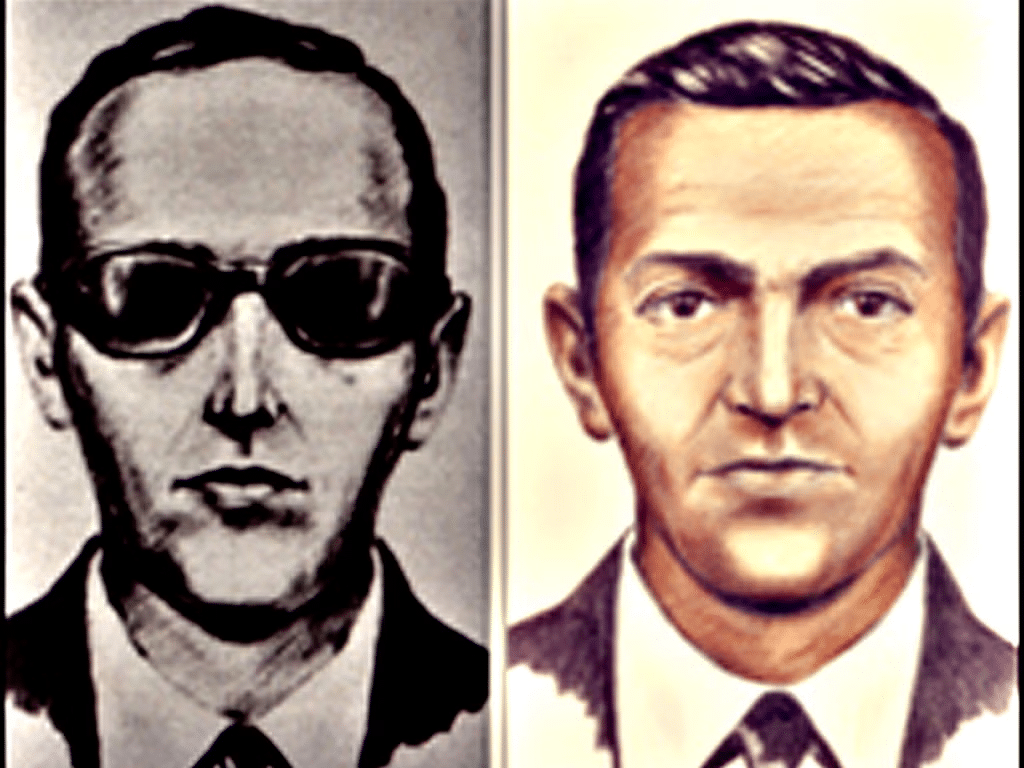
Witnesses also provided descriptions of the hijacker.
They remembered a man who appeared to be middle-aged, with dark hair and a relatively ordinary appearance. Composite sketches were produced and distributed widely.
Thousands of tips followed.
None solved the case.
The name itself also became part of the mystery. The hijacker gave his name as Dan Cooper when purchasing the ticket. A news report mistakenly referred to him as “D.B. Cooper,” and that incorrect name quickly entered popular culture.
The real Dan Cooper remained unidentified.
The $5,800 Clue That Appeared Years Later
For nearly a decade, investigators found no confirmed trace of Cooper.
Then, in 1980, something extraordinary happened.
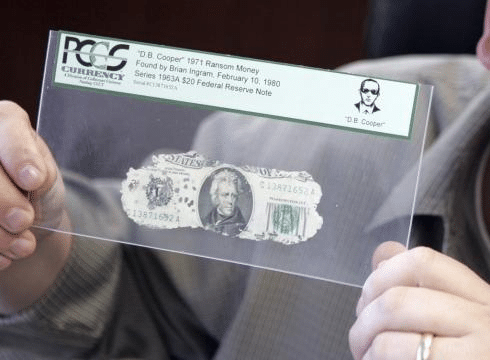
An eight-year-old boy named Brian Ingram was playing along the Columbia River near Tena Bar, Washington, when he discovered several bundles of deteriorating cash buried in the sand.
The money was badly damaged.
But the serial numbers told investigators exactly what they were looking at.
The bills came from Cooper’s ransom.
The discovery totaled $5,800, consisting of 58 $20 bills.
It was the first and only confirmed portion of the ransom ever recovered.
But the find created another puzzle.
Tena Bar was not simply sitting beneath the most obvious projected landing point.
How did the money get there?
Could it have traveled through the river?
Did the ransom somehow become separated from Cooper?
Or did investigators misunderstand the original jump zone?
No explanation has answered every question.
The remaining roughly $194,200 has never been conclusively found.
Theories About Who D.B. Cooper Really Was
Over the years, investigators and independent researchers have proposed numerous suspects.
Some had military backgrounds. Others had aviation experience, criminal histories or personalities that appeared to fit the limited description provided by witnesses.
Several theories became famous enough to generate books, documentaries and years of debate.
But suspicion is not proof.
No proposed identity has been established beyond reasonable doubt.
The FBI examined an enormous number of leads during its investigation. Investigators interviewed suspects, reviewed records and followed claims from people who believed they recognized Cooper.
None produced a definitive answer.
The absence of a confirmed identity remains one of the strangest aspects of the case.
Usually, even an elusive criminal eventually leaves behind a document, a witness, a fingerprint, a financial trail or a body.
Cooper left almost none of those things.
Did D.B. Cooper Survive?
This is the question that has kept the case alive for generations.
The FBI generally considered death in the jump or shortly afterward more likely than a successful escape.
The conditions were harsh. The landing area was remote. Cooper carried a large amount of money and had limited supplies. He would have needed to survive the landing, navigate unfamiliar terrain and avoid detection afterward.
Yet the absence of his body creates an uncomfortable gap in that theory.
No verified remains were discovered.
No confirmed parachute was recovered.
No reliable witness ever established that Cooper died.
And only a small fraction of the ransom was found.
That leaves the door open to a more tantalizing possibility: perhaps he survived.
Could he have landed safely, hidden the money and disappeared into ordinary life?
It is possible.
But possibility is not evidence.
The FBI Investigation Eventually Went Cold
For decades, the FBI devoted substantial resources to the Cooper investigation.
Video: Hijacker Jumps Out of Plane With $200,000! | History’s Greatest Mysteries (S4)
Agents followed suspects, analyzed physical evidence and investigated reported sightings. The case became one of the bureau’s most famous unsolved investigations.
In 2016, the FBI announced that it was redirecting its resources away from active investigation of the case. The bureau made clear that credible new evidence could still be submitted, but routine investigative work would no longer continue as it had for decades.
That decision effectively closed the most active chapter of the investigation without solving its central mystery.
Who was Dan Cooper?
What happened after the jump?
Where did the missing ransom go?
Those questions remain unanswered.
A Disappearance That Became an American Mystery
The D.B. Cooper case endures because its beginning and middle are unusually well documented.
We know where he boarded the plane.
We know what he demanded.
We know how much money he received.
We know that he obtained parachutes.
We know he ordered the aircraft into the night.
And we know that he lowered the rear staircase and jumped.
After that, the story becomes a blank space.
A man in a business suit disappeared into a dark November sky carrying $200,000. Nearly $194,000 of that money was never recovered. His identity remains unknown, and his fate has never been conclusively established.
Perhaps Cooper died in the wilderness that night.
Perhaps he survived and spent the rest of his life keeping the secret.
Either way, the mystery has outlived the man at its center.
More than 50 years later, the most famous question remains remarkably simple:
Who was D.B. Cooper—and what happened after he vanished into the night?