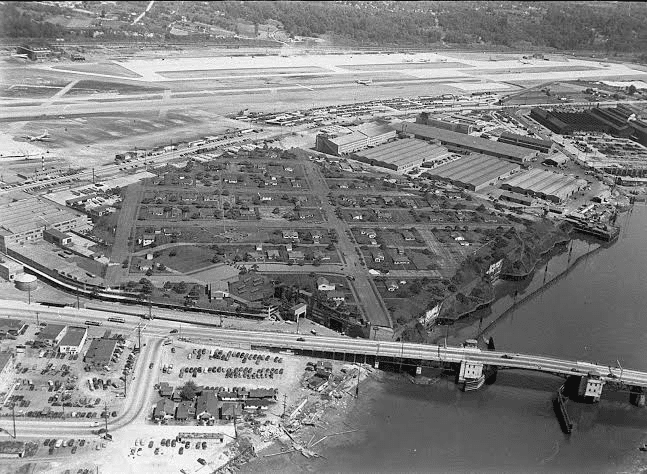
From high above Seattle during World War II, something looked strangely ordinary.
There were streets. Houses. Trees. Even what appeared to be parked cars.
It could have been a quiet residential neighborhood anywhere in America.
But nobody lived there.
The “neighborhood” was actually a giant camouflage installation built on the roof of Boeing’s Plant 2, a massive aircraft factory along Seattle’s Duwamish River. Beneath the artificial houses and painted streets, thousands of workers were building some of the most important bombers of the war.
It sounds like something from a spy movie, but the idea was remarkably practical.
The goal was simple: if enemy aircraft ever reached Seattle, pilots looking down would hopefully see an ordinary neighborhood instead of one of America’s most valuable military factories.
Why Boeing Plant 2 Became a Wartime Target
After the Japanese attack on Pearl Harbor in December 1941, Americans could no longer assume that the mainland was beyond the reach of enemy forces.
The West Coast received particular attention.
Seattle was especially important because the city had become a major center of aircraft production. Boeing’s facilities were producing military aircraft on an enormous scale, making the company’s factories strategically valuable targets.
Plant 2 stood along the Duwamish River, south of downtown Seattle. Its huge industrial footprint made it difficult to hide naturally.
From the air, a large factory roof was exactly what it appeared to be: a large factory roof.
And that presented a problem.
A successful bombing raid did not necessarily require enemy pilots to know every detail about the building. They simply needed to identify a large industrial complex and aim for it.
Video: Fake town built on roof of Boeing B17 Bomber factory during WWII
So Boeing and military planners looked for another solution.
Instead of trying to hide the factory underground, they decided to change what it looked like from above.
The Hollywood Art Director Behind the Illusion
The camouflage effort became an extraordinary mixture of engineering, military planning and theatrical design.
John Stewart Detlie, a Hollywood art director, was brought into the project. His experience creating convincing scenery for films turned out to be surprisingly useful for aerial camouflage.
Think about the challenge.
A movie set only needs to fool people looking at it from a particular angle. Boeing’s camouflage needed to fool observers looking down from thousands of feet in the air.
The rooftop therefore became a gigantic outdoor stage.
Designers did not need to create a neighborhood that would withstand close inspection from the ground. They needed one that would look convincing from above.
That difference saved enormous amounts of material and effort.
How Engineers Built a Neighborhood on the Roof
The camouflage installation used lightweight materials rather than full-size houses.
Workers constructed frameworks across portions of the enormous factory roof. Burlap, wire mesh, painted fabric and wood helped create the basic shapes.
False building fronts suggested houses and garages.
Painted surfaces represented roads.
Artificial trees added irregular shapes and shadows.
Even fake vehicles appeared in the landscape.
From ground level, the installation would have looked strange and theatrical. From an aircraft, however, the individual pieces blended into a much larger visual pattern.
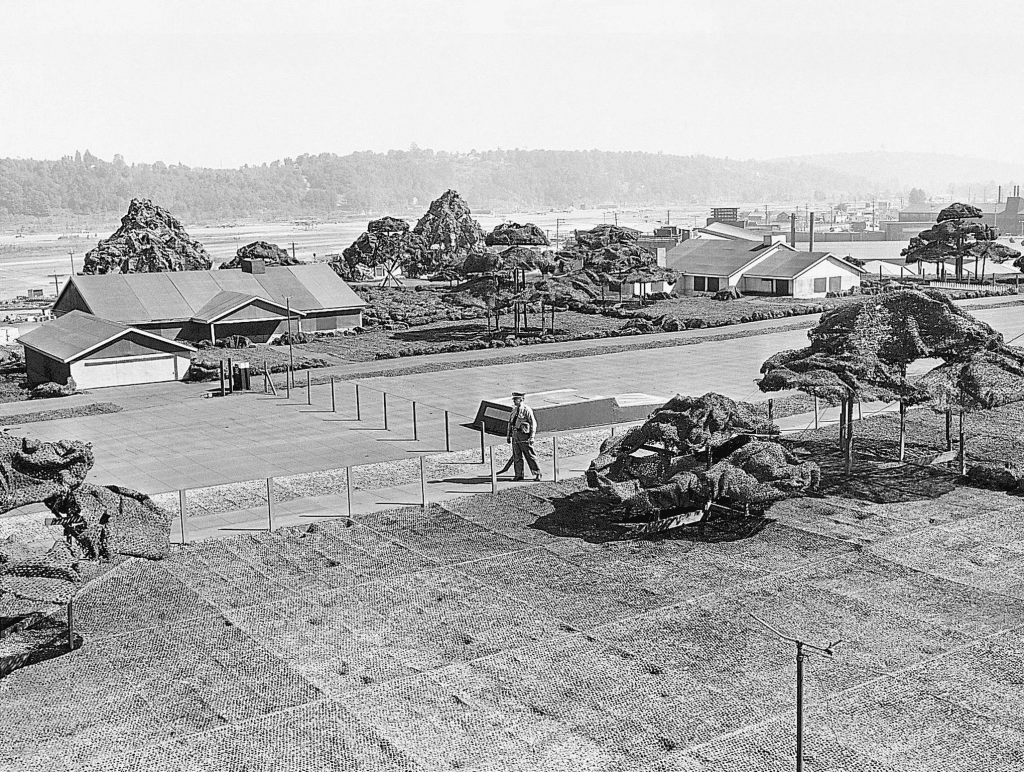
The designers carefully considered proportions, colors and shadows. A building that looked convincing from directly overhead might look completely wrong from an angle, so aerial observation played an important role in testing the camouflage.
The installation was not designed to make the factory literally disappear.
Instead, it attempted to make the factory difficult to recognize.
That distinction is important.
The camouflage belonged to an era when aerial reconnaissance depended heavily on human observers and photographic interpretation. A confusing visual pattern could buy valuable protection.
The Roof Became a Giant Stage Set
The artificial neighborhood covered a substantial portion of the factory complex.
Workers constructed rooftop features that suggested the ordinary signs of suburban life. The streets did not need to function. The houses did not need plumbing. The cars did not need engines.
They only needed to look plausible from the sky.
It was essentially Hollywood scenery scaled up to industrial proportions.
And underneath it all, the real work continued.
Thousands of Workers Built Bombers Beneath the Fake Streets
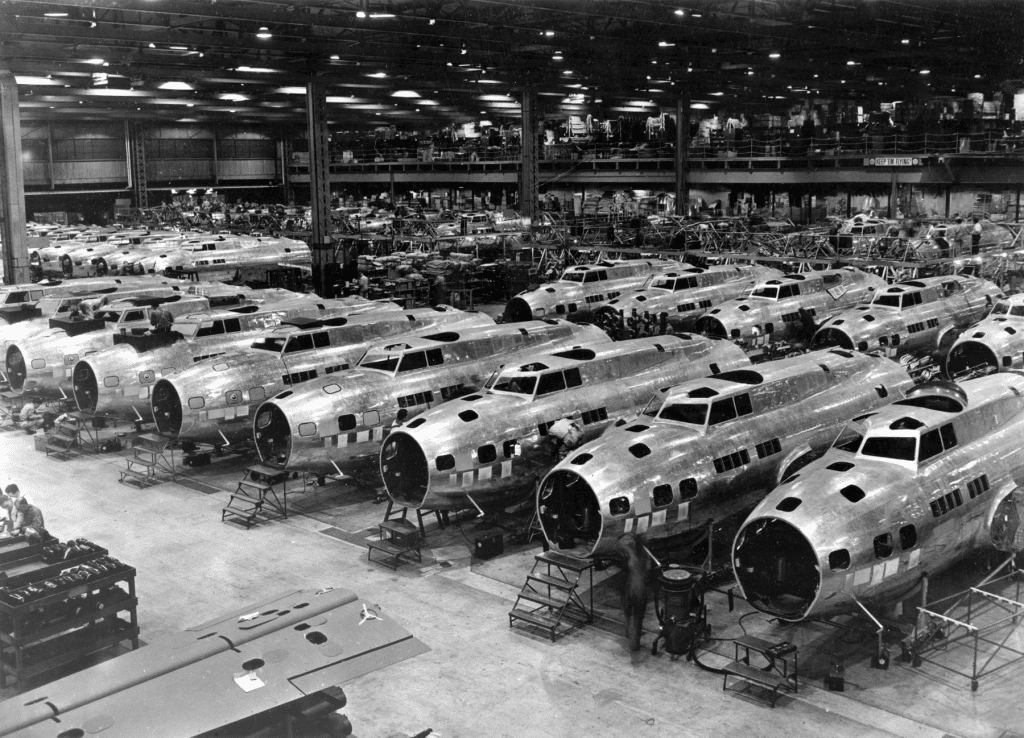
While the camouflage team created an imaginary neighborhood above, Boeing employees continued assembling aircraft below.
Plant 2 played a major role in producing the B-17 Flying Fortress, one of the best-known heavy bombers of World War II.
The factory became part of America’s enormous wartime industrial machine.
Inside, workers dealt with a completely different world from the one represented on the roof. Aircraft components moved through production areas, workers assembled structures and systems, and finished bombers eventually emerged from the facility.
The contrast was extraordinary.
Above the workers sat fake streets and artificial homes.
Below them, a huge aircraft factory was helping supply the Allied war effort.
The rooftop scenery therefore served as a kind of visual mask over one of the busiest industrial sites in the region.
Women and the Expanding Wartime Workforce
The camouflage story also belongs to the larger history of American industrial mobilization during World War II.
Video: Boeing Plant 2 Manufactures “Flying Fortresses”
As men entered military service, American factories increasingly relied on women and other workers who had not traditionally held industrial jobs.
Boeing’s Seattle operations expanded rapidly during the war.
The famous image of “Rosie the Riveter” was not simply a piece of wartime advertising. Women really did enter factories in large numbers, taking on jobs that had previously been dominated by men.
At Plant 2, that expanding workforce helped maintain the enormous production effort while the camouflage installation overhead quietly performed another job: protecting the facility from possible attack.
The roof might have looked like a peaceful neighborhood.
The factory floor was anything but peaceful.
Why the Fake Neighborhood Wasn’t Perfect
It is tempting to imagine that the camouflage fooled every enemy pilot completely.
Historical evidence does not support such an absolute claim.
The rooftop neighborhood was not invisible.
An experienced observer looking carefully from close range might have recognized inconsistencies. The streets were artificial, the buildings were shallow structures, and the trees were representations rather than living landscaping.
But perfection was never the objective.
Camouflage works by creating uncertainty.
If a reconnaissance aircraft saw something that looked sufficiently ordinary, the observer might not immediately identify the site as a critical aircraft factory.
That hesitation could matter.
During wartime, even a few moments of uncertainty could influence whether a target was correctly identified and selected.
The Boeing project therefore demonstrates an important principle of camouflage: sometimes the best disguise is not invisibility. It is confusion.
Maintaining the Illusion Was a Job of Its Own
Seattle’s weather created another challenge.
Rain, wind and changing seasons were not kind to lightweight rooftop scenery.
The artificial structures required maintenance. Materials could deteriorate, painted surfaces could fade and pieces could be damaged by weather.
A camouflage installation was therefore not something engineers could simply build and forget.
Crews had to keep the illusion intact.
That maintenance requirement illustrates just how seriously planners treated the threat. Building the fake neighborhood was only the beginning. Keeping it believable was part of the operation.
Meanwhile, production below continued.
Aircraft workers had no luxury of stopping every time the scenery above needed attention.
The two operations had to coexist.
What Happened After World War II?
When World War II ended in 1945, the need for elaborate rooftop camouflage disappeared.
The artificial neighborhood was dismantled.
The factory itself, however, continued serving Boeing for decades.
Plant 2 remained an important part of Seattle’s industrial history long after the war. Boeing adapted its manufacturing operations as aircraft technology changed and the company moved between military and commercial programs.
Eventually, the aging facility was no longer practical to maintain.
The building was demolished in 2010, bringing the physical story of Plant 2 to an end.
The surrounding Duwamish River area also became associated with long-term environmental cleanup efforts resulting from decades of industrial activity.
The neighborhood that once existed above the factory had disappeared many decades earlier.
But photographs remained.
The Wartime Illusion That Still Amazes People
Today, photographs of Boeing’s fake neighborhood remain among the most fascinating images from America’s World War II home front.
They capture something difficult to imagine now: an enormous aircraft factory concealed beneath what appeared to be an ordinary American community.
No families lived in those houses.
Nobody drove on those painted streets.
The trees were not really trees.
The cars were not really cars.
It was all scenery.
Yet beneath that scenery, thousands of people were building aircraft for a global war.
That contrast makes the story so memorable. The project was not simply an unusual piece of camouflage. It represented the extraordinary lengths American engineers, designers and workers were willing to take to protect critical wartime production.
A Neighborhood That Was Never Meant to Be Real
The fake neighborhood above Boeing Plant 2 was ultimately a temporary wartime illusion, but it reveals something much larger about World War II.
America’s factories had become military assets. Protecting them required more than soldiers and weapons. It required architects, engineers, artists, construction crews and ordinary factory workers to think creatively about an entirely new kind of threat.
Boeing’s rooftop neighborhood was one answer.
It did not make the factory disappear. Instead, it transformed its appearance from the sky, turning a massive industrial complex into something that looked almost boring.
And perhaps that was the entire point.
A bomber pilot searching for a major aircraft factory was supposed to look down and see nothing worth noticing.
Just houses.
Just streets.
Just another neighborhood.
Meanwhile, beneath the illusion, the war machine kept working.