The trail was nothing special.
A Northern California couple had walked it countless times with their dog, passing the same trees, rocks, and patches of moss without giving them much thought. It was simply part of the familiar landscape surrounding their rural property.
Then, one day in 2013, something caught their attention.
A small piece of rusted metal was sticking out of the ground.
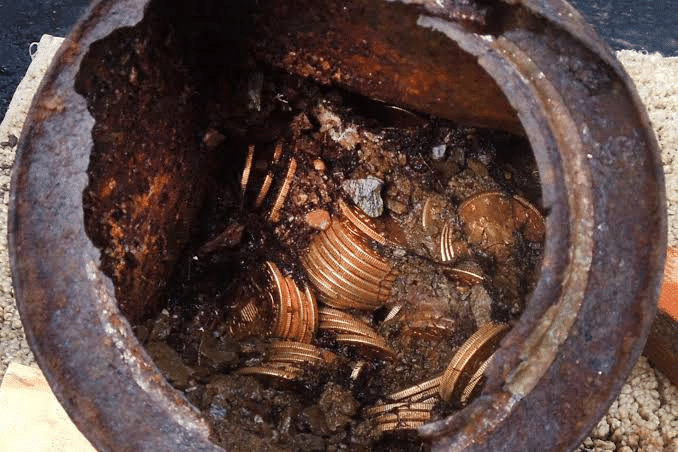
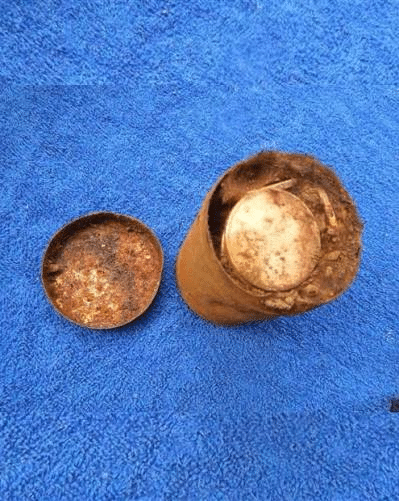
They stopped. They dug around it. And when they finally pulled the object free, they realized it was an old metal can.
It was surprisingly heavy.
Inside were gold coins dating back to the 19th century.
That first discovery led to more searching — and eventually to one of the most remarkable buried-treasure finds in modern American history.
Known as the Saddle Ridge Hoard, the collection contained 1,427 U.S. gold coins dating from 1847 to 1894. Their original face value totaled just $27,980, but their collector value was estimated at roughly $10 million.
How could such a fortune have remained hidden for more than a century?
The Rusted Can That Changed Everything
The discovery occurred in California’s historic Gold Country, a region forever associated with the state’s 19th-century gold rush.
The couple, who chose to remain anonymous and were publicly identified only as “John” and “Mary,” had owned their rural property for years. They were familiar with the hillside and had walked the area many times.
Nothing suggested that a fortune was buried beneath their feet.
During one walk, however, they noticed the edge of an old can protruding from the soil.
Curiosity won.
They dug it out and carried it home. When the deteriorated container opened, they discovered several old gold coins packed inside.
At first, the couple could hardly know what they had found. Were the coins valuable? Were they authentic? Had somebody buried them recently, or had they been underground for generations?
The answers became much more surprising when they returned to the hillside.
More Cans Were Waiting Underground
After finding the first container, the couple began searching the surrounding area more carefully.
Additional buried containers appeared.
Some were badly corroded after spending decades underground. Others still held remarkably preserved coins. The couple eventually used a metal detector to help locate additional areas of interest.
Piece by piece, the scale of the discovery became clear.
This wasn’t a handful of forgotten coins.
It was a buried collection.
And someone had deliberately placed it there long ago.
Inside the Saddle Ridge Gold Hoard
Experts eventually identified 1,427 United States gold coins in the collection.
The coins represented nearly five decades of American monetary history. Most were $20 Liberty Head double eagles, although the hoard also contained $10 gold eagles and $5 half eagles.
Many of the coins came from the San Francisco Mint, adding another connection to the region where the treasure had remained hidden.
The dates offered an important clue.
The collection included coins from 1847 through 1894. Because the newest pieces dated to 1894, the hoard could not have been buried before that year.
But exactly when someone placed the containers underground remains unknown.
The mixture of dates suggests that the coins may have been accumulated gradually rather than purchased or obtained as a single group.
Imagine saving money over decades and then deciding that the safest place for it was not a bank vault, but the earth itself.
That may have been the thinking behind the hoard.
Video: THE SADDLE RIDGE TREASURE HOARD – HISTORY OF COINS & CURRENCY
Why Ordinary Gold Coins Became Worth Millions
At first glance, the face value of the collection seems surprisingly low.
The coins were worth a combined $27,980 according to their denominations.
But that number tells only a fraction of the story.
A 19th-century $20 gold coin is not necessarily worth just $20 today. Collectors consider numerous factors, including rarity, date, mint mark, condition, historical significance, and demand.
The Saddle Ridge coins benefited from several of those factors at once.
Many had survived in unusually strong condition. Instead of spending decades in pockets, purses, cash registers, or collections where they could be handled repeatedly, these coins had spent generations underground inside containers.
That unusual history helped preserve some of them.
Professional grading later revealed several particularly impressive examples.
One Rare Coin Became a Standout
Among the most notable pieces was an 1866-S $20 Liberty Head double eagle without the “In God We Trust” motto.
The Saddle Ridge example received a Mint State 62 grade from Professional Coin Grading Service, or PCGS, and was recognized at the time as an exceptional example of that scarce issue.
Another remarkable group consisted of hundreds of 1889-S double eagles.
The discovery added unusually high-grade examples to the known population of certain dates, giving collectors something more valuable than simply another old gold coin.
The coins represented pieces of American history that had somehow survived both circulation and more than a century underground.
Video: How Did This Couple Find $10 Million?
Who Buried the Treasure?
This may be the most fascinating question of all.
Nobody knows for certain.
There is no confirmed name, diary, family record, or historical document identifying the person who buried the Saddle Ridge Hoard.
One possibility is that the coins represented personal savings.
During the late 19th century, Americans did not have the same relationship with banks that many people have today. Financial institutions were less accessible in some communities, and concerns about bank failures or economic instability could encourage people to keep wealth close at hand.
For someone who trusted buried gold more than a bank, hiding coins on private property may have seemed perfectly reasonable.
The pattern of dates supports that possibility.
Rather than containing a single year’s production, the collection includes coins from many different years and mints. That makes the hoard look more like accumulated wealth than one large payment.
Could the Coins Have Been Stolen?
One theory connected the discovery to a historic theft from the San Francisco Mint around the beginning of the 20th century.
The story was intriguing, but investigators found no reliable evidence connecting the stolen funds to the Saddle Ridge coins.
The coins came from too broad a range of dates and mints to provide a convincing match.
So the mystery remains.
The person who buried the treasure may have been a miner, merchant, rancher, investor, or simply someone who preferred keeping savings hidden.
Perhaps they intended to return.
Perhaps they forgot.
Perhaps they died without telling anyone where the money was buried.
More than a century later, we simply don’t know.
How Experts Confirmed the $10 Million Discovery
The couple faced an unusual problem after realizing the possible value of their discovery.
They couldn’t simply take hundreds of old gold coins to a local shop and ask what they were worth.
They needed authentication, grading, documentation, and a secure way to sell them.
Coin specialist David McCarthy of Kagin’s helped examine and document the collection. Professional Coin Grading Service then authenticated and graded all 1,427 coins.
Each piece was photographed and placed in a protective holder identifying its connection to the Saddle Ridge Hoard.
That provenance became an important part of the collection’s story.
A rare coin with a documented history can be much more appealing to collectors than an otherwise similar coin whose origins are uncertain.
The hoard offered something unusual: hundreds of coins discovered together in their original buried context.
The Treasure Became a Family Fortune
The couple eventually began selling portions of the collection.
Rather than placing every coin on the market simultaneously, selected pieces were offered through different channels, allowing collectors to evaluate individual examples.
Some coins attracted significant attention because of their rarity and condition.
The couple also chose to remain anonymous.
That decision made sense.
A buried fortune worth millions can attract more than collectors. It can also attract unwanted attention from treasure hunters, curious strangers, trespassers, and people making unsupported claims about ownership.
Keeping the property’s exact location private helped protect both the couple and the remaining coins.
Two Coins Found a Permanent Home at the Smithsonian
Not every coin from the Saddle Ridge Hoard disappeared into private collections.
Two examples were donated to the Smithsonian’s National Numismatic Collection at the National Museum of American History.
The donated pieces included an 1888 $10 gold coin and an 1892 $20 gold coin.
Their preservation ensures that at least part of the extraordinary discovery remains available as a piece of the nation’s monetary history.
The coins tell a story that goes beyond their market value.
They connect the California Gold Rush era, 19th-century American commerce, private savings, coin collecting, and one astonishing modern discovery.
A Treasure Hidden in Plain Sight for More Than 100 Years
What makes the Saddle Ridge Hoard so captivating isn’t simply the estimated $10 million value.
It’s how ordinary the discovery began.
There was no elaborate expedition.
No ancient map.
No professional treasure hunter.
Just a couple walking a familiar trail with their dog.
They noticed a piece of rusty metal that most people might have ignored.
That small decision changed everything.
Beneath the hillside were 1,427 gold coins, carefully hidden by someone whose identity has disappeared into history. The coins had survived decades of economic change, two world wars, technological revolutions, and generations of California history.
The person who buried them is still unknown.
The reason they did it remains a mystery.
But the result is certain.
A forgotten collection that once represented less than $28,000 in face value eventually became one of America’s most extraordinary modern treasure discoveries, with collector estimates reaching roughly $10 million.
And perhaps the most remarkable part is this:
The couple had walked past that spot many times before.
The treasure had been there all along.
They simply hadn’t looked down.