Imagine looking across a field during World War II and seeing an entire American armored force preparing for battle.
Tanks are lined up.
Trucks appear to be moving into position.
Radio operators are sending messages.
Somewhere in the distance, the unmistakable rumble of armored vehicles fills the air.
It would be easy to assume thousands of soldiers were nearby.
But what if almost none of it were real?
During World War II, the U.S. Army created an extraordinary deception unit that specialized in making small groups of soldiers appear to be much larger military formations. Its equipment included inflatable tanks, fake artillery, imitation vehicles, recorded battlefield sounds, and carefully constructed radio transmissions.
The unit became known as the Ghost Army.
Its official name was the 23rd Headquarters Special Troops, and its unusual mission was not to destroy the enemy directly. Instead, its soldiers tried to convince German forces that American troops were somewhere they were not.
The deception was elaborate, risky, and remarkably creative.
Why the U.S. Army Needed a Ghost Army
By 1944, Allied commanders had learned that deception could sometimes accomplish what brute force could not.
The massive preparations for the invasion of Europe had already demonstrated the value of misleading German intelligence. If German commanders could be persuaded to expect an attack in the wrong location, Allied forces might gain valuable time and reduce resistance elsewhere.
But battlefield deception presented a different challenge.
Commanders needed a mobile unit that could move into an area, create the appearance of a large American formation, and then disappear when the real troops had completed their movement.
That was the job given to the 23rd Headquarters Special Troops.
Video: Ghost Army WWII: How Inflatable Tanks Saved 30,000 American Lives
Activated in January 1944, the unit contained roughly 1,100 men. Instead of functioning like a conventional combat formation, it brought together specialists in visual deception, sound, radio communications, and military theater.
Artists, engineers, radio operators, technicians, and other specialists became part of a strange new form of warfare.
Their most important weapon was the ability to make the enemy believe something that wasn’t there.
The Inflatable Tanks That Looked Real From a Distance
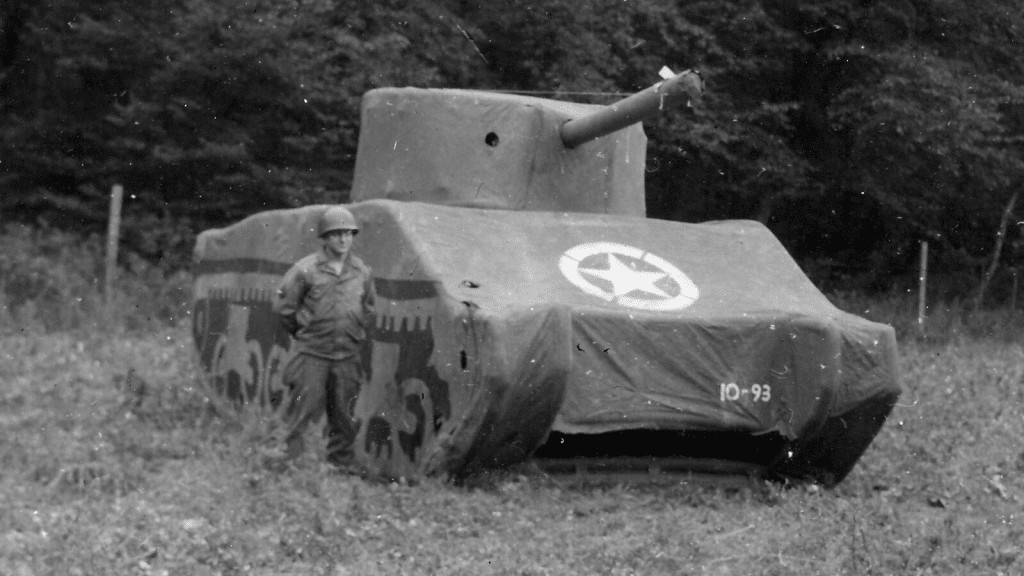
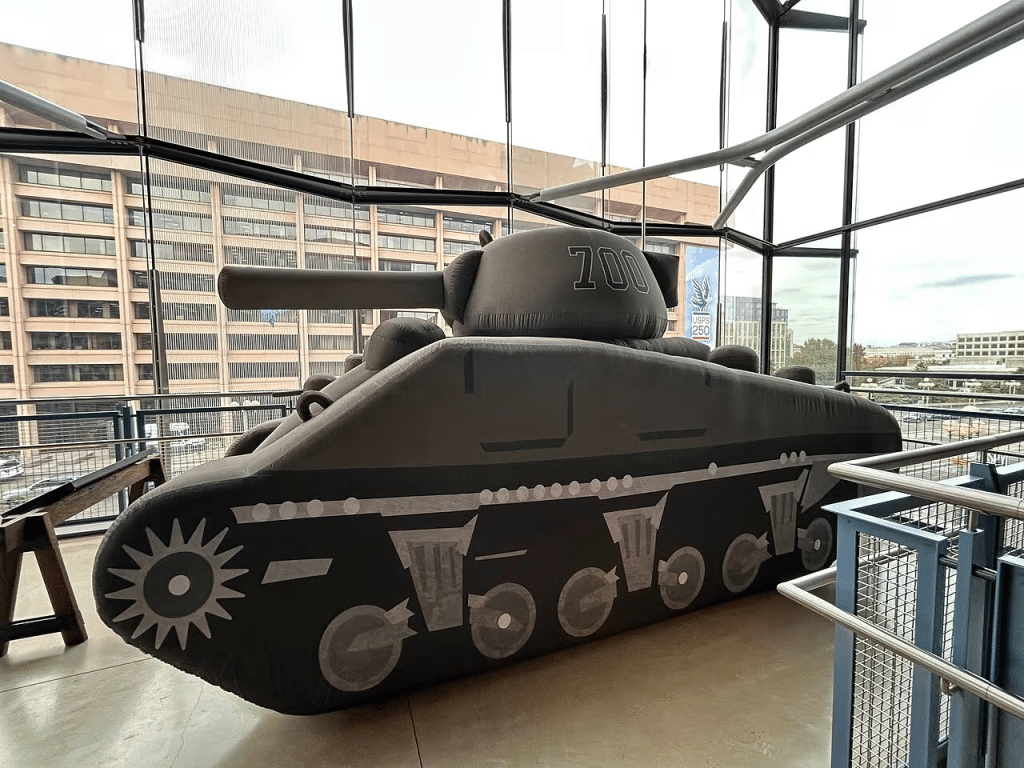
Perhaps the most memorable part of the Ghost Army was its collection of inflatable military vehicles.
At first glance, an inflatable Sherman tank sounds almost comical.
It wasn’t.
The replicas were designed to resemble real American tanks closely enough to deceive observers at useful distances. When inflated and positioned correctly, they could create the impression of an armored unit preparing for action.
The trick depended heavily on perspective.
German observers were not necessarily standing a few feet away and inspecting the vehicles. They might be studying aerial photographs, observing from distant positions, or viewing a battlefield through binoculars.
At those distances, a carefully shaped rubber vehicle could provide exactly the visual clue enemy intelligence needed to reach the wrong conclusion.
A Tank That Weighed Almost Nothing
A real M4 Sherman weighed more than 30 tons.
The inflatable version was light enough for a small number of soldiers to move by hand.
That difference became one of the Ghost Army’s greatest advantages.
Soldiers could rapidly create what appeared to be an armored concentration in a location where no actual tanks existed. They could arrange the vehicles, add camouflage netting, create tracks and position equipment to make the scene look lived-in.
The goal was never to survive close inspection.
The goal was to survive long enough to fool the enemy.
The Ghost Army Created More Than Fake Tanks
Inflatable tanks were only one part of the illusion.
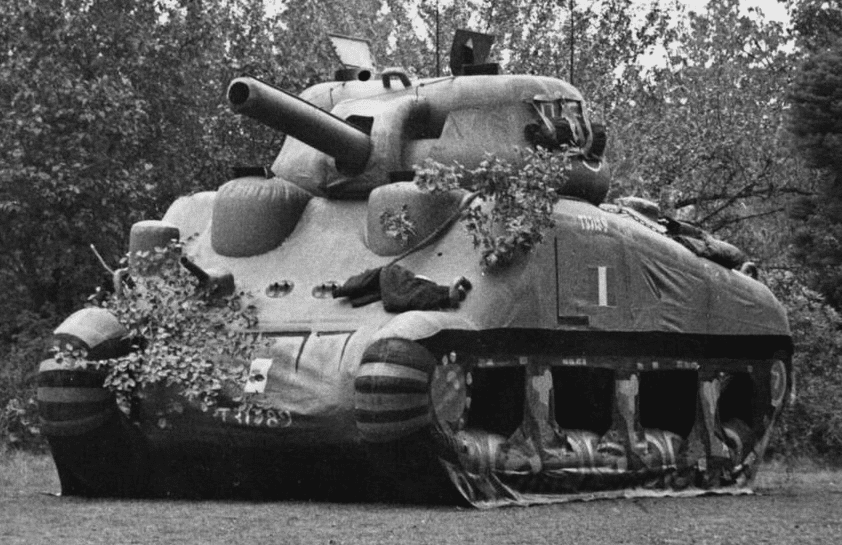
The soldiers also used dummy trucks, artillery pieces, command posts and other equipment designed to suggest the presence of a much larger American force.
The men understood that simply placing a few fake vehicles in a field would not be convincing.
Real military units leave traces.
They create roads and tracks.
They establish supply areas.
They organize equipment.
They communicate.
They move soldiers around.
The Ghost Army therefore tried to reproduce those details.
A convincing deception had to look like a real military operation rather than a collection of props.
This required discipline.
If the fake vehicles were arranged incorrectly, the enemy might notice. If the radio traffic did not match the supposed unit, the deception could collapse. If soldiers behaved in ways inconsistent with the formation they were impersonating, local observers could become suspicious.
Every detail mattered.
Recorded Battlefield Sounds Added Another Layer
Visual deception could fool the eyes.
But what about the ears?
A real armored division makes an enormous amount of noise.
Engines roar. Tracks move. Trucks arrive. Artillery crews work. Soldiers communicate. Vehicles travel along roads.
The Ghost Army developed a way to manufacture those sounds.
Specialists recorded the noises produced by genuine military equipment and played them through powerful sound systems mounted on half-tracks.
Under favorable conditions, the broadcasts could be heard many miles away.
Imagine standing several miles from a darkened road at night and hearing the unmistakable sound of a large armored column approaching.
You cannot see the tanks.
Video: Ghost Army: Combat Con-Artists of WWII
But you hear them.
Would you assume they were fake?
That was precisely the reaction the Ghost Army hoped to create.
Sound Had to Match the Story
The recordings were not simply played at random.
Operators could combine different sounds to create the impression of military activity. A sequence might suggest vehicles arriving, equipment being unloaded, troops establishing positions, or an armored formation moving through an area.
The sound also had to fit the visual deception.
Fake tanks without appropriate noise might look suspicious.
Recorded tank sounds without visible equipment could create a different problem.
But when the eyes and ears appeared to confirm each other, the deception became much more persuasive.
The Ghost Army was essentially creating a military story and giving the enemy multiple reasons to believe it.
The Secret Radio Network Was Perhaps the Cleverest Trick
The radio specialists performed another crucial task.
If the Ghost Army pretended that a particular American division occupied an area, it could not simply broadcast generic military messages.
German signals intelligence was sophisticated.
Enemy radio operators could recognize patterns in communication, including the distinctive habits of individual operators.
The Ghost Army therefore studied the radio behavior of actual American formations.
Its operators learned how particular units communicated, how often they transmitted, and how their messages sounded.
They then reproduced those patterns.
The result was a fictional radio network that could make German intelligence analysts believe a real American formation was operating nearby.
This part of the deception was especially important when an actual American unit quietly moved away.
The Ghost Army could continue transmitting in that unit’s name, creating the impression that it had never left.
Meanwhile, the real soldiers could relocate elsewhere.
The enemy was effectively listening to a military unit that existed only on the radio.
The Soldiers Had to Act the Part
There was another layer that sounds almost like theater.
Ghost Army soldiers sometimes wore the insignia associated with the formation they were impersonating. They moved through nearby towns, visited locations where soldiers might normally be seen, and behaved in ways designed to reinforce the false identity.
This became the human side of the deception.
An enemy informant might notice a soldier’s shoulder patch.
A local resident might see military vehicles.
A radio operator might intercept transmissions.
An aerial reconnaissance photograph might reveal what appeared to be a large vehicle concentration.
Each piece of information supported the others.
Individually, any one clue might have been questionable.
Together, they could create a convincing picture.
The Ghost Army’s Deceptions During the European Campaign
The 23rd Headquarters Special Troops operated across parts of France, Belgium, Luxembourg, and Germany during the final stages of World War II.
The unit participated in roughly twenty deception operations.
One of the best-known examples came during the Allied advance toward the Rhine in 1945.
The Ghost Army conducted Operation Viersen, creating the impression that a large American force was preparing to cross the Rhine at a location different from the actual crossing point.
The deception included visual equipment, sound, radio traffic, and other techniques.
As always, historians must be careful about claiming that one deception alone caused a particular battlefield outcome. Military operations involve many variables, including artillery, air power, terrain, intelligence, logistics, and the condition of opposing forces.
Still, the Ghost Army’s purpose was clear.
It sought to make German commanders react to an army that did not exist.
Why the Ghost Army Remained Secret for Decades
After World War II ended, the soldiers of the 23rd Headquarters Special Troops returned home.
But they could not freely tell their stories.
Much of the unit’s work remained classified for decades.
That meant thousands of Americans grew up without knowing that such a strange military organization had existed.
The men had participated in real wartime operations, but their contribution remained largely invisible.
That secrecy also explains why photographs of inflatable tanks can seem almost unbelievable today.
The images are real.
The tanks were real.
The deception was real.
What was fake was the army those objects appeared to represent.
Recognition Finally Came Long After the War
As records were declassified and veterans began sharing their experiences, historians gradually reconstructed the story of the Ghost Army.
Documentaries, books, interviews, photographs, and archival research introduced the unit to a much wider audience.
In 2022, Congress awarded the 23rd Headquarters Special Troops the Congressional Gold Medal, recognizing the unit’s contribution to the Allied war effort.
It was a remarkable moment for men whose entire wartime mission had depended on remaining unseen.
The soldiers had spent the war pretending to be someone else.
Decades later, America finally recognized who they really were.
The Army That Fought With Illusions
The Ghost Army did not win battles by firing more shells or sending more tanks into combat.
It fought with perception.
Its soldiers understood something fundamental about warfare: commanders make decisions based on what they believe is happening.
If you can influence what the enemy sees, hears, and believes, you can influence what the enemy does.
That is why inflatable tanks mattered.
That is why recorded battlefield sounds mattered.
That is why fake radio transmissions mattered.
And that is why a small group of soldiers could sometimes make an enemy believe that an entire American division was nearby.
The Ghost Army’s greatest weapon was never rubber, sound equipment, or radio technology.
It was the human imagination.
For a few remarkable months during World War II, American soldiers turned deception into an art form — creating armies out of air, filling empty fields with phantom tanks, and making silence sound like thousands of men preparing for battle.
The tanks were inflatable.
The army was imaginary.
But the effect on the battlefield was very real.