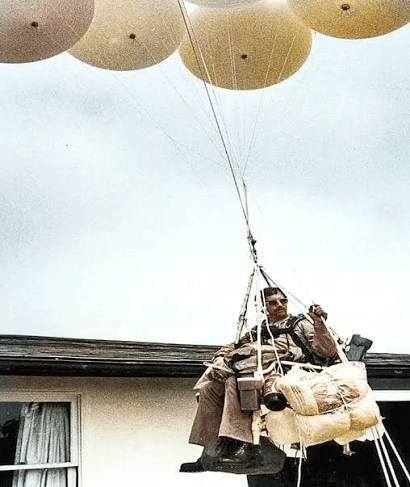
What would you do if you had a lawn chair, a collection of helium balloons, and a dream of seeing the world from above?
For Larry Walters, the answer was simple: he built a flying machine.
It had no engine. No wings. No cockpit. No sophisticated navigation system.
It was an ordinary aluminum lawn chair suspended beneath 42 helium-filled weather balloons.
On July 2, 1982, Walters launched his homemade craft from San Pedro, California. He expected a strange but manageable adventure. Instead, the chair climbed thousands of feet into the sky and eventually reached approximately 16,000 feet.
Suddenly, this backyard experiment had become an aviation emergency.
Commercial pilots reported seeing the unusual craft near the airspace around Los Angeles International Airport. Walters had somehow gone from sitting in a backyard chair to drifting among aircraft at an altitude of nearly three miles.
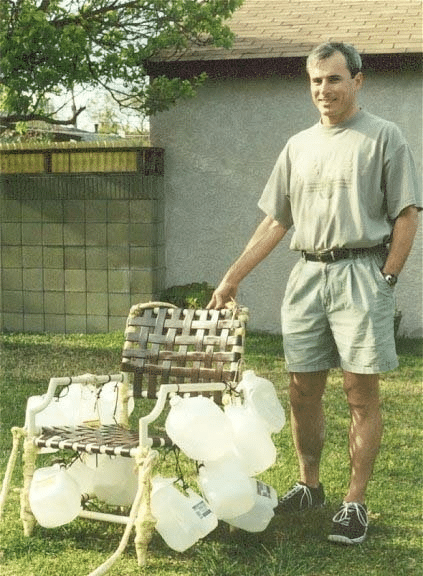
The story sounds like something from a comedy film. But the flight really happened, and the lawn chair eventually became part of the collection of the Smithsonian’s National Air and Space Museum.
The Backyard Dream Behind Inspiration I
Walters, a truck driver, had reportedly dreamed about flying with balloons for years.
The basic idea was surprisingly straightforward. Helium is lighter than ordinary air, so a sufficiently large collection of balloons can generate enough lift to carry a person and a payload.
Walters decided to test that principle using something he already had: a lawn chair.
He named his homemade craft Inspiration I.
The chair was attached to a cluster of large weather balloons. Walters also prepared equipment intended to help him control his altitude, including water ballast, a radio, a parachute, and a BB or pellet gun.
His plan was to rise to a relatively modest height, enjoy the view, and then gradually descend by puncturing balloons.
It sounded simple on paper.
The sky had other ideas.
When the Lawn Chair Shot Into the Sky
The moment Walters released the restraints holding the chair down, the experiment became much more dramatic than expected.
Instead of slowly floating upward, the craft climbed rapidly.
The ground began shrinking beneath him. Buildings became tiny shapes. The surrounding landscape spread out below like a map.
Walters kept rising.
And rising.
Eventually, the lawn chair reached approximately 16,000 feet, or about 4,880 meters above sea level.
At that altitude, the situation was no longer a harmless backyard curiosity.
The temperature was extremely cold, oxygen levels were much lower than at ground level, and Walters had almost no conventional way to control his horizontal movement.
He was essentially a passenger on a balloon-powered aircraft that he could not properly steer.
A Lawn Chair in Commercial Airspace
Perhaps the strangest part of the story came when Walters drifted into controlled airspace near Los Angeles International Airport.
Imagine being an airline pilot approaching Los Angeles and suddenly spotting something that looks like a tiny chair floating in the sky.
That was essentially the situation faced by commercial pilots who reported the unusual object to air traffic controllers.
The problem was not simply that Walters was flying an unconventional aircraft.
He was flying an uncontrolled craft in an area where commercial aircraft were operating.
From the ground, the scene must have been almost surreal. From the cockpit of a passenger jet, however, the strange object represented a genuine aviation hazard.
Walters now needed to get down.
The question was how.
Video: Canadian man arrested for floating lawn chair by balloon
How Walters Tried to Bring Himself Back to Earth
Walters had designed his homemade system with a basic descent strategy.
He carried a BB or pellet gun and planned to puncture the balloons individually.
Each damaged balloon would reduce the overall lift.
In theory, removing enough lift would allow the chair to descend gradually.
But controlling altitude was only part of the problem.
Walters had little ability to control where the wind carried him.
A conventional aircraft can turn, climb, descend, and change direction using engines and aerodynamic control surfaces. A lawn chair hanging beneath balloons has none of those advantages.
The wind largely decided the route.
Walters could determine whether he went up or down, but steering toward a particular street or field was another matter entirely.
As he began puncturing balloons, the chair slowly descended.
Unfortunately, the wind carried him toward Long Beach.
The Flight Ended in Power Lines
Walters eventually descended close enough to the ground for the balloon rig to become entangled in electrical wires.
The contact caused a neighborhood power outage that reportedly lasted around 20 minutes.
For Walters, the landing could have been much worse.
The electrical lines prevented the chair and balloons from immediately reaching the ground. Eventually, however, he made it safely down.
The adventure was over.
The consequences were not.
Federal aviation officials were waiting for him.
The Federal Aviation Administration took enforcement action over the flight, including allegations involving controlled airspace and aviation regulations. Contemporary reporting stated that Walters was eventually fined $1,500.
His strange invention had demonstrated something important: once an object rises into the national airspace system, it is no longer merely a private backyard experiment.
The Surprisingly Simple Physics of the Flight
The science behind Walters’ flight was not mysterious.
Helium balloons rise because helium has a lower density than the surrounding atmosphere. The surrounding air therefore provides an upward force on the balloon.
One balloon could not lift an adult sitting in a chair.
Forty-two large weather balloons were a different story.
Together, they produced enough buoyant force to lift Walters, the aluminum chair, ropes, equipment, ballast, and other materials.
The problem was calculating exactly how much lift the entire system would generate.
A small difference between expected and actual lift can produce a surprisingly large change in altitude.
That appears to have been one of the great surprises of Walters’ experiment.
He did not simply float a few feet above his neighborhood.
He reached an altitude normally associated with conventional aircraft.
Why 16,000 Feet Was a Serious Problem
At 16,000 feet, the environment is dramatically different from the ground.
The temperature can be far below comfortable outdoor conditions. Atmospheric pressure is lower, and the amount of oxygen available with each breath decreases.
Walters had no pressurized cabin.
Video: Flying To 16,500ft With A Garden Chair, Rope, Balloons & Duct Tape (Larry Walters 1982)
He had no enclosed cockpit.
He was sitting outdoors in a lawn chair with the sky surrounding him.
That made the flight considerably more dangerous than the photographs might suggest.
The chair itself offered almost no protection. If Walters had lost control of the balloon system or fallen from the chair, the consequences could have been catastrophic.
He also faced another problem that no backyard test could fully reproduce: wind changes with altitude.
A balloon craft may travel in one direction near the ground and another direction several thousand feet higher.
Walters therefore had very limited control over his destination.
From Aviation Curiosity to Smithsonian Artifact
The story did not disappear after the flight.
Walters’ lawn chair eventually became part of the collection of the National Air and Space Museum.
That is perhaps the most amusing part of the entire story.
Many museum aircraft represent decades of engineering research and enormous industrial achievements.
Walters’ aircraft was a lawn chair.
The surviving object is remarkably ordinary. Without its original balloon cluster, it looks less like an aircraft than something you might expect to find on a backyard patio.
Yet that ordinary chair represents one of the strangest documented flights in American aviation history.
It demonstrates how an unconventional idea, basic physics, and a remarkable willingness to experiment combined to produce something nobody could have expected.
The Man Who Took a Lawn Chair to the Sky
Larry Walters did not become famous because he built a sophisticated aircraft.
He became famous because he looked at something completely ordinary and imagined it doing something extraordinary.
A lawn chair was supposed to stay on the ground.
Walters disagreed.
His experiment proved that enough helium balloons could indeed lift a person thousands of feet into the sky. It also proved that making something fly is much easier than making it controllable.
That distinction is the heart of the story.
Walters had enough lift to reach the sky.
He did not have an engine to turn around.
He did not have wings to glide.
He did not have a rudder to steer.
He had balloons, a chair, and the wind.
And for a few unforgettable hours, that was enough to make him one of the most unusual figures in American aviation history.
A Flight That Still Sounds Too Strange to Be True
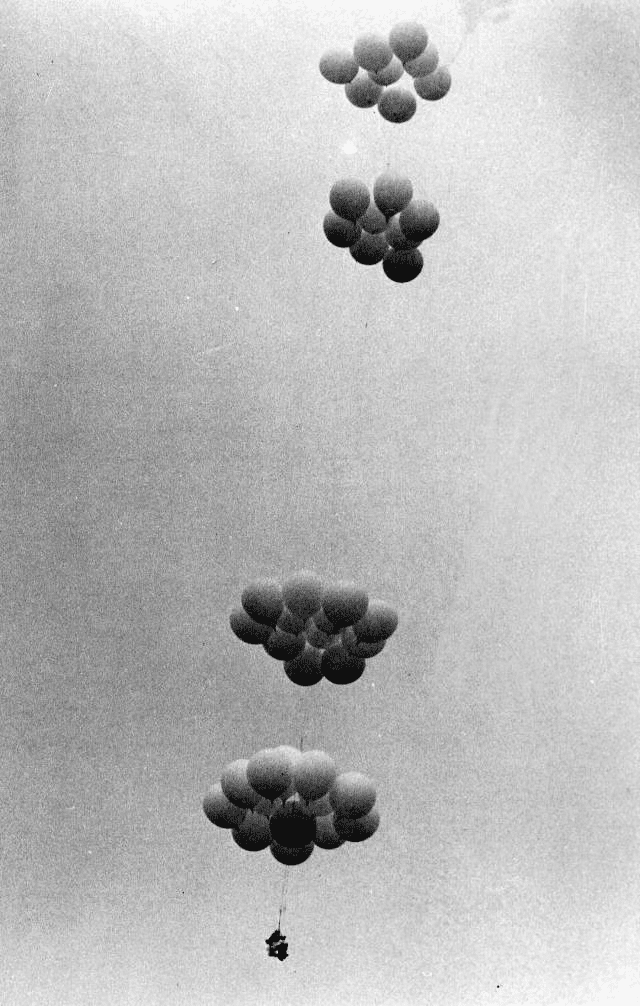
More than four decades later, the story remains difficult to believe.
A truck driver sat in an aluminum lawn chair.
Forty-two helium balloons lifted him nearly three miles above Southern California.
Commercial pilots reported seeing him.
He descended by shooting balloons with a BB gun.
He eventually became tangled in electrical wires and caused a temporary power outage.
Then the strange aircraft became a museum artifact.
There is something almost timeless about the story. It captures a particular kind of American ingenuity—the urge to experiment, improvise, and see whether an improbable idea might actually work.
Of course, the flight also carried serious risks. Walters entered controlled airspace and created a potential danger for other aircraft and people on the ground. His experience is fascinating precisely because the experiment went far beyond what he originally intended.
Still, the image remains unforgettable: a man sitting calmly in a lawn chair, suspended beneath a cluster of balloons, drifting through the California sky.
It was not an airplane.
It was not a helicopter.
It was barely an aircraft at all.
But on that July day in 1982, it carried Larry Walters nearly three miles above the ground—and turned an ordinary lawn chair into one of the most memorable homemade flying machines in American history.