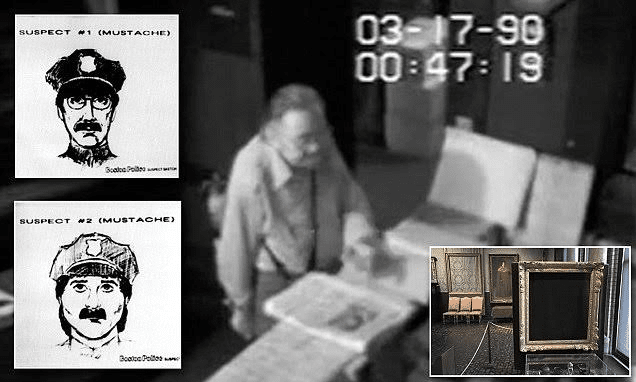
Shortly after midnight on March 18, 1990, two men arrived at the Isabella Stewart Gardner Museum in Boston wearing what appeared to be Boston Police uniforms.
They claimed they were responding to a disturbance.
A security guard opened the employee entrance.
Within minutes, the two supposed officers had restrained the museum’s two night guards and gained access to the galleries.
For the next 81 minutes, they moved through one of America’s most remarkable art collections, removing 13 works by artists including Rembrandt, Johannes Vermeer, Édouard Manet, and Edgar Degas.
Then they disappeared into the Boston night.
More than three decades later, the paintings remain missing.
The Isabella Stewart Gardner Museum theft is not simply a famous art robbery. It is a mystery defined by empty frames, unanswered questions, and a collection of masterpieces that vanished without a confirmed trace.
How the Gardner Museum Robbery Began
The museum had closed for the night after Boston’s St. Patrick’s Day celebrations.
Only two security guards remained inside the building.
Around 1:24 a.m., two men wearing police uniforms approached the employee entrance. They told the guard that they were investigating a disturbance and needed to come inside.
That small decision changed the museum’s history.
The guard allowed them through the door, despite security procedures that prohibited unauthorized visitors from entering at that hour.
Once inside, the men ordered the guard away from the security desk. When the second guard arrived, the intruders revealed their real purpose.
This was not a police investigation.
It was a robbery.
The guards were handcuffed and restrained with duct tape before being taken to separate areas of the basement. With the only overnight security personnel neutralized, the thieves were free to explore the museum.
The building’s security system continued detecting movement, but the robbers eventually removed surveillance material from the night.
For the thieves, the most difficult part of the operation was no longer getting inside.
It was deciding what to take.
81 Minutes Inside the Galleries
The robbers spent approximately 81 minutes moving through the museum.
They did not simply grab the first valuable paintings they saw. Instead, they visited several galleries and selected specific objects.
Their most important stop was the Dutch Room.
There, they targeted works by two giants of European art: Rembrandt van Rijn and Johannes Vermeer.
The thieves removed Rembrandt’s Christ in the Storm on the Sea of Galilee, painted in 1633. The work holds a particularly important place in Rembrandt’s career because it is his only known seascape.
They also took Rembrandt’s A Lady and Gentleman in Black.
Then came one of the theft’s most extraordinary losses: Vermeer’s The Concert.
Vermeer produced relatively few paintings during his lifetime, so each surviving work carries exceptional importance for art historians and collectors. Losing one was like removing a chapter from a very small book.
The thieves also took Govaert Flinck’s Landscape with an Obelisk, along with a small Rembrandt self-portrait etching and an ancient Chinese bronze vessel.
They were not finished.
The Degas Works and Manet Painting
The robbers next entered the Short Gallery, where they took five works on paper by Edgar Degas.
Among them were studies and scenes involving horses and riders, including Three Mounted Jockeys, Procession on a Road Near Florence, and Leaving the Paddock.
They also removed a bronze eagle finial associated with a Napoleonic military flag.
Video: New Surveillance Video Released From Gardner Museum
Finally, the thieves entered the Blue Room.
There they took Édouard Manet’s Chez Tortoni.
The selection remains one of the most puzzling aspects of the case.
Why these 13 objects?
Why take an ancient bronze vessel alongside paintings by some of history’s most celebrated artists?
Why remove smaller works while leaving other valuable pieces untouched?
Investigators and art historians have considered numerous possibilities, but no explanation has been conclusively established.
The thieves may have followed a list.
They may have known something about the collection.
Or they may simply have chosen works that appeared accessible.
Whatever their reasoning, they created one of the greatest unsolved losses in the history of American museums.
What Was Stolen From the Gardner Museum?
The missing collection includes 13 objects connected to major artists and historical traditions.
The stolen works are:
- Johannes Vermeer’s The Concert
- Rembrandt’s Christ in the Storm on the Sea of Galilee
- Rembrandt’s A Lady and Gentleman in Black
- Rembrandt’s Portrait of the Artist as a Young Man
- Govaert Flinck’s Landscape with an Obelisk
- Édouard Manet’s Chez Tortoni
- Edgar Degas’ Three Mounted Jockeys
- Degas’ Procession on a Road Near Florence
- Degas’ Leaving the Paddock
- Two Degas studies for The Programme
- An ancient Chinese bronze gu
- A bronze Napoleonic eagle finial
The collection’s estimated value runs into hundreds of millions of dollars.
But the financial figure does not fully explain the significance of the loss.
These objects are irreplaceable pieces of cultural history. Even if someone had unlimited money, replacing the original Vermeer or Rembrandt would be impossible.
There is only one original.
And it is still missing.
Why the Empty Frames Became Famous
Perhaps the most haunting feature of the Gardner Museum today is not what visitors can see.
It is what they cannot see.
After the robbery, the museum chose to leave empty frames hanging where several masterpieces once appeared.
The decision carries a powerful message.
Instead of allowing time to make the theft disappear from public memory, the museum created a permanent reminder.
Walk through the galleries and you can still encounter those empty spaces.
The frames remain almost like outlines of ghosts.
They show visitors exactly what was lost and preserve the memory of the collection Isabella Stewart Gardner carefully assembled.
Gardner herself had created the museum as a highly personal environment. Paintings, sculpture, architecture, furniture, plants, textiles and decorative elements were arranged as parts of a larger artistic experience.
The stolen paintings were therefore not merely individual objects.
Their absence changed the atmosphere of the rooms themselves.
The Investigation Took an Unexpected Turn
The FBI has spent decades investigating the case.
Over time, authorities developed evidence suggesting that the thieves were connected to organized crime networks in New England and the Mid-Atlantic region.
Investigators also reconstructed parts of the artwork’s possible journey after the robbery.
According to information released by the FBI, some of the stolen works may have been transported through Connecticut and the Philadelphia area. At least some pieces were reportedly offered for sale there.
Then the trail went cold.
That creates one of the central problems in recovering stolen art.
A famous painting cannot easily enter the legitimate market. Dealers, auction houses, museums and serious collectors know the works are stolen.
So the art may move through private networks, criminal organizations, intermediaries, or people who do not understand exactly what they possess.
After decades, the trail can become increasingly difficult to follow.
Video: Inside the FBI Podcast: The Isabella Stewart Gardner Museum Heist
People die.
Relationships change.
Records disappear.
And memories become unreliable.
False Leads and Claims of Hidden Paintings
The Gardner theft has attracted countless tips and theories.
Some people have claimed to know where the paintings are.
Others have offered supposed evidence in exchange for money.
Not every claim has been genuine.
One particularly notable case involved a man who falsely claimed he could provide Rembrandt’s Christ in the Storm on the Sea of Galilee in exchange for millions of dollars. Investigators eventually determined that he did not possess the painting.
Stories like this create another challenge for investigators.
A famous unsolved crime attracts attention from people who genuinely want to help, people who have partial information, and people hoping to exploit the mystery.
Authorities must separate those possibilities while protecting evidence and avoiding unnecessary publicity.
The passage of time makes that task even harder.
A $10 Million Reward Still Awaits
The Gardner Museum continues to seek information that could lead to the recovery of the stolen works.
A reward of up to $10 million has been offered for information leading directly to the recovery of the 13 missing objects in good condition. A separate reward applies to information concerning the missing Napoleonic eagle finial.
The museum has emphasized that confidentiality can be protected for people who provide credible information.
That reward reflects the extraordinary importance of the missing collection.
For more than 30 years, the stolen works have remained outside public view.
Somewhere, perhaps, one of the missing paintings may still exist in a private room, storage facility, hidden collection, or location that investigators have never discovered.
The possibility is part of what keeps the case alive.
The Mystery Behind the Empty Frames
The Gardner Museum robbery lasted less than two hours.
The mystery has lasted for decades.
Two men entered wearing police uniforms. They subdued two guards, walked through the galleries and removed 13 works of art.
They left behind empty frames.
They left behind questions.
And they left investigators without the one thing that would finally end the story: the paintings themselves.
The case remains extraordinary because the thieves did not steal anonymous objects. They took works whose identities were already known around the world.
A Vermeer cannot simply disappear into the legitimate art market.
A Rembrandt cannot quietly become another painting.
Each missing work carries its own history, its own dimensions, its own photographs and its own unmistakable identity.
Yet none has returned.
Today, those empty frames continue to hang in the Isabella Stewart Gardner Museum as silent reminders of what happened in the early hours of March 18, 1990.
Perhaps one day, a forgotten storage room will be opened.
Perhaps an old estate will reveal something unexpected.
Perhaps someone who has remained silent for decades will finally decide to speak.
Until then, the greatest art theft in American history remains an unfinished story—one where the most important clues may still be hidden somewhere beyond the museum’s walls.