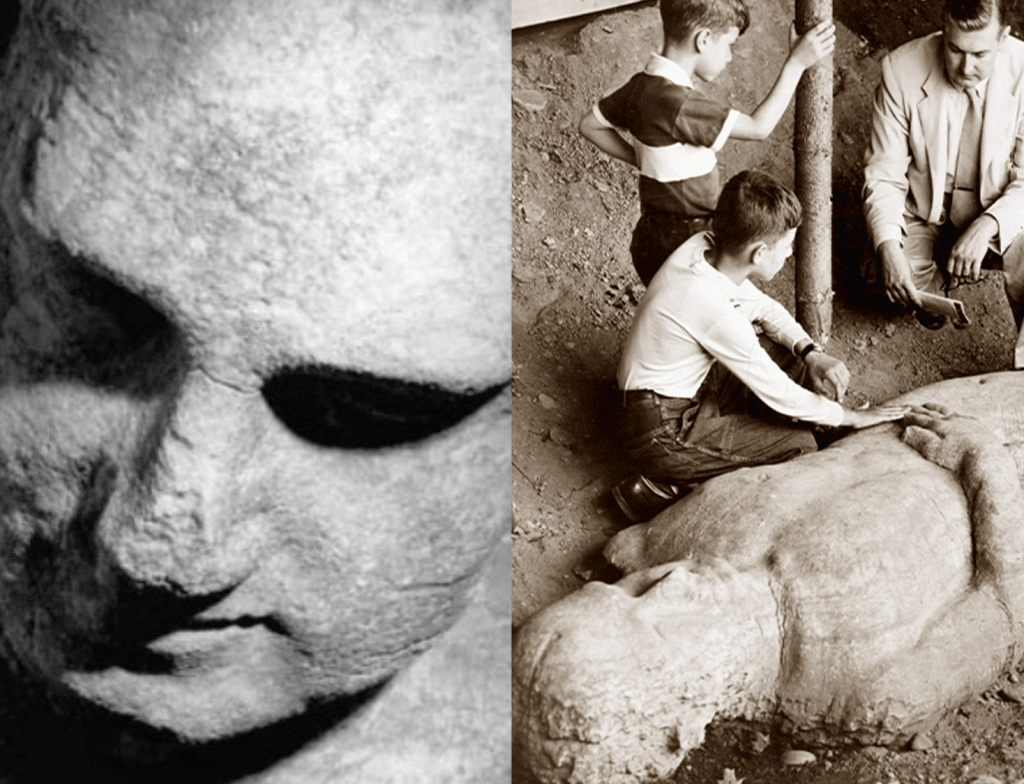
Imagine digging a well and discovering a stone figure more than ten feet tall buried beneath the ground.
That is exactly what appeared to happen on a farm in Cardiff, New York, in October 1869.
Two workers digging near a barn struck something solid. As they cleared away the soil, a huge stone foot emerged. Then came the legs, torso, arms, and head of what looked remarkably like a gigantic human being.
News spread almost overnight.
Visitors traveled to the farm by wagon and on foot, eager to see what newspapers were calling a possible petrified giant. Farmer William “Stub” Newell quickly realized that curiosity had commercial value. He covered the excavation with a tent and began charging admission.
The mystery seemed extraordinary.
There was only one problem.
The giant was not ancient.
It was not petrified.
And it had not been discovered by accident.
The entire spectacle had been carefully engineered by a man who understood exactly how powerful a good mystery could become.
How the Cardiff Giant Was “Discovered”
The supposed discovery took place on October 16, 1869.
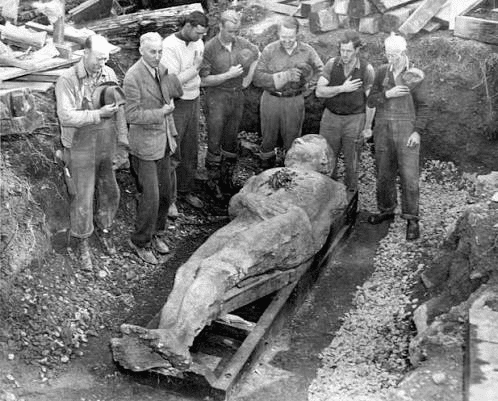
Gideon Emmons and Henry Nichols were working on a well near Newell’s barn when their tools struck the buried figure. After removing more soil, they uncovered a massive human-shaped object lying on its back.
The figure measured roughly ten feet long and weighed close to 3,000 pounds.
Its surface looked weathered and strangely organic. It had an expression carved into its face, detailed limbs, and markings that could be interpreted as pores or traces of hardened skin.
For people living in the 19th century, such an object could seem almost impossible to explain.
Was it a prehistoric human?
Had a gigantic person somehow been turned to stone?
Could ancient stories about giants have been based on real people?
Those questions were enough to bring crowds.
Newell initially charged a modest admission fee, reportedly beginning at 25 cents. As interest increased, the price rose to 50 cents.
Thousands came to see it.
And every visitor who paid helped make the hoax more successful.
George Hull Had a Very Different Story in Mind
The real story began almost two years before the supposed discovery.
George Hull, a New York cigar maker and tobacco dealer, had become involved in an argument with a religious revivalist while traveling in Iowa. The discussion reportedly centered on biblical references to giants.
Hull was skeptical of literal interpretations of those passages.
Then he had an unusual idea.
What if someone created a giant human figure and buried it?
Would people believe they had discovered an ancient giant?
Hull apparently believed they would.
More importantly, he realized that such a discovery could attract paying crowds.
That combination of skepticism and business opportunity became the foundation of one of America’s most famous hoaxes.
A Five-Ton Block Became a Ten-Foot Man
Hull obtained a massive block of gypsum from Iowa. Historical accounts say the material weighed around five tons.
He arranged for it to be transported to Chicago, where stoneworkers carved it into the shape of a gigantic human being.
The sculptors worked carefully enough to create something that looked less like a heroic statue and more like a strange, weathered body.
The figure was more than ten feet long.
Its limbs were positioned naturally.
Its face was deliberately understated.
Hull wanted something that could plausibly be mistaken for a body that had somehow become stone.
The project reportedly cost thousands of dollars—a considerable investment for a scheme whose success depended entirely on convincing strangers that the impossible had happened.
How the Hoax Made Fresh Gypsum Look Ancient
A newly carved statue would never have survived serious inspection.
Hull needed to make it appear old.
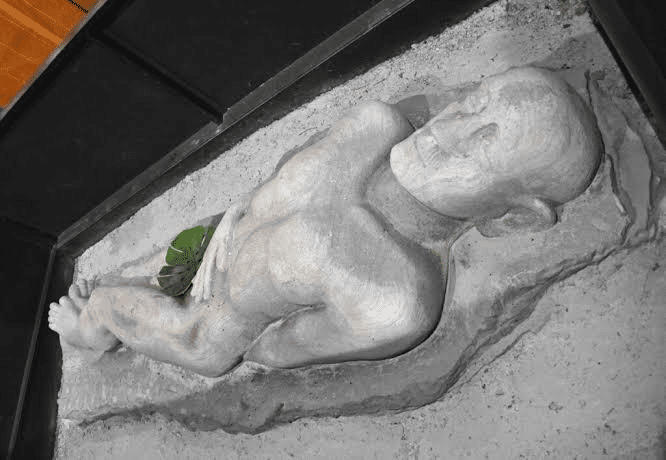
The surface was treated and altered to create the appearance of age and weathering. Fine marks were added to imitate the texture of skin, while chemicals helped roughen and discolor the gypsum.
The objective was simple: remove obvious signs of recent manufacture.
Then came the most important part.
The giant had to disappear.
Hull arranged for the enormous figure to be transported to the farm of William Newell, a relative and participant in the scheme. The statue was secretly buried near the barn in 1868.
The men packed earth around it and allowed the site to remain undisturbed for months.
That waiting period mattered.
Freshly disturbed soil could have exposed the deception. By leaving the statue underground for nearly a year, Hull created a much more convincing setting for the eventual “discovery.”
The location of the well was no coincidence, either.
The workers had unknowingly been directed toward the exact place where the giant had been planted.
What looked like a lucky accident was actually the final act of a carefully prepared performance.
Why Americans Were So Ready to Believe
The Cardiff Giant appeared at an ideal moment.
Americans were fascinated by geology, fossils, archaeology, religion, and new scientific discoveries. Newspapers regularly reported strange finds and debates about the origins of humanity.
Scientific knowledge was expanding rapidly, but most people did not have direct access to specialists.
That created fertile ground for unusual claims.
The giant sat right at the intersection of several popular interests.
Could it be evidence of an ancient civilization?
Could it support stories about giants?
Could some forgotten natural process have turned a human body into stone?
Video: The True Story Behind the Cardiff Giant
Nobody needed to have the same explanation.
They only needed to be curious.
And curiosity proved remarkably profitable.
The more people argued about the figure, the more people wanted to see it for themselves.
The controversy became part of the attraction.
Experts Quickly Began Finding Problems
Not everyone was convinced.
Some observers questioned the figure’s anatomy and surface markings. Others noticed characteristics that did not fit the idea of a naturally petrified human body.
One of the most influential skeptics was Yale paleontologist Othniel Charles Marsh.
After examining the giant, Marsh concluded that it was a modern creation rather than an ancient fossilized person.
He also pointed out a fundamental geological problem: gypsum would not have survived underground for the enormous period required by the story.
Other clues began to connect the supposed discovery to Hull.
Questions arose about why the well had been dug in that particular location.
People also began examining the giant’s unusual journey to New York and the financial relationships between the people involved.
As the evidence accumulated, the mystery became increasingly difficult to defend.
Eventually, Hull publicly acknowledged that the figure was a hoax.
The men who had carved it also confirmed their involvement.
The petrified giant was exposed.
But the story was nowhere near finished.
P. T. Barnum Turned One Hoax Into Another
Perhaps nobody understood the commercial possibilities of the Cardiff Giant better than showman P. T. Barnum.
Barnum reportedly attempted to acquire the original figure.
When its owners refused to sell, he found another solution.
He commissioned a replica.
Then he displayed his version as the “real” giant.
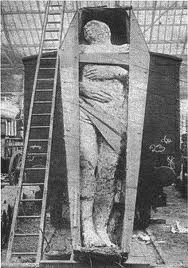
That created a wonderfully absurd situation: the original Cardiff Giant was a fake, Barnum’s version was also fake, and the two sides were effectively competing over which fake was genuine.
Legal disputes followed.
The story became even more popular because the public now had multiple giants to discuss.
Barnum understood something important about entertainment: sometimes the argument surrounding an attraction can be more valuable than the attraction itself.
The Cardiff Giant had already become famous.
Its exposure as a fraud did not erase its popularity.
Instead, the hoax became part of the show.
What Happened to the Original Cardiff Giant?
The original figure continued traveling after its deception became widely known.
Its identity changed from supposed archaeological wonder to famous American curiosity.
Over the years, ownership changed hands, exhibitions came and went, and the public fascination gradually shifted from “Is this real?” to “How did they fool so many people?”
Eventually, the giant found a permanent home in Cooperstown, New York.
Today, the figure is associated with The Farmers’ Museum, where visitors can see the enormous gypsum sculpture and learn about the story behind it.
Its meaning has changed completely.
In 1869, people paid to decide whether they were looking at an ancient giant.
Today, they visit because they already know the answer.
That transformation is part of what makes the object historically valuable.
The Empty Question Was the Real Attraction
The Cardiff Giant was never a scientific discovery.
It was a carefully constructed question.
What is this?
Where did it come from?
Could it really be ancient?
Those questions encouraged people to travel, argue, investigate, and pay admission.
Hull did not need everyone to believe the story.
He only needed enough people to wonder.
That may be the most enduring lesson of the Cardiff Giant.
A convincing mystery does not always depend on convincing evidence. Sometimes it depends on creating just enough uncertainty for people to want to see the answer with their own eyes.
The hoax also revealed something about 19th-century America. New discoveries were changing how people understood the natural world, while newspapers and traveling exhibitions were creating new ways to turn uncertainty into entertainment.
The giant became a perfect product of that era.
A Fake Giant That Became Real History
The Cardiff Giant began as a deception.
George Hull commissioned a gypsum statue, had it artificially aged, buried it on a farm, and arranged for unsuspecting workers to “discover” it.
Crowds arrived.
Money changed hands.
Newspapers spread the story.
Scientists questioned it.
And eventually, the truth emerged.
Yet the hoax did not disappear.
More than a century later, the Cardiff Giant remains one of America’s best-known examples of public deception.
Its strange journey tells us as much about people as it does about the man who created it. We are naturally drawn to mysteries, especially when they challenge what we think we know.
The figure was never a petrified human.
It was a sculpture.
But the sensation surrounding it was very real.
For a brief moment in 1869, thousands of people looked at a buried stone figure and wondered whether they were seeing evidence of a forgotten world.
They were actually seeing something much more familiar: human ingenuity, commercial ambition, and a perfectly staged illusion.
The giant was fake.
The curiosity was real.
And that was enough to make the Cardiff Giant part of American history.