Sometimes, the most extraordinary discoveries begin with the most ordinary purchases.
In 1989, a man browsing a flea market in Adamstown, Pennsylvania, came across a landscape painting that hardly seemed special. He wasn’t searching for a rare historical artifact or an important piece of Americana. In fact, the painting itself barely interested him.
The frame was what caught his attention.
At just four dollars, the purchase seemed like an easy bargain. He brought the painting home, intending to take the frame apart and perhaps use it for something else.
Then he discovered something hidden behind the canvas.
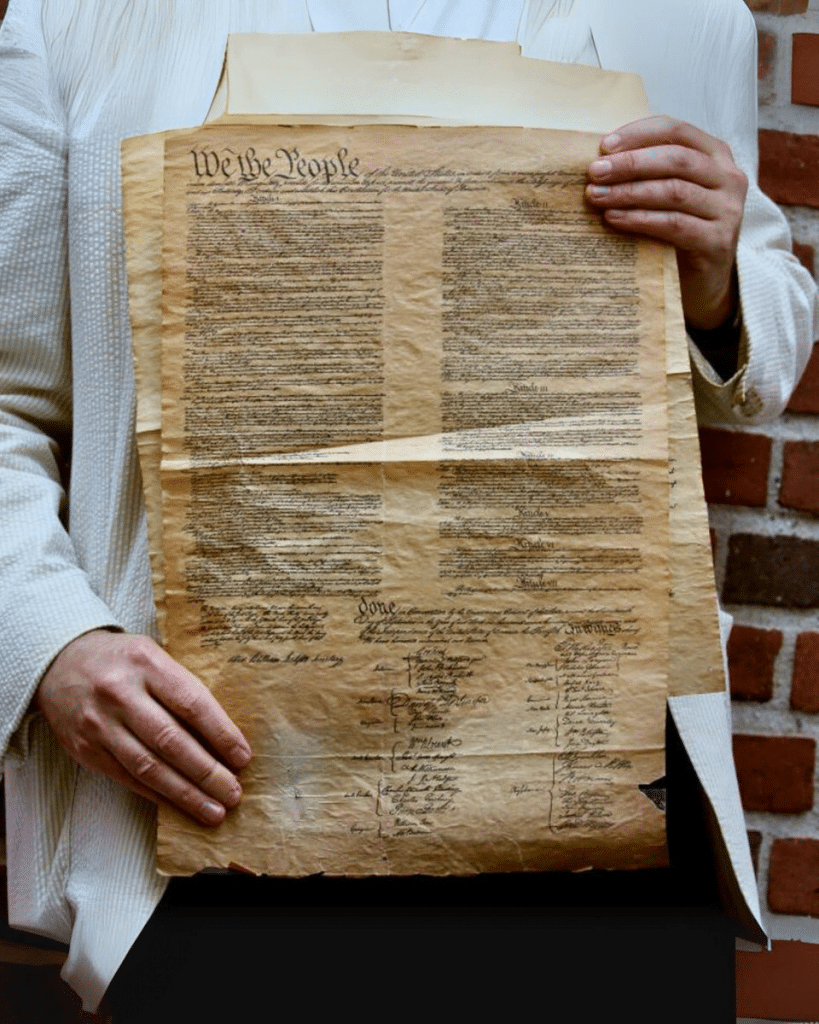
Folded against the backing was an old sheet of paper. It looked fragile and unremarkable at first. But when experts examined it, they realized the paper was anything but ordinary.
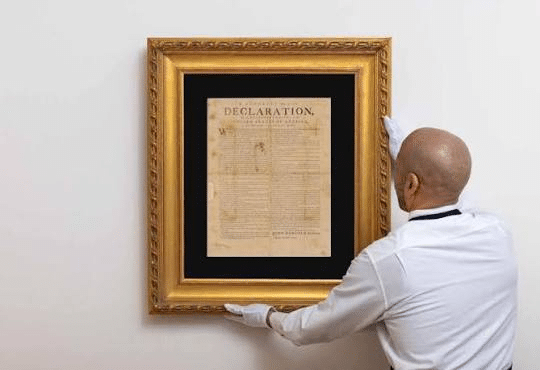
It was a rare Dunlap broadside of the Declaration of Independence—one of the earliest printed copies of America’s founding document.
More than a decade after the discovery, that forgotten sheet of paper sold for $2.42 million.
The man had paid four dollars.
The difference was extraordinary.
A Flea-Market Bargain With an Unexpected Secret
The painting that contained the document was reportedly a generic landscape. Nothing about its appearance suggested that something historically important had been concealed behind it.
That is precisely what makes the story so fascinating.
Flea markets often contain objects that have passed through estate sales, family homes, attics and storage rooms. Their histories can be almost impossible to reconstruct. An old frame might have been hanging in a farmhouse for decades before someone decides it is no longer wanted.
This particular frame became the unlikely hiding place for an eighteenth-century document.
When the buyer dismantled the painting, he found the folded sheet pressed against the back.
He could easily have thrown it away.
Instead, he looked closer.
That small decision changed everything.
What Was the Document Hidden Behind the Canvas?
The document turned out to be a Dunlap broadside, a term used for the first printed version of the Declaration of Independence.
The Continental Congress approved the Declaration in July 1776 and needed copies produced quickly. Philadelphia printer John Dunlap was tasked with printing the text for distribution.
Unlike the famous handwritten parchment now associated with the Declaration, these early printed sheets were created for immediate communication.
They carried news.
They were meant to travel.
And they helped spread the announcement that the American colonies had declared independence.
The copy discovered behind the Pennsylvania painting belonged to this exceptionally rare group of early printings.
Why the First Printed Copies Were So Important
Think about how quickly information travels today. A major announcement can reach millions of people in seconds.
In 1776, communication worked very differently.
There were no telephones, television broadcasts or digital networks. Printed sheets were among the fastest ways to distribute important news across the colonies.
Dunlap’s broadsides therefore served a practical purpose. They carried the Declaration beyond the walls of Congress and into the wider world.
Video: The $4 Declaration of Independence That Sold for $2.4 Million
George Washington’s troops, for example, encountered the Declaration through a printed copy.
That makes the surviving broadsides more than old pieces of paper. They are physical evidence of how Americans first received one of the most important announcements in the nation’s history.
Why So Few Dunlap Broadsides Survived
Historical estimates indicate that Dunlap produced roughly 200 copies in the initial printing.
That might sound like a large number.
It wasn’t.
Printed broadsides were working documents, not necessarily objects intended to survive for centuries. People read them, passed them around, posted them, folded them and eventually discarded them.
Paper is also remarkably vulnerable to time.
Fire, moisture, insects, careless storage and simple neglect can destroy documents that would otherwise survive for generations.
As a result, only a small number of Dunlap broadsides are known to have survived.
Most reside in prestigious institutional collections, including major libraries, universities and museums.
The Pennsylvania discovery was remarkable because the document had somehow escaped those established collections and spent generations hidden in an entirely ordinary frame.
How Experts Determined It Was Genuine
Finding an eighteenth-century document is one thing.
Proving that it is authentic is another.
A document claiming to be an original 1776 printing must survive intense examination. Experts can study its paper, printing characteristics, typography, dimensions, ink and physical condition. They can also compare it with authenticated surviving examples.
In the case of the Pennsylvania discovery, specialists determined that the document matched the characteristics expected of a genuine Dunlap broadside.
The discovery was therefore not simply an interesting old paper tucked behind a painting.
It was a genuine historical artifact.
And its rarity gave it enormous value.
From Four Dollars to $2.42 Million
The document eventually reached the auction market.
On June 13, 2000, it was sold by Sotheby’s for $2.42 million.
That figure transformed the flea-market discovery into one of the most memorable American treasure stories of its kind.
The contrast is almost impossible to ignore.
The buyer originally spent four dollars because he wanted the frame.
He had not set out to discover a Revolutionary-era document.
He had not visited the flea market with a historian’s eye.
He simply saw something inexpensive that might be useful.
Years later, the hidden document became a multimillion-dollar artifact.
The story demonstrates an important truth about historical collecting: an object’s value may have very little to do with how it looks at first glance.
A faded sheet of paper can be more important than a beautiful painting.
A battered frame can conceal something priceless.
And an ordinary flea-market purchase can occasionally open a window into the past.
Video: Dunlap Broadside, the First Printing of the Declaration of Independence
The Declaration People Remember Wasn’t the First Copy
There is another fascinating detail behind the story.
When most Americans picture the Declaration of Independence, they imagine the large handwritten parchment displayed at the National Archives.
That document is enormously important, but it was not the first version created.
The parchment engrossed copy was prepared later in the summer of 1776.
The Dunlap broadside came much earlier.
These printed sheets were produced immediately after Congress approved the Declaration so that the news could spread.
In that sense, a Dunlap broadside represents the Declaration as Americans first encountered it.
It wasn’t yet a carefully preserved national treasure.
It was news.
It was a message.
It was something meant to be read aloud, circulated and shared.
That everyday purpose makes surviving examples especially powerful.
A Document That Nearly Disappeared Into an Ordinary Frame
Perhaps the most remarkable part of the story isn’t the auction price.
It is how easily the document could have been lost.
Imagine the painting changing hands several more times. Imagine someone throwing the frame away during a house cleaning. Imagine the paper remaining folded and forgotten for another generation.
History might never have known where it went.
Instead, one buyer decided to take the painting apart.
That simple act revealed something that had been hidden for generations.
The document had survived because someone, at some point, placed it behind the canvas. We don’t know exactly why. Perhaps it was stored there for safekeeping. Perhaps someone simply used the frame as a convenient hiding place.
Whatever the reason, the decision accidentally created a time capsule.
Why the Discovery Still Captures the Imagination
Treasure stories usually involve dramatic searches: buried gold, lost ships, secret maps or forgotten vaults.
This story is different.
There was no treasure map.
There was no expedition.
There wasn’t even a deliberate search.
There was a four-dollar purchase at a flea market.
That ordinary beginning makes the discovery feel wonderfully American. It is a story about curiosity, luck and the possibility that something overlooked may carry a history far greater than its appearance suggests.
The buyer saw value in an old frame.
Behind that frame was a document connected directly to the birth of the United States.
And suddenly, a discarded-looking piece of paper became one of the most valuable historical documents to emerge from an everyday American marketplace.
A Four-Dollar Purchase That Opened a Door to 1776
The story of the Pennsylvania flea-market discovery is ultimately about more than money.
Yes, a four-dollar purchase eventually led to a $2.42 million auction result. But the real significance lies in what the document represented.
The Dunlap broadside belonged to the first wave of printed copies that carried the Declaration of Independence beyond Congress and into the wider colonies. It survived wars, generations, changing families and centuries of ordinary wear before ending up behind a painting that almost nobody considered valuable.
For years, it remained silent and unseen.
Then one person decided to look behind the canvas.
That small moment brought an extraordinary piece of America’s founding story back into view.
The painting may have been worth only four dollars.
The frame may have been the only thing the buyer wanted.
But hidden behind it was a piece of 1776—and a reminder that sometimes history doesn’t sit behind museum glass. Sometimes, it waits quietly in the most ordinary places, hoping someone will take a second look.