For years, an enormous painting sat quietly in the television room of a family home in northern France.
It wasn’t hanging proudly above a fireplace. It wasn’t displayed beneath special lighting. It wasn’t protected behind museum glass.
Instead, much of the canvas remained hidden behind an open door.
The family believed the old painting was probably a copy. It had been in their possession for generations, but nobody had recently examined it closely enough to question that assumption.
Then auctioneer Malo de Lussac came to inspect the family’s belongings.
One glance changed everything.
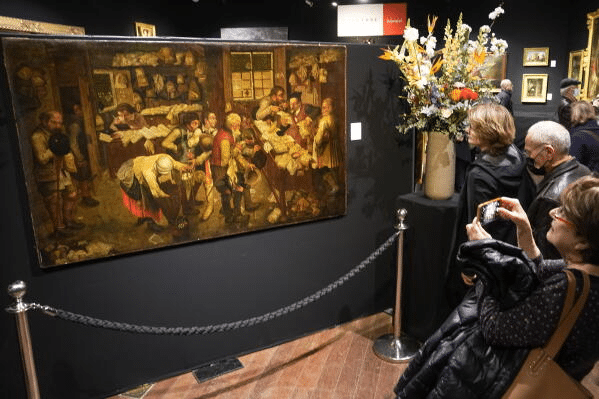
What appeared to be an ordinary old painting turned out to be a remarkable work associated with Pieter Brueghel the Younger, the celebrated Flemish artist of the early 17th century.
After extensive examination and authentication, the painting went to auction in Paris.
It sold for €780,000, roughly $845,000 at the time.
How could something so valuable remain hidden in an ordinary family home for so long?
A Valuable Old Master Was Hiding in Plain Sight
The painting was large enough that hiding it should have been difficult.
It measured approximately 112 by 184 centimeters, or about 44 by 72 inches. Yet because a door covered much of the canvas, anyone entering the room could see only part of the composition.
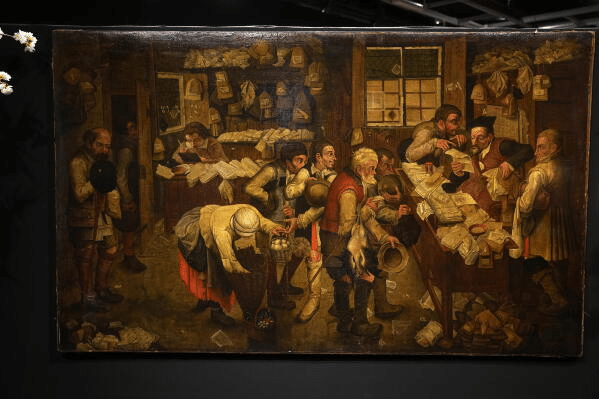
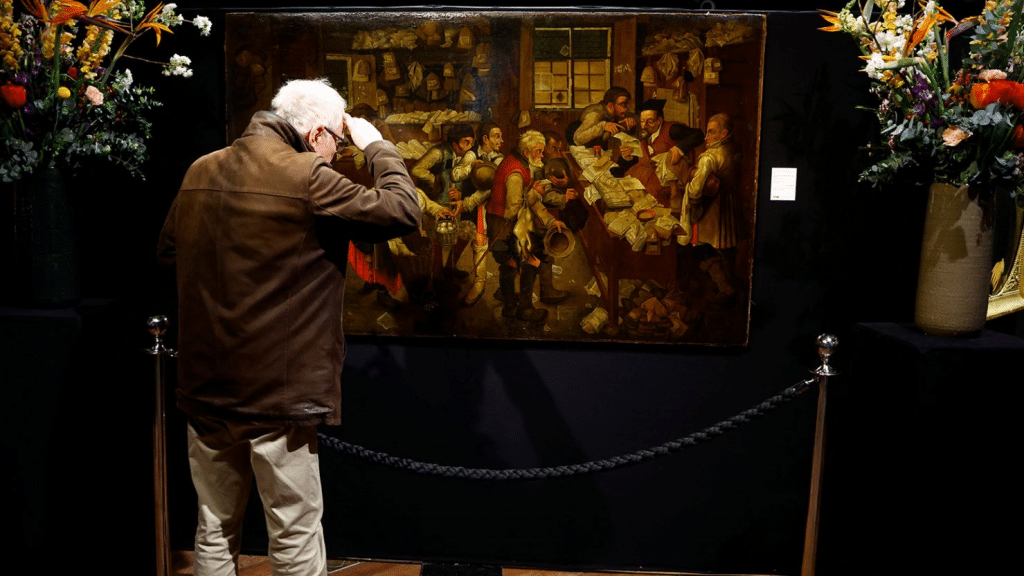
The painting depicted a busy rural office filled with villagers waiting before a seated legal official. People carried documents and small offerings, including eggs and poultry.
The scene is generally known as The Village Lawyer, although art historians have also used titles such as The Payment of the Tithe, The Tax Collector’s Office and The Notary’s Office.
The subject itself provided an important clue.
Brueghel the Younger painted multiple versions of similar scenes, and other examples survive in museums and private collections. The composition was therefore familiar to specialists.
But this particular canvas had something unusual.
Its enormous scale.
The larger format allowed the artist to include remarkably fine details. Faces, clothing, gestures and even small signs of everyday rural life became visible across the crowded composition.
Some figures appear anxious or apprehensive, while others seem absorbed in their dealings with the official.
It wasn’t simply a busy painting.
It was a carefully observed snapshot of social life.
Why the Family Thought It Was Only a Copy
The family’s mistake was understandable.
The painting had reportedly been in the family since around 1900. Over the generations, its history became increasingly unclear.
Earlier relatives apparently regarded it as an original Brueghel, but that understanding gradually faded. Later family members continued referring to it as “the Brueghel,” yet they no longer believed the name represented an authentic attribution.
Instead, they assumed the painting was a reproduction or imitation.
Why?
Because Brueghel the Younger produced numerous versions of successful compositions. His workshop was highly productive, and copies, workshop paintings and later imitations can make attribution extremely complicated.
A painting that resembles a famous Old Master does not automatically mean the master himself painted it.
That distinction matters enormously in the art market.
A genuine work by a major artist can be worth hundreds of thousands or millions of dollars. A later copy of the same composition may be worth only a fraction of that amount.
For the French family, there was no obvious reason to challenge the old assumption.
The canvas had simply become part of the furniture.
Then an auctioneer walked into the room.
The Appraiser Who Looked Past the Door
Malo de Lussac was inspecting the family’s possessions when he noticed the painting.
At first, he could see only part of it.
The open door blocked roughly two-thirds of the canvas, creating an accidental curtain over the artwork. But the section that remained visible caught his attention.
Something about the composition didn’t look ordinary.
The crowded scene, the expressive figures and the quality of the brushwork suggested that the painting deserved closer examination.
De Lussac did not immediately declare it an authentic Brueghel. That would have been premature.
Instead, he recognized a possibility.
The painting needed experts.
And that decision started a chain of events that would eventually transform an overlooked household object into a major Old Master discovery.
The Details That Raised Questions
Several features stood out during the initial examination.
The subject matched a known Brueghel composition.
The execution appeared sophisticated.
The large dimensions were unusual.
And the painting had survived in surprisingly good condition considering its presumed age.
Video: Lost Brueghel painting to be auctioned
The visible details were particularly important. The villagers were not treated as generic figures. Their expressions, clothing and gestures were rendered with the kind of observation associated with skilled early 17th-century painting.
The painting also appeared to preserve characteristics associated with early versions of The Village Lawyer.
None of these clues could prove the artist’s identity individually.
Together, however, they created a compelling reason to investigate.
Experts Put the Painting Through a Serious Examination
The discovery did not immediately make the canvas worth hundreds of thousands of dollars.
First, specialists had to determine whether the attribution could withstand scrutiny.
The painting was examined in Paris by experts associated with Cabinet Turquin, including Éric Turquin and Old Master specialist Stéphane Pinta.
Their analysis suggested that the work possessed qualities consistent with Pieter Brueghel the Younger.
But the investigation went further.
The canvas was sent to Germany for examination by Klaus Ertz, a leading Brueghel specialist whose research and cataloging work has helped establish the identity and chronology of the artist’s paintings.
Ertz confirmed the attribution in December 2022.
That confirmation was crucial.
The art market depends heavily on expert scholarship. A painting can look convincing to the untrained eye, but questions about authorship require comparisons with known works, materials, technique, composition and historical context.
In this case, specialists compared the newly discovered canvas with other versions of the same scene.
They studied details that might seem insignificant to a casual observer.
A garment.
A background element.
A particular arrangement of figures.
Video: Brueghel — Sale Highlight
Even changes to decorative features could help establish where the painting belonged within Brueghel’s development of the composition.
The Painting Revealed Clues About Its Date
Experts placed the work around 1615 to 1617.
That dating was important because Brueghel repeatedly returned to the Village Lawyer theme during this period.
The versions were not identical.
Small changes appeared over time.
For example, later examples changed certain background details and altered elements of the clothing worn by some figures. The newly examined canvas retained characteristics associated with an earlier stage of the composition.
Its enormous dimensions also attracted attention.
Only one other recorded example was reported to have exactly the same large measurements.
The support presented another interesting question. The work was painted on canvas, which was less typical for some versions of this subject, requiring specialists to consider how its physical construction related to known examples.
This is where art authentication becomes more like detective work than simple visual recognition.
Experts weren’t asking only, “Does this look like Brueghel?”
They were asking a much more complicated question:
Does every piece of evidence make sense if Brueghel the Younger actually painted it?
In this case, the evidence ultimately supported that conclusion.
From a Family Wall to a Paris Auction
Once the attribution had been established, the painting entered a completely different world.
It was no longer an old household canvas with an uncertain history.
It was presented as an authenticated work by Pieter Brueghel the Younger.
The auction house Daguerre offered it at Hôtel Drouot in Paris on March 28, 2023.
The pre-sale estimate ranged from €600,000 to €800,000.
That estimate alone would have been astonishing compared with the family’s original understanding of the painting.
But the final result landed comfortably within the predicted range.
Bidding reached €780,000, equivalent to approximately $845,000 at the time.
The buyer was identified as a collector from Switzerland.
For the family, the transformation was extraordinary.
The painting had spent decades in a domestic room where its true importance remained largely unnoticed. The open door had literally concealed much of the image, while the family’s assumption that it was merely a copy concealed something even more valuable: its artistic identity.
The Real Value Was Hidden in Its History
It is tempting to focus entirely on the final price.
After all, turning an overlooked painting into an $845,000 auction result makes for an irresistible story.
But the real significance goes deeper.
The painting represents the way historical objects can become detached from their original identities.
Generations can inherit an artwork without knowing who made it. A frame can be moved from one room to another. A family story can gradually change. A once-important attribution can become little more than a nickname.
And sometimes, nobody asks the right question for decades.
The painting behind the door demonstrates why provenance and expert scholarship matter so much in the art world.
The canvas itself didn’t suddenly become better in 2023.
The brushwork didn’t magically improve.
The figures had always been there.
The colors had always been there.
The historical clues had always been embedded in the paint.
What changed was that someone finally looked closely enough to recognize them.
An Old Painting Finally Stepped Into the Light
The story began with a canvas that seemed almost too ordinary to investigate.
It had spent generations in a French family home. Much of it remained hidden behind a door. Its owners believed it was probably a copy.
Then an auctioneer noticed something unusual.
Specialists examined the work.
Comparisons with known Brueghel paintings followed.
The attribution was confirmed.
And suddenly, a forgotten household painting became an important Old Master discovery.
When it sold for €780,000, or roughly $845,000, the result provided a remarkable ending to a story that began with an artwork hiding in plain sight.
The lesson is almost poetic.
Sometimes history doesn’t disappear completely. Sometimes it simply waits behind a door, covered by dust and overlooked by generations, until someone finally stops and takes a closer look.