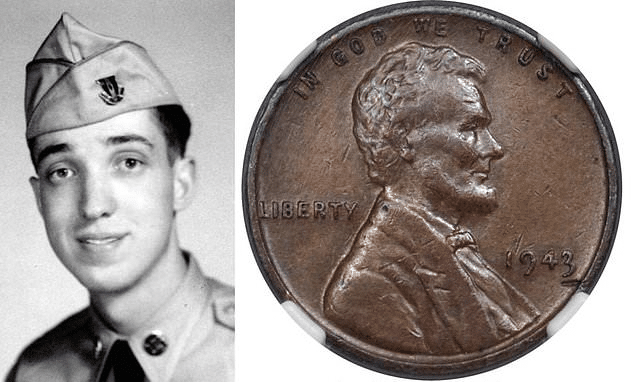
In 1947, 16-year-old Don Lutes Jr. received a handful of ordinary change at his high school cafeteria in Pittsfield, Massachusetts.
One penny immediately caught his attention.
It didn’t look like the other pennies from the same period. Instead of the pale, silvery appearance of the wartime steel cents circulating in 1943, this coin had the familiar reddish-brown color of copper.
Lutes was already interested in coins, so he didn’t spend it.
That small decision changed the story of an otherwise ordinary school lunch.
More than seven decades later, the unusual penny sold for $204,000 at auction.
How could one cent become worth more than two hundred thousand dollars?
The answer was hiding in the metal.
Why the 1943 Penny Looked So Strange
To understand why Lutes noticed the coin, you have to go back to World War II.
During 1943, the United States Mint made an unusual change to the Lincoln cent. Copper had become strategically important to the war effort, with large quantities needed for military equipment, ammunition and communications materials.
So the Mint temporarily replaced the traditional bronze composition with zinc-coated steel.
The result was unmistakable.
Instead of the familiar copper-brown penny Americans knew, the new 1943 cents looked gray or silver-colored. Collectors eventually nicknamed them “steelies.”
Lutes had seen enough of them to recognize the difference.
His new coin looked wrong.
It had the correct 1943 date, but its reddish appearance suggested that it had been struck on bronze rather than steel.
That seemingly minor observation became the key to identifying one of the most famous American coin errors.
The Bronze Planchet That Shouldn’t Have Been There
A coin’s blank metal disk is called a planchet.
For most 1943 Lincoln cents, the planchet was steel coated with zinc. But a small number of bronze planchets from the previous year’s production apparently remained inside Mint equipment.
According to the accepted explanation, some leftover bronze blanks became trapped in machinery or containers used to move planchets through the production process.
When the Mint switched to steel blanks, those bronze pieces were not immediately noticed.
Eventually, a few apparently entered the presses.
The coin dies didn’t care what metal sat beneath them.
They stamped the familiar Lincoln cent design onto the bronze planchet just as they would have stamped a steel one.
The result was an extraordinary mistake: a 1943 Lincoln cent struck on bronze.
It was an ordinary production process producing an extraordinarily rare outcome.
A Tiny Manufacturing Error With Huge Consequences
The mistake was easy to overlook because the resulting coin looked perfectly normal apart from its color and weight.
It still carried the familiar portrait of Abraham Lincoln.
It still displayed the 1943 date.
It still looked like a penny.
But underneath the design was the wrong metal.
That distinction turned an everyday coin into a major numismatic rarity.
A genuine bronze 1943 cent weighs about 3.11 grams, while the standard steel version weighs considerably less.
The composition also provides an important clue. A genuine bronze example does not behave like a steel cent when tested with a magnet.
Video: 1943 Bronze Cent Discovery – Don Lutes Jr
Of course, appearance alone cannot establish authenticity.
Copper-colored coins can be altered, plated or otherwise manipulated. That’s why professional authentication remains essential when a potentially rare 1943 bronze cent turns up.
Don Lutes Didn’t Spend His Mysterious Penny
After receiving the coin in his cafeteria change, Lutes began investigating.
He had already learned that 1943 pennies were supposed to look different from traditional copper cents. So why did his coin appear to be made of bronze?
His curiosity led him into the world of coin collecting and eventually toward an unusual rumor.
Stories circulated that Henry Ford would reward anyone who discovered a genuine 1943 copper penny with a new automobile.
Lutes contacted Ford and learned that the supposed offer was not real.
He also contacted the U.S. Treasury.
The response was equally interesting: officials maintained that 1943 cents had been produced using zinc-coated steel.
But Lutes still had the strange coin in his possession.
Rather than dismissing it, he kept it.
That patience proved enormously valuable.
Experts Eventually Confirmed the Coin Was Genuine
Lutes took the penny to a coin convention in Worcester, Massachusetts, in 1958.
There, prominent numismatist Walter Breen examined the piece and identified it as a genuine 1943 bronze cent.
That recognition gave the coin a place in the numismatic record.
Over the years, the penny appeared in specialist publications and exhibitions. Its history remained unusually compelling because Lutes could explain exactly how he had obtained it.
The story wasn’t simply that someone discovered a rare coin.
He had found it in school lunch change in 1947, recognized that something seemed unusual and then preserved it for decades.
That kind of provenance can make an already rare coin even more interesting to collectors.
It creates a direct link between the physical object and the moment when someone first realized that it didn’t belong.
Why Genuine 1943 Bronze Cents Are So Rare
The rarity of these coins is what drives their extraordinary value.
The U.S. Mint produced enormous quantities of 1943 steel cents, but only a tiny number of bronze planchets apparently slipped through the production process.
The surviving population is generally estimated in small numbers rather than hundreds or thousands.
Some known examples came from Philadelphia, while others are associated with the San Francisco and Denver Mints.
That scarcity creates a powerful combination for collectors:
historical significance + manufacturing error + extreme rarity + authentication.
Think about it this way.
Millions of ordinary 1943 cents tell us about America’s wartime economy. But a genuine bronze example tells a much smaller story: the moment when the Mint’s carefully controlled material change failed in a tiny but unforgettable way.
Collectors aren’t simply buying a penny.
They’re buying physical evidence of a production mistake that happened during one of the most consequential periods in American history.
The Coin’s Journey to a Six-Figure Auction
Lutes kept his famous penny for the rest of his life.
He died in September 2018, and the coin eventually entered the Heritage Auctions January 2019 FUN U.S. Coins Signature Auction in Orlando, Florida.
Before the sale, Heritage estimated its value at approximately $170,000.
The final result went even higher.
More than 30 bids pushed the price to $204,000 on January 10, 2019.
The buyer was identified as Massachusetts collector Tom Caldwell, who said he intended to display the historic coin at coin shows.
The result demonstrated just how strongly collectors valued the coin’s rarity and documented history.
The penny was not valuable because it was old.
Plenty of old coins are relatively inexpensive.
It was valuable because almost everything about its existence was unusual.
It was the wrong metal.
It came from a year when that metal was not supposed to be used.
Very few examples survived.
And this particular specimen had an extraordinary discovery story attached to it.
A School Cafeteria Became the Starting Point of a Numismatic Mystery
There’s something wonderfully ordinary about the beginning of this story.
Video: The 1943 Coin Found In Lunch Money Change Made This Guy A Millionaire | U.S. Mint’s Costly Mistake
Lutes wasn’t searching through a historic collection.
He wasn’t exploring an old estate.
He wasn’t attending a major coin auction.
He was simply receiving change after buying food at school.
Most people would have spent the penny without a second thought.
Lutes looked twice.
That second look made all the difference.
The coin eventually became known as the “Discovery Specimen”, reflecting its importance within the history of 1943 bronze cents.
Its story also carried a personal connection to Pittsfield. Lutes directed the auction proceeds to the Berkshire Athenaeum, the public library where he had been active.
So the coin’s final chapter wasn’t simply about money.
It was also about returning something valuable to the community connected to the person who first recognized it.
What the $204,000 Penny Teaches Us
The story of Don Lutes Jr.’s penny is a reminder that extraordinary objects don’t always announce themselves.
Sometimes they look completely ordinary.
A coin can sit unnoticed in a pocket.
A painting can hang behind a door.
A document can remain forgotten inside a drawer.
The difference often comes down to whether someone notices the detail that doesn’t quite fit.
In Lutes’ case, that detail was color.
The 1943 cents around him were gray steel.
His penny was copper-colored.
That small inconsistency led him to investigate, preserve the coin and eventually establish its authenticity.
More than 70 years later, collectors placed a value of $204,000 on that discovery.
Conclusion: One Small Coin, One Remarkable Mistake
The 1943 bronze Lincoln cent represents one of the most fascinating errors in American coinage.
During World War II, the U.S. Mint switched from bronze to zinc-coated steel to conserve copper. Yet a handful of bronze planchets apparently remained in the production system and were accidentally struck with the 1943 Lincoln cent design.
Don Lutes Jr. happened to receive one in his school cafeteria change in 1947.
Instead of spending it, he questioned why it looked different.
That curiosity led to decades of preservation, professional recognition and eventually a remarkable auction result.
When the coin sold for $204,000 in 2019, it proved that value isn’t always obvious at first glance.
Sometimes, the most valuable thing in your pocket is the thing that looks just a little bit wrong.