For decades, stories about governments secretly staging attacks have often been dismissed as conspiracy fiction.
Then one document emerged from the Cold War archives.
It described plans involving manufactured incidents, simulated attacks and carefully constructed provocations that could have been used to create public support for military intervention against Cuba.
The document was real.
It was not written by a fringe group, an anonymous blogger or a fictional screenwriter. It came from the Joint Chiefs of Staff, the highest-ranking military leadership in the United States, and was submitted to Secretary of Defense Robert McNamara in March 1962.
The proposal became known as Operation Northwoods.
But there is an important distinction that often disappears in online retellings: the document records a proposal, not an operation that was actually carried out.
That difference changes the entire story.
What Was Operation Northwoods?
Operation Northwoods emerged during one of the most tense periods of the Cold War.
The United States was determined to weaken or remove Fidel Castro’s communist government in Cuba. The failed Bay of Pigs invasion in 1961 had badly damaged American credibility, while Washington continued searching for ways to pressure Castro.
Against that background, military planners considered how a future intervention might be justified publicly.
The March 13, 1962 memorandum was titled “Justification for US Military Intervention in Cuba.”
Its authors proposed creating incidents that could make Cuba appear responsible for attacks against American interests.
The suggestions were extraordinary.
Among the scenarios were simulated attacks on U.S. military installations at Guantánamo Bay, manufactured incidents at sea and staged violence that could be blamed on the Cuban government.
One proposal even discussed creating the appearance of a Cuban terror campaign in the United States.
Video: The Operation Northwoods Conspiracy, Explained
Another suggested staging the destruction of a remotely controlled aircraft while creating false documentation indicating that it had carried American civilians.
The objective was straightforward: create an event dramatic enough to generate public outrage and provide a political justification for military intervention.
Reading the language today, it sounds like something written for a Cold War thriller.
It wasn’t.
Why Senior Military Officials Considered Such a Plan
To understand Northwoods, you have to step into the political atmosphere of early 1962.
The United States and the Soviet Union were engaged in an intense global confrontation. Cuba had become a particularly dangerous point of tension because Castro’s government had aligned itself with Moscow.
The Bay of Pigs disaster had also created enormous frustration inside Washington.
The CIA-backed invasion had collapsed quickly. Castro remained in power, and the Kennedy administration faced criticism over the failed operation.
At the same time, Operation Mongoose was already underway.
Mongoose was a broader campaign designed to undermine the Cuban government through covert action, economic pressure, propaganda and sabotage. Some assassination plots against Castro were also pursued during this period.
Northwoods belonged to that larger environment.
The military was thinking about what circumstances might make direct intervention politically possible.
That does not make the proposal acceptable. It does, however, explain how such a document could emerge from an official planning process.
The Man Who Signed the Proposal
The memorandum carried the authority of General Lyman Lemnitzer, then Chairman of the Joint Chiefs of Staff.
That detail matters.
Lemnitzer was not an obscure officer acting independently. He was the senior uniformed military officer in the United States.
The proposal therefore tells us something uncomfortable about the institutional thinking of the period.
Ideas involving deception and manufactured justification had entered a formal planning environment.
But the chain of command did not end with the Joint Chiefs.
The proposal still required approval from civilian leadership.
And that approval never came.
The Most Important Fact: Northwoods Was Rejected
This is the part that frequently disappears when the document is discussed online.
Operation Northwoods was not implemented.
The memorandum proposed scenarios. It did not authorize them.
President John F. Kennedy rejected the framework, and Secretary of Defense Robert McNamara did not approve the recommendations.
That distinction is essential.
A military document can contain a proposed operation without that operation ever becoming reality.
Think of it like a blueprint that never becomes a building. The blueprint can tell you exactly what someone wanted to construct, but it cannot prove that the building was ever erected.
Northwoods works the same way.
The document proves that senior officials considered these ideas.
It does not prove that the staged attacks actually happened.
What Operation Mongoose Really Did
The confusion becomes even greater because another Cuba operation really did take place.
Operation Mongoose involved genuine covert activities against Castro’s government.
These included sabotage, propaganda and assassination-related planning.
Those activities are documented in historical records.
But they should not be confused with the specific Northwoods scenarios.
A real sabotage operation does not prove that a separate false-flag attack occurred.
The distinction may sound obvious, but it becomes extremely important when historical documents are used to support much broader claims.
Northwoods demonstrates that senior officials proposed manufactured incidents.
Mongoose demonstrates that the United States actually conducted covert operations against Cuba.
Those are both troubling historical facts.
But they are not the same fact.
How the Secret Document Became Public
For decades, the Northwoods memorandum remained classified.
That changed during the wave of government document releases connected with the assassination of President Kennedy.
Congress created the Assassination Records Review Board in the 1990s to oversee the release of previously classified material related to the Kennedy assassination.
During that process, the Northwoods memorandum became available to researchers.
The National Security Archive at George Washington University subsequently published the document, helping bring it to a much wider audience.
Journalist James Bamford also discussed the memorandum extensively in his 2001 book Body of Secrets.
Once researchers could examine the original material, the story spread quickly.
The document’s bureaucratic language made it particularly striking.
There was no dramatic villain speaking in secret code.
There were formal headings, recommendations and operational concepts written in the restrained language of military planning.
That contrast made the contents even more disturbing.
The Document Contains Some Truly Extraordinary Suggestions
The proposals are difficult to read precisely because they were so specific.
Video: The Day the Pentagon Proposed Bombing Miami to Justify War
Rather than merely suggesting that Cuba be blamed for an incident, the memorandum considered ways to manufacture convincing evidence.
The scenarios included simulated attacks against American targets, false records and staged incidents involving aircraft and civilians.
The planners were thinking not only about creating an event but also about creating the evidence and public reaction surrounding it.
That is what makes Northwoods historically significant.
It demonstrates that officials were not merely discussing abstract deception. They were considering practical mechanisms for creating a believable pretext.
Yet again, the historical record draws a hard line.
The proposals remained proposals.
There is no verified operational record showing that the Northwoods scenarios were executed.
What Happened to General Lemnitzer?
Lemnitzer’s career after the memorandum has sometimes become part of the legend surrounding Northwoods.
He was replaced as Chairman of the Joint Chiefs later in 1962 and eventually became Supreme Allied Commander Europe.
Some accounts suggest that Kennedy’s dissatisfaction with military leadership contributed to the decision.
But historians should be careful here.
There is no simple documentary statement proving that Kennedy removed Lemnitzer specifically because he rejected Northwoods.
The broader relationship between Kennedy and the military leadership was complicated, particularly after the Bay of Pigs.
So while the timing is interesting, the claim that Northwoods directly caused Lemnitzer’s reassignment should be treated as an interpretation rather than an established fact.
That distinction is important whenever a fascinating historical detail begins to grow into a larger story.
What the Northwoods Document Does Not Prove
The authenticity of the memorandum is not the controversial part.
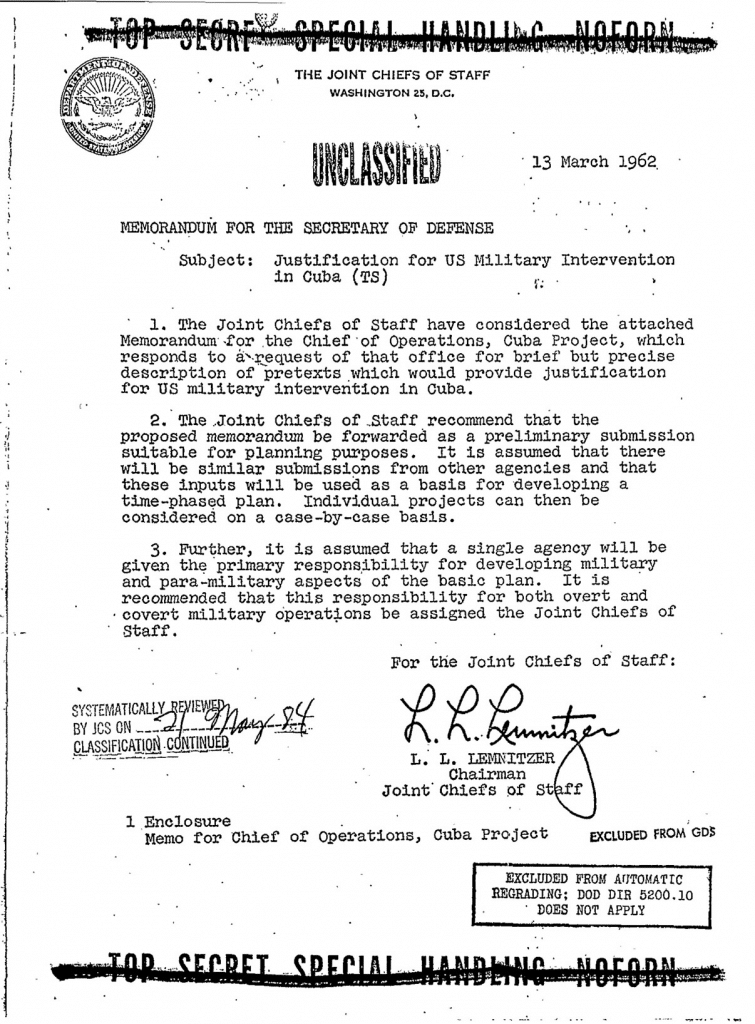
The document is genuine.
The problem begins when people use it as evidence for events it does not actually describe.
For example, some internet discussions have attempted to connect Northwoods with the September 11, 2001 attacks.
The reasoning usually follows a simple pattern:
Officials once proposed staged attacks in 1962, therefore later attacks could also have been staged by the government.
But the first statement does not establish the second.
The Northwoods document contains no connection to 2001. It was written nearly four decades earlier, rejected by civilian leaders and never accompanied by evidence tying it to later events.
A historical document must be interpreted within its own evidence.
Otherwise, almost any old proposal can be transformed into proof of something unrelated simply because the idea appears similar.
A Real Document Still Needs a Careful Reading
There is another danger.
People sometimes assume that because some government records remain classified or incomplete, any theory about what happened behind closed doors becomes equally plausible.
It doesn’t.
Missing information creates uncertainty.
It does not automatically confirm the most dramatic explanation.
That principle matters particularly with Cold War history, where intelligence agencies routinely classified sensitive material and some records were later destroyed or heavily redacted.
Researchers must work with what survives.
In the case of Northwoods, the surviving evidence clearly establishes the proposal.
It does not establish implementation.
Why the Story Became So Powerful Online
Northwoods arrived in the public consciousness at an interesting moment.
Bamford’s Body of Secrets was published in 2001, only months before the September 11 attacks.
After 9/11, interest in historical government deception increased dramatically.
People searching for evidence that governments had previously considered staging attacks encountered a genuine document that seemed to confirm exactly that fear.
The emotional impact was enormous.
And it is easy to understand why.
Most people would assume that a proposal involving manufactured attacks on American targets could exist only in fiction.
Then they discover that something remarkably similar really was written by senior military officials.
But the most interesting historical lesson is actually more complicated.
The document proves that government officials can contemplate morally extraordinary actions.
It also proves that those proposals can be rejected.
Both facts matter.
Why the Rejection Is Just as Important as the Proposal
It is tempting to focus entirely on the shocking content of Northwoods.
But the rejection is equally important.
The document demonstrates that the military leadership proposed something extreme and that civilian authority ultimately refused to authorize it.
That tells us something important about the structure of American government during the Cold War.
Military planners could recommend.
Civilian leaders could reject.
The chain of command mattered.
The story therefore isn’t simply about what officials were willing to imagine.
It is also about what the political system ultimately refused to permit.
That is a much more complicated—and historically useful—lesson than the simplified version often seen online.
The Real Mystery Isn’t Whether the Document Existed
There is no serious historical mystery about whether Operation Northwoods was real.
The memorandum exists.
It was produced by senior military officials.
It was submitted in 1962.
It proposed manufactured incidents that could have been used to justify intervention against Cuba.
And it was rejected.
The unresolved questions lie elsewhere.
Why did military planners believe such proposals were worth presenting?
How much influence did this kind of thinking have on broader Cold War policy?
What other proposals from the same era remain classified?
Those are legitimate historical questions.
But they should not be answered by assuming that every frightening proposal became an operation.
Conclusion: The Document Was Real, but the Operation Wasn’t
Operation Northwoods remains one of the most unsettling documents to emerge from the Cold War archives.
Its authenticity is not in serious doubt.
Senior U.S. military officials really did submit a memorandum proposing manufactured incidents that could have created public support for military intervention in Cuba. The suggested scenarios were extraordinary, and the bureaucratic language makes them even more striking.
But there is an equally important second half to the story.
The plan was rejected.
There is no verified evidence that the proposed false-flag incidents were carried out. The existence of Operation Mongoose and its genuine covert activities does not change that conclusion.
The document therefore deserves neither dismissal nor exaggeration.
It should be read for what it actually reveals: a disturbing moment in Cold War planning when senior military officials considered ideas that sound almost unbelievable today—and a civilian leadership that ultimately refused to authorize them.
The most remarkable part may be that both facts survived in the historical record.
The proposal was real.
The conspiracy-fiction-sounding language was real.
But the operation described in those pages never became reality.