What if the most unlikely spy in Cold War history had four legs, whiskers and absolutely no interest in following orders?
It sounds like the setup for a comedy. Yet during the 1960s, the CIA seriously investigated whether a cat could be turned into a mobile listening device.
The project became known as Acoustic Kitty.
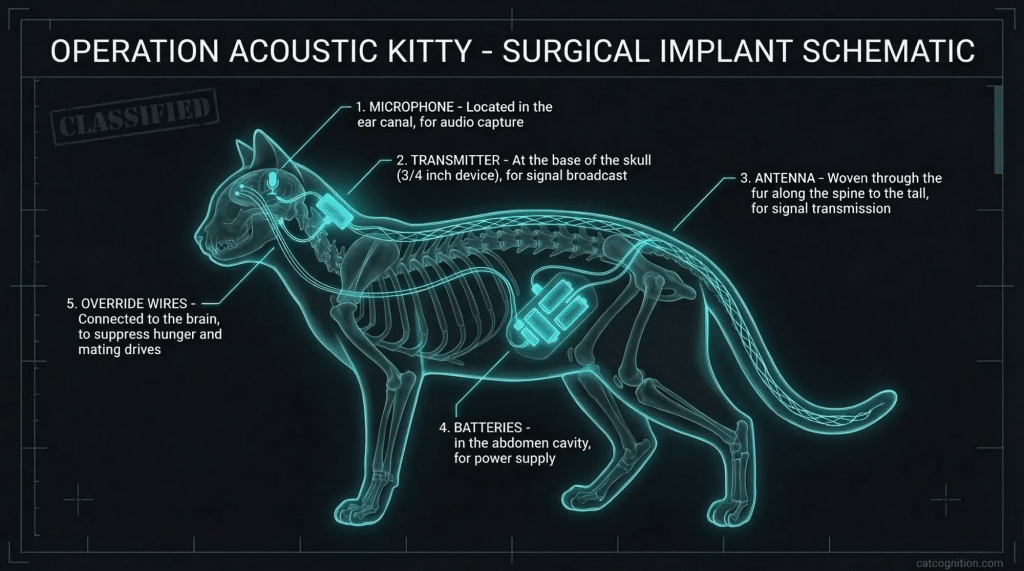
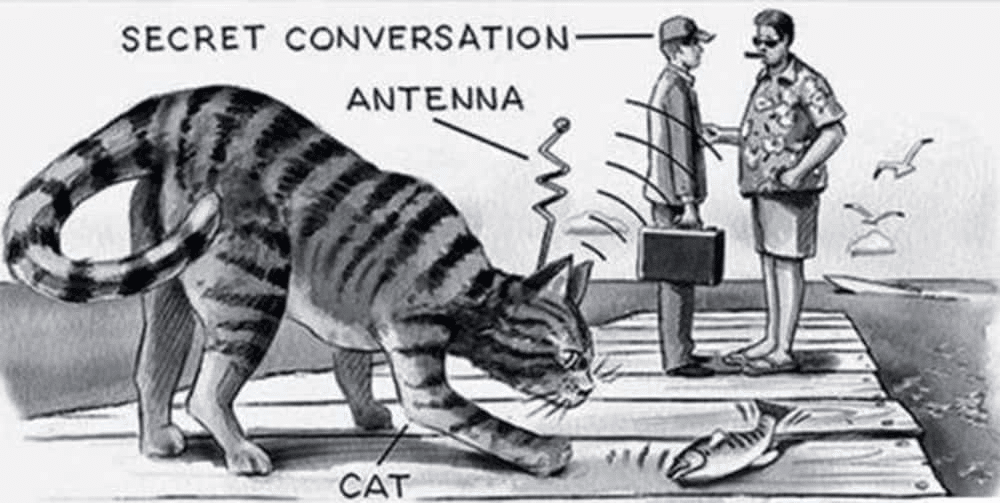
The basic idea was remarkably ambitious. Engineers wanted to place miniature surveillance equipment inside a cat and use the animal to approach people having sensitive conversations. Instead of hiding a microphone in a bench, car or building, the agency hoped the cat itself could wander naturally into the right location.
A declassified CIA memorandum confirms that the project existed and that officials eventually concluded it was not practical for real intelligence operations.
But the famous story has grown considerably beyond what the surviving documents actually prove.
So what really happened?
Why Would the CIA Need a Spy Cat?
During the Cold War, intelligence officers faced a simple but frustrating problem: people could avoid obvious surveillance equipment.
A conversation inside a building might be monitored with a concealed microphone. But what happened when two people deliberately met outdoors?
A park bench could be searched. A nearby building might be watched. A human operative could attract attention.
A cat, on the other hand, seemed almost perfect.
A stray animal could wander across a sidewalk, sit near a bench or move around a courtyard without immediately attracting suspicion. Nobody would expect a cat to be carrying sophisticated surveillance equipment.
That was the theory.
The CIA’s Directorate of Science and Technology was responsible for developing unusual technical solutions to intelligence problems. During this period, the agency experimented with increasingly sophisticated methods of collecting information.
Video: The Secret CIA Acoustic Kitty Project
The Cold War Was a Race of Unusual Ideas
The early 1960s encouraged experimentation.
The United States and Soviet Union were competing not only with missiles and aircraft but also with intelligence technology. Smaller transmitters, better microphones and increasingly discreet surveillance systems could provide enormous advantages.
The challenge was always the same: get close enough to the target without being noticed.
Acoustic Kitty represented an extreme answer to that problem.
Instead of disguising a surveillance device as an ordinary object, the agency considered making the animal itself part of the surveillance platform.
It was an extraordinary concept.
And someone actually tried to make it work.
What the Declassified CIA File Confirms
The most important evidence comes from a CIA memorandum released through the Freedom of Information Act.
The document confirms that the agency developed and evaluated a system involving a cat fitted with listening equipment.
The goal was to capture conversations from nearby people while allowing the animal to behave naturally.
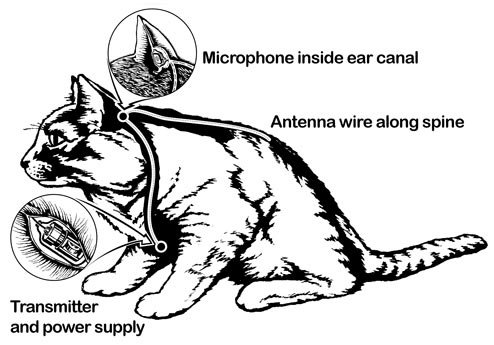
The equipment reportedly included a miniature microphone and transmitter.
However, there is an important distinction between the primary documents and later accounts.
The surviving CIA material does not provide every technical detail that has appeared in books and newspaper stories. Some of the most colorful descriptions come from former intelligence personnel and later journalists rather than from the released memorandum itself.
That means the broad story is well established, while certain details should be treated more cautiously.
The CIA did pursue the concept.
The agency developed equipment.
The project reached the testing stage.
And officials eventually decided that it was not useful enough to continue.
How Do You Train a Cat to Spy?
This was where the brilliant theory ran into a very ordinary problem.
Cats have minds of their own.
You can build a transmitter smaller than a matchbox. You can create an extremely sensitive microphone. You can design a clever antenna.
But none of that matters if the cat decides to walk somewhere else.
A surveillance operative needs predictable behavior. The animal would have to approach the right people, remain close enough to hear the conversation and stay there long enough to collect useful audio.
A cat might have other plans.
Perhaps it sees another animal.
Perhaps it notices food.
Perhaps it becomes frightened by a vehicle.
Or perhaps it simply decides that the opposite direction looks more interesting.
That unpredictability created a serious operational problem.
The Technology Wasn’t the Only Challenge
The CIA’s engineers were trying to combine two very different worlds: delicate electronic equipment and unpredictable animal behavior.
The microphone had to remain functional.
The transmitter had to operate while the animal moved.
The equipment could not obviously change the cat’s appearance.
And the animal still had to behave naturally.
Even if the technology worked perfectly, the system would remain useless if the cat wandered away from the target.
That is precisely why the project’s eventual evaluation was so important.
The agency wasn’t simply asking, “Can we build this?”
It was asking a much harder question:
“Can we depend on it in the real world?”
The answer was no.
The Famous Taxi Story: Fact or Legend?
This is where the story becomes much murkier.
One of the most famous versions claims that the CIA eventually deployed its specially equipped cat for a field test, only for the animal to cross a road and be struck by a taxi.
It is an almost perfect ending to the story.
Unfortunately, the surviving primary CIA documents do not clearly establish that this happened.
The account became associated with former CIA officer Victor Marchetti, whose later comments helped bring Acoustic Kitty into public discussion.
Because Marchetti had worked inside the agency, his recollections attracted considerable attention. But a former officer’s later account is not the same thing as a surviving operational report.
That distinction matters.
The taxi story may have originated from a genuine event. It may have been simplified over time. It may also have been embellished because it provided such a memorable explanation for why the project failed.
Without a primary document confirming the incident, the safest conclusion is that the taxi story remains reported rather than proven.
What the CIA Actually Decided
The strongest documentary evidence comes from the project’s closing assessment.
By the late 1960s, CIA officials concluded that Acoustic Kitty was not practical for operational intelligence collection.
The problem wasn’t necessarily that engineers had failed to create the equipment.
The bigger issue was reliability.
A surveillance system has to perform under unpredictable circumstances. It needs to deliver information consistently, not merely demonstrate that something is technically possible in a controlled experiment.
Acoustic Kitty could not meet that standard.
Outdoor environments introduced wind, traffic, voices and other sources of interference. The cat’s position could change from one moment to the next. Even small deviations could make the recorded conversation useless.
The animal could also behave unpredictably.
In intelligence work, unpredictability is more than an inconvenience. It can ruin an entire operation.
How Much Did the Project Really Cost?
One of the most repeated claims about Acoustic Kitty is that the CIA spent around $20 million developing the project.
That number has appeared repeatedly in popular accounts.
But there is a problem.
The publicly available primary documentation does not clearly establish that exact figure as the project’s verified cost.
Without a detailed budget record, researchers cannot confidently say that the CIA spent precisely $20 million on the cat program itself.
The figure may represent an estimate, a broader research budget or a number that became distorted through repetition.
This is a useful reminder that even famous historical stories need to be separated into different levels of evidence.
A claim can be repeated thousands of times and still lack a primary source.
Was the CIA Really Going to Send a Cat Into the Field?
The available evidence indicates that the program progressed beyond pure theoretical discussion.
The agency invested resources in developing the concept and testing whether the equipment and animal could function together.
But the surviving record does not provide a complete operational diary.
We do not have a publicly available file showing every test, every animal involved or every location where the system was evaluated.
Some records may never have been released.
Others may have disappeared during the decades between the project and its eventual declassification.
Video: How the CIA uses animals to spy
That leaves historians with an unusual situation.
The broad outline is clear.
The details are not.
What We Know—and What We Don’t
The confirmed portion of the story is surprisingly straightforward.
The CIA investigated the use of a cat as a listening platform.
The agency developed miniature surveillance equipment for the purpose.
The project was evaluated.
Officials concluded that it was unsuitable for practical intelligence operations.
The program ended.
Beyond that, some of the most entertaining details require additional caution.
The exact cost is uncertain.
The precise technical configuration described in later accounts is not fully documented in the released material.
The famous taxi incident remains unconfirmed by the primary file.
And the public record does not provide a complete account of every test.
Why Acoustic Kitty Became a Cold War Legend
So why has this strange experiment survived in popular culture?
Because it captures something larger than one failed intelligence project.
The Cold War encouraged governments to pursue extraordinary technological ideas. Satellites, miniature cameras, listening devices and unconventional surveillance methods all emerged from the same race for information.
Acoustic Kitty simply happened to be one of the strangest.
There is also something almost irresistible about the contrast.
The CIA was one of the world’s most powerful intelligence organizations.
Its engineers were working on advanced technology.
And yet the entire concept depended on an animal that might simply decide to go somewhere else.
That contradiction makes the story memorable.
The project did not become famous because it changed intelligence history.
It became famous because it revealed how far institutional creativity could stretch when secrecy, technology and Cold War pressure collided.
The Real Lesson Behind the Spy Cat
Acoustic Kitty is often presented as a ridiculous government experiment.
There is certainly an amusing side to it.
But the historical reality is more interesting than the joke.
The CIA faced a genuine surveillance problem. Engineers attempted an unconventional solution. They developed technology that appeared promising enough to warrant testing. Then officials examined the practical difficulties and concluded that the system could not reliably perform its intended mission.
That is actually a very normal pattern in research.
You have an idea.
You build it.
You test it.
Reality pushes back.
Then you move on.
The unusual part is simply that the prototype happened to involve a cat.
Conclusion: The Spy Cat Was Real, but the Legend Grew Larger
The story of Acoustic Kitty sounds unbelievable because it combines two things that rarely appear together: one of the world’s most powerful intelligence agencies and an ordinary household cat.
Yet the central claim is genuine.
The CIA really did investigate the possibility of using a cat fitted with listening equipment for surveillance during the Cold War. Declassified records confirm the program and show that officials eventually judged the concept impractical for real intelligence operations.
But some of the details that have made the story famous are less certain.
The frequently repeated $20 million price tag lacks clear primary documentation. The precise engineering details come partly from later recollections. And the famous taxi incident, while widely reported, is not established by the surviving CIA memorandum.
In other words, the truth is strange enough without embellishment.
The CIA really tried to solve a serious intelligence problem with an unconventional biological platform.
And after testing the idea, the agency reached a remarkably simple conclusion:
A cat might be able to carry a listening device—but that doesn’t mean you can get the cat to listen where you want.
The technology could be engineered.
The animal couldn’t be controlled.
And that was the end of the experiment.