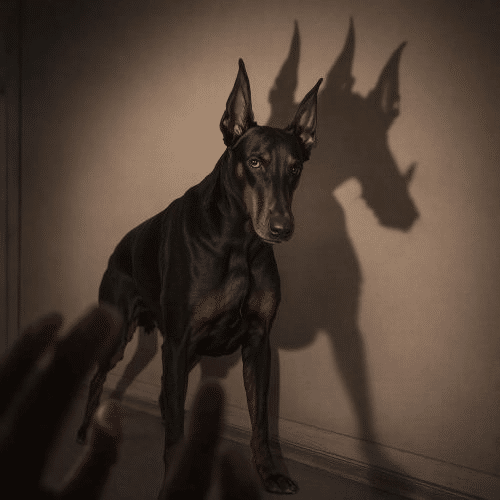
Imagine coming home and finding your dog struggling desperately to breathe.
You rush the animal to the veterinarian, expecting to discover a swallowed toy, a piece of food, or some other ordinary household accident. Instead, the veterinarian makes a discovery that turns a frightening emergency into something much darker: human fingers lodged in the dog’s throat.
Then comes the phone call.
The owner is warned not to return home. Police should go first.
According to the story, the dog had fought with an intruder. The burglar had escaped into the house but suffered a terrible hand injury during the struggle. Officers eventually searched the property and found the wounded man hiding inside.
It sounds like something written for a suspense movie.
But this story has circulated for decades as if it happened to a real family somewhere in America.
So, was there ever an actual case behind it?
The answer is more complicated—and considerably more interesting—than the legend suggests.
The Choking Doberman Became an American Urban Legend
The tale is commonly known as The Choking Doberman, and versions of it were circulating widely by the early 1980s.
The story usually begins with an ordinary homeowner returning to the house and discovering a large dog in distress. The animal cannot breathe properly, so the owner takes it to a veterinarian.
That is where the plot suddenly changes direction.
Instead of finding an ordinary object blocking the dog’s airway, the veterinarian supposedly discovers human fingers. The conclusion seems obvious: the dog must have attacked someone.
Then the veterinarian calls the owner with an urgent warning.
Don’t go home.
Video: The Choking Doberman, Urban Legend
Call the police.
When officers investigate, they allegedly discover the injured burglar hiding somewhere inside the residence.
The setting changes from one version to another. Sometimes the story takes place in a suburban neighborhood. Sometimes the house belongs to a young couple. The breed may be a Doberman, German shepherd, or Rottweiler.
Yet the basic structure barely changes.
A protective dog fights an unseen intruder, suffers an injury in the process, and accidentally provides the clue that reveals the crime.
Why the Dog Is Almost Always a Large Breed
The choice of dog is important.
A tiny household pet would weaken the story. The listener has to believe that the animal could realistically confront a grown burglar.
Dobermans, German shepherds, and Rottweilers carried a strong cultural association with protection and security, especially during the decades when the story became popular.
The dog therefore becomes more than an animal in the narrative. It becomes the silent security system that nobody realized was working.
That is one reason the story feels believable even before the shocking discovery.
Jan Harold Brunvand Helped Put the Story on the Map
One of the most important figures in the history of the legend was folklorist Jan Harold Brunvand, a scholar who spent decades studying contemporary American folklore.
In 1984, Brunvand published The Choking Doberman and Other “New” Urban Legends. The book helped establish the tale as a classic example of the modern urban legend.
Brunvand was particularly interested in stories passed from person to person through what folklorists often call FOAF, or “friend of a friend,” storytelling.
Think about how people tell these stories.
They rarely say, “This happened to me.”
Instead, they say:
“My neighbor’s cousin knew someone this happened to.”
Or:
“My friend’s brother heard about a case like this.”
That little bit of distance performs an important job. It makes the story feel personal while keeping it almost impossible to verify.
The teller sounds trustworthy because they appear to have a connection to the event.
But when someone tries to follow that connection backward, the trail tends to disappear.
The Evidence for a Real Crime Is Missing
This is where the legend runs into trouble.
Despite decades of retelling, researchers have not identified an authenticated police case that matches the complete story.
There is no verified case file establishing the familiar sequence of events: a dog choking on human fingers, a veterinarian discovering them, police arriving at the house, and an injured burglar being found hiding inside.
That does not mean every individual detail is impossible.
Dogs certainly bite intruders. Veterinarians certainly remove foreign objects from animals’ mouths and throats. Burglars certainly have been injured during break-ins.
But those facts do not prove the legend.
For the entire story to be established as historical fact, researchers would need independent evidence tying those events together. A police report, veterinary record, contemporary newspaper account, court case, or other reliable documentation could provide that connection.
No such authenticated record has been identified as the original source of the legend.
The Newspaper Trail Creates Another Problem
Some versions of the story have been attributed to local newspapers.
At first glance, that sounds convincing. After all, newspapers document real crimes every day.
But when researchers examine these references more closely, the trail often leads back to another person repeating the same story rather than to an original police investigation.
In other words, the newspaper may have reported that people were saying an incident happened.
That is very different from proving that the incident happened.
A rumor can acquire a newspaper address without becoming a documented fact.
Why Does the Story Feel So Real?
The Choking Doberman works because almost every part of it is designed to feel ordinary.
The homeowner is ordinary.
The house is ordinary.
The dog is familiar.
The veterinarian is a trusted professional.
Even the burglar is believable.
Nothing seems unusual until the veterinarian makes the discovery.
That structure is remarkably effective. The listener is allowed to settle into a familiar domestic situation before the story pulls the floor away.
And then comes the reversal.
The dog wasn’t simply choking.
The dog had been fighting.
The strange medical problem wasn’t an accident.
It was evidence.
Suddenly, the house that seemed safe becomes a crime scene.
That transformation is the heart of the legend.
Video: The Choking Doberman Urban Legend is REAL… And What Happened Next Will Haunt You
The Hidden Fear Behind the Intruder Story
The legend also reflects a very real American anxiety: the fear that your home may not actually be secure.
During the late twentieth century, burglary and home invasion became common themes in news coverage, movies, television and everyday conversations about neighborhood safety.
People worried about alarms.
They worried about unlocked doors.
They worried about strange noises at night.
And, perhaps most frighteningly, they worried about returning home without knowing whether someone was already inside.
The Choking Doberman turns that fear into a story with a satisfying twist.
The owner initially believes the dog is the victim of an accident.
Instead, the dog becomes the hero.
The animal has apparently discovered the intruder before the humans did. Its injuries become evidence. The veterinarian becomes the person who understands what the dog cannot explain.
It is almost like a detective story in which the detective has four legs and cannot speak.
The Older Story Hidden Beneath the Modern Legend
The basic idea behind The Choking Doberman is not entirely new.
Folklorists have identified similarities between the modern legend and much older stories about loyal animals whose actions are misunderstood by their owners.
One famous example is the Welsh tale associated with Gelert, the faithful hound.
In that story, a ruler returns home and finds his dog covered in blood. Believing the animal has harmed his child, he kills the dog. Only afterward does he discover that the child survived and that the dog had actually protected him from a wolf.
The emotional structure is strikingly similar.
The animal appears guilty.

The owner misunderstands the evidence.
The truth eventually emerges.
The modern American version simply changes the circumstances.
The wolf becomes a burglar.
The medieval household becomes a suburban home.
And instead of discovering the truth personally, the owner receives a telephone call from a veterinarian.
The machinery is modern, but the storytelling pattern is remarkably old.
How the Legend Changed With the Times
As the story traveled, people naturally adjusted it.
The breed changed.
The location changed.
The number of fingers changed.
Even the communication method could change depending on when and where someone heard the story.
That flexibility is one of the strongest signs that we are dealing with folklore rather than a single documented crime.
A genuine criminal case usually has fixed details: a date, a location, names, investigators and physical evidence.
A legend behaves differently.
It adapts.
Put the story in one town and it feels local. Change the neighborhood and suddenly it becomes something that supposedly happened “just a few miles away.”
That adaptability helps explain why The Choking Doberman survived for so many years.
What the Story Does—and Does Not—Prove
The most responsible conclusion is surprisingly simple.
There is no reliable evidence establishing that the famous incident happened exactly as the legend describes.
That does not mean everyone who tells the story is lying. Quite the opposite. Many people who repeat urban legends genuinely believe them.
They may have heard the story from someone they trusted.
That person may have heard it from someone else.
Eventually, a tale can become so familiar that people stop asking where it started.
The absence of documentation does not prove that no dog has ever injured a burglar or that no veterinarian has ever discovered something extraordinary in an animal’s throat. Those things could certainly happen.
What has not been established is the complete cinematic sequence that defines The Choking Doberman.
And that distinction matters.
Why the Legend Refuses to Die
The story has everything a memorable piece of folklore needs.
There is danger inside an ordinary home.
There is a loyal animal.
There is a mysterious medical discovery.
There is a professional who recognizes the clue.
There is a hidden criminal.
And, most importantly, there is a reversal that makes the ending satisfying.
The owner thought the dog needed rescuing.
The dog may have been the one protecting everyone.
That idea is powerful enough to survive long after the original details have disappeared.
Conclusion: A Famous Story With No Confirmed Crime
The tale of the veterinarian finding human fingers in a dog’s throat remains one of America’s most memorable urban legends, but its fame should not be confused with proof.
Versions of The Choking Doberman were circulating widely by the early 1980s, and folklorists such as Jan Harold Brunvand documented its recurring structure. The story consistently features a large protective dog, an injured intruder, a veterinarian who uncovers the shocking clue, and police who discover the criminal hiding inside the home.
Yet no authenticated police, veterinary, medical, or contemporary news record has established the complete incident as a real case.
That is what makes the legend so fascinating.
It feels like a crime report, but it behaves like folklore. It travels through friends, neighbors and secondhand sources. Details change while the central plot survives. Each retelling gives the story a slightly more convincing setting.
Perhaps that is why it still works.
A dog is struggling to breathe. A veterinarian discovers something impossible. A telephone rings. Somewhere inside an apparently empty house, someone may be hiding.
For a moment, the listener believes every word.
Then comes the question that has followed the story for decades:
If this really happened, where is the original case file?
So far, no one has found it.