For more than five centuries, the Voynich Manuscript has carried a secret that no historian, linguist, or codebreaker has been able to unlock with confidence.
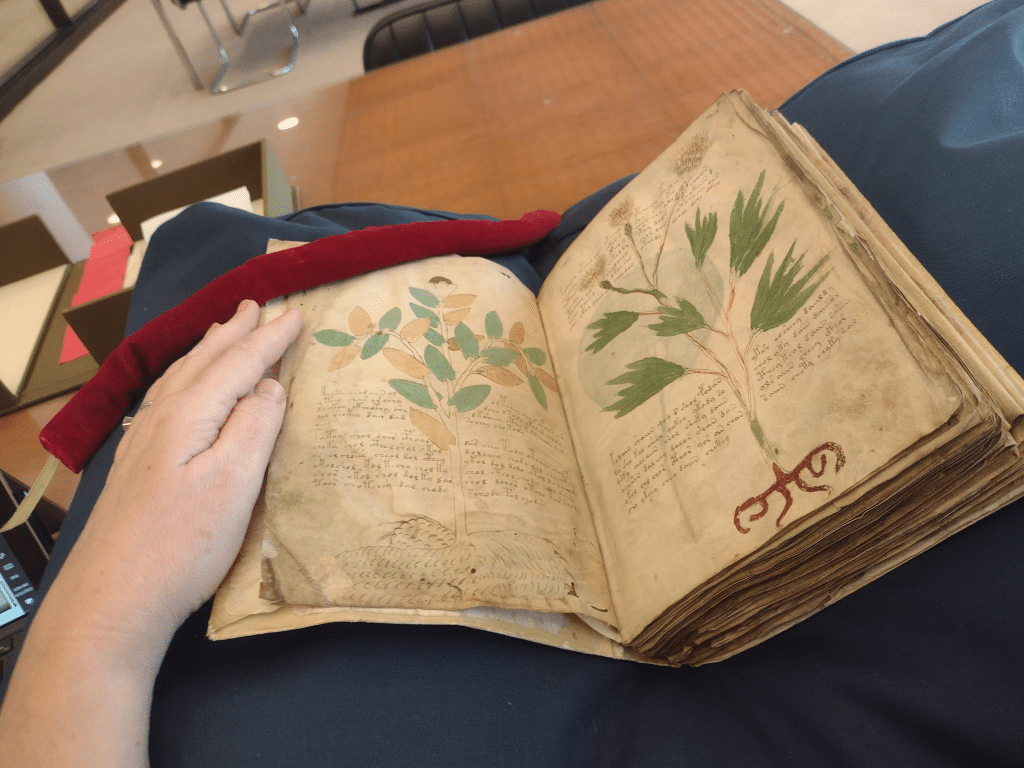
Its pages are filled with neat lines of unfamiliar writing. Strange plants appear beside blocks of text. Stars, zodiac symbols, circular diagrams, roots, jars, and mysterious human figures fill other pages. The manuscript looks organized, deliberate, and surprisingly sophisticated.
It does not look like nonsense.
It looks like a book that once made perfect sense to someone.
The problem is that nobody today can say exactly what it says.
Known as the Voynich Manuscript, or Beinecke MS 408, the volume remains one of the world’s most famous undeciphered manuscripts. Its parchment has been scientifically examined, its handwriting has been studied, and its illustrations have inspired countless theories.
Yet the central mystery remains untouched:
Who wrote it, and what were they trying to tell us?
A Mysterious Manuscript That Looks Remarkably Organized
The Voynich Manuscript is fascinating partly because its writing does not resemble random scribbling.
Characters repeat. Certain combinations appear more often than others. Words seem to follow consistent patterns, and the text is arranged in a way that resembles a genuine writing system.
Then there are the illustrations.
Some pages appear to focus on plants, although many of the botanical drawings are difficult to match confidently with real species. Other pages contain astronomical or astrological imagery, including recognizable zodiac symbols.
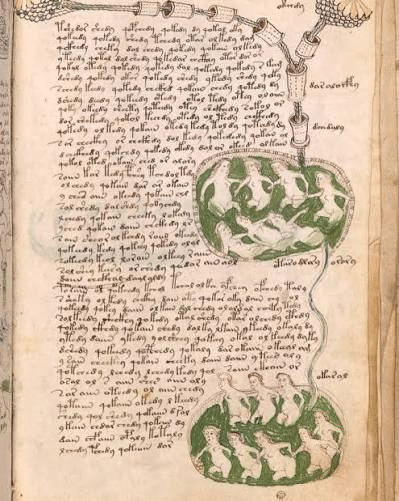
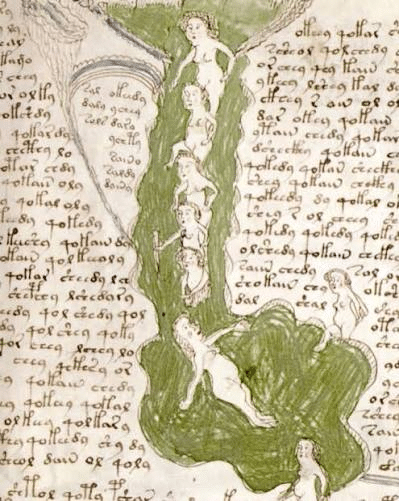
Still more pages show strange human figures surrounded by pools, tubes, vessels, and flowing shapes.
Near the end are illustrations that resemble roots, herbs, jars, and other pharmaceutical materials.
The manuscript therefore appears to have sections devoted to different subjects.
But what those subjects actually mean remains uncertain.
A drawing may look like a plant, but that does not tell us whether the accompanying text describes medicine, mythology, agriculture, symbolism, or something completely different.
Video: The world’s most mysterious book – Stephen Bax
The book repeatedly gives us the appearance of meaning without the key needed to understand it.
Scientific Evidence Shows the Book Really Is Centuries Old
For years, one of the simplest explanations was that the entire manuscript might be an elaborate forgery.
Modern scientific testing has made that theory much less convincing.
Radiocarbon analysis of the parchment placed it in the fifteenth century. Researchers have also examined the pigments and inks used throughout the manuscript, finding materials consistent with historical manuscript production.
The parchment itself was made from calfskin, and producing a volume of this size would have required a considerable amount of material and labor.
That does not tell us who created the manuscript.
It does, however, make the idea of a recent fake extremely difficult to sustain.
Someone in medieval or early modern Europe went to considerable trouble to create this object.
The manuscript also contains unusual foldout pages, including large diagrams that extend beyond the normal dimensions of a page. Producing such features required planning rather than casual writing.
Whatever the text means, the physical manuscript is a serious historical artifact.
And that raises an even more interesting question: why would someone put so much effort into a book that no one outside its original circle can now understand?
The Strange Journey That Gave the Book Its Name
The manuscript’s early history is incomplete, but researchers have managed to reconstruct parts of its journey.
One of its earliest confirmed owners was Rudolf II, the Holy Roman Emperor. Historical records suggest that Rudolf acquired the manuscript for a substantial sum and believed it might have been connected to the English philosopher Roger Bacon.
Modern scientific dating makes that attribution extremely unlikely.
The manuscript later passed through intellectual and scholarly circles in Central Europe. Ownership marks connect it to figures including the pharmacist and alchemist Jacobus Horčický de Tepenec.
By the seventeenth century, the manuscript had reached scholars associated with Prague and Rome. Johannes Marcus Marci eventually sent it to the Jesuit scholar Athanasius Kircher.
Then the trail became quiet.
For centuries, the strange book remained largely hidden from public attention.
That changed in 1912, when Polish-American bookseller Wilfrid Voynich acquired the manuscript from a collection associated with a Jesuit institution near Rome.
Voynich recognized that the book was unusual and began showing it to scholars.
The manuscript eventually became known by his name.
After passing through several private owners, it was donated to Yale University in 1969. Today, it is preserved at the Beinecke Rare Book and Manuscript Library as MS 408.
Why Has Nobody Been Able to Decipher It?
The biggest obstacle is not simply the unfamiliar alphabet.
Researchers do not know what kind of writing system they are looking at.
The symbols could represent letters, sounds, words, abbreviations, numbers, or a combination of several systems.
There is also no confirmed bilingual document that could provide a translation key.
That makes the Voynich Manuscript very different from famous decipherment successes.
When scholars decoded Egyptian hieroglyphs, for example, the Rosetta Stone provided the same text in multiple scripts. Researchers could compare known and unknown versions and gradually identify the symbols.
The Voynich Manuscript offers no equivalent guide.
There is no confirmed dictionary.
No known translation exists.
No second manuscript has been discovered that clearly uses the same script.
And nobody has established even one complete sentence whose meaning is universally accepted.
The Writing Has Patterns—but Patterns Can Be Misleading
Researchers have still found interesting statistical characteristics in the text.
Repeated symbols and word-like sequences suggest that the manuscript follows rules.
But rules alone do not prove that the text represents an ordinary human language.
It could be an encrypted language.
It could be shorthand.
It could represent a lost writing system.
It could even be a deliberately constructed language.
And there is always the possibility that the text was designed to look meaningful without actually communicating conventional language.
Every possibility explains some features.
None explains everything.
That is what makes the mystery so stubborn.
Could the Illustrations Hold the Missing Clues?
If the writing cannot be read, researchers naturally turn to the pictures.
The botanical illustrations are among the most famous.
Some plants look vaguely familiar, while others seem to combine characteristics from several different species. This has led to numerous interpretations.
Perhaps medieval artists drew unfamiliar plants inaccurately.
Perhaps the illustrations are symbolic.
Perhaps they represent medicinal preparations rather than actual plants.
Or perhaps we are simply looking at images whose original purpose has been misunderstood.
The astronomical pages offer more recognizable clues.
Zodiac symbols appear alongside elaborate circular diagrams, suggesting some connection to astrology, astronomy, calendars, or celestial calculations.
Then come the strange bathing illustrations.
Small human figures appear within colorful pools and interconnected structures. Tubes and branching shapes surround them.
Some researchers have interpreted these scenes as medical diagrams. Others have suggested connections to reproduction, anatomy, bathing practices, alchemy, or symbolic representations of the body.
No interpretation has been conclusively proven.
The pharmaceutical-looking pages create another tantalizing possibility.
Roots, leaves, containers, and star-shaped markers resemble elements found in medieval medical or herbal texts.
Could the manuscript have been a medical encyclopedia?
Possibly.
But without readable captions, even the most convincing visual interpretation remains a theory.
A Secret Cipher or an Elaborate Medieval Hoax?
The possibility of a secret code has fascinated cryptographers for decades.
Perhaps the manuscript contains an ordinary language that has been transformed using a sophisticated encryption method.
Another theory suggests that the writing represents a lost language or an unusual system of shorthand understood only by a small community.
Then there is the hoax theory.
Perhaps someone deliberately created meaningless text and surrounded it with elaborate illustrations to make the book appear to contain secret knowledge.
That explanation sounds plausible at first.
But it immediately creates another problem.
Why would someone spend so much time preparing hundreds of pages of calfskin, producing elaborate illustrations, creating foldouts, and maintaining a consistent writing system?
A sophisticated fraud was certainly possible.
But proving that explanation requires just as much evidence as proving the manuscript contains a genuine lost language.
For now, neither side has won.
Why Every New “Voynich Solution” Needs Skepticism
Every few years, a new claim appears announcing that the manuscript has finally been decoded.
One researcher identifies possible similarities to an obscure language. Another uses statistical analysis. Someone else applies artificial intelligence or proposes that the symbols represent medieval abbreviations.
These discoveries can be fascinating.
But producing a few readable phrases is not the same as deciphering an entire manuscript.
A convincing solution would need to work consistently across large sections of the text. It would need to explain recurring symbols, grammatical patterns, word structure, and the relationship between the writing and illustrations.
Most importantly, other researchers would need to reproduce the result.
So far, no proposed decipherment has reached that level of acceptance.
The mystery survives because the standard for solving it is appropriately high.
What We Know Without Being Able to Read the Words
The Voynich Manuscript may be unreadable, but it is far from unknowable.
Researchers know that its parchment dates to the fifteenth century. They know something about its pigments and materials. They have studied its handwriting and identified evidence suggesting that multiple scribes may have contributed to the text.
They have also reconstructed portions of its ownership history.
Modern digitization has opened the manuscript to researchers around the world. High-resolution scans allow specialists to examine individual characters, compare repeated sequences, study corrections, and inspect illustrations without repeatedly handling the fragile original.
In other words, the mystery is no longer hidden behind a locked library door.
It is sitting on computer screens around the world.
And despite all that access, the words remain stubbornly silent.
Conclusion: The Book That Refuses to Give Up Its Secret
The Voynich Manuscript has survived for roughly five centuries, yet its most important message remains beyond our reach.
Scientific evidence indicates that the manuscript itself is genuinely old. Its parchment, pigments, illustrations, handwriting, and construction all point toward a serious historical artifact rather than an obvious modern fabrication.
Researchers have proposed almost every reasonable explanation: a forgotten language, a secret cipher, medical shorthand, an esoteric reference book, a constructed writing system, or an elaborate deception.
None has solved the entire puzzle.
Perhaps the key is still hidden in some forgotten archive.
Perhaps a new technology will eventually recognize a pattern that earlier researchers missed.
Or perhaps the people who created the manuscript took their language to the grave with them.
That possibility may be the most haunting of all.
Because somewhere around five hundred years ago, someone looked at these strange symbols and understood them perfectly.
They knew what the plants meant.
They knew what the diagrams represented.
They knew what every line of text said.
Today, we have the book.
We simply don’t have the key.