In the spring of 1845, two British ships sailed toward one of the most unforgiving places on Earth.
HMS Erebus and HMS Terror carried 129 men, provisions, scientific equipment, and enough supplies to remain in the Arctic for years. Their mission was ambitious: find a navigable route through the Northwest Passage and complete a journey that had challenged explorers for generations.
Instead, the expedition vanished.
For decades, families waited for news. Search parties crossed frozen islands and dangerous channels. Investigators found graves, abandoned equipment, written messages, and human remains, but the ships themselves remained missing.
Then, more than 160 years later, archaeologists located both wrecks.
The discoveries of Erebus in 2014 and Terror in 2016 finally answered one of the greatest mysteries surrounding the Franklin Expedition.
But strangely enough, the wrecks also made the story more complicated.
The Franklin Expedition Set Out With Confidence
Sir John Franklin’s expedition left Greenhithe, England, on May 19, 1845.
The two ships were specially prepared for polar exploration. Both had already served in Arctic waters, and their hulls had been strengthened to withstand difficult conditions. They also carried steam engines, heating systems, preserved food, scientific instruments, and supplies intended to support the crew for several years.
At first, everything appeared promising.
The ships crossed the Atlantic and reached Greenland. Five men were sent home from Disko Bay, leaving 129 people aboard the expedition’s two vessels.
From there, Franklin and his crew continued west toward the Canadian Arctic.
Whaling ships encountered Erebus and Terror in Baffin Bay during the summer of 1845.
Those encounters became the last confirmed sightings of the expedition by people from the outside world.
After that, the Arctic swallowed the trail.
The Ships Became Trapped in the Ice
The expedition spent the winter of 1845–1846 near Beechey Island.
Three crew members died there, and their graves later became some of the earliest clues to the expedition’s fate.
When summer returned, the ships moved farther south and west.
Then the ice closed around them.
In September 1846, Erebus and Terror became trapped near King William Island.
At first, being frozen into the sea would not necessarily have meant disaster. Arctic expeditions sometimes spent an entire winter locked in ice before continuing when conditions improved.
But this time, the ice did not release them.
The ships remained trapped through another season.
Then, on June 11, 1847, Sir John Franklin died.
Command passed to Captain Francis Crozier of Terror, while Captain James Fitzjames became one of the senior officers aboard Erebus.
By the following spring, the situation had become increasingly desperate.
The Final Written Message
In April 1848, officers left a message at Victory Point on King William Island.
It recorded the deaths of Franklin and other crew members and stated that the remaining 105 men had abandoned the ships.
Their plan was to travel south toward the Back River.
That document became known as the Victory Point Note.
It remains one of the most important pieces of evidence from the expedition because it provides a rare glimpse into the crew’s final known plans.
But it leaves a haunting question.
What happened after the men walked away from the ships?
No member of the expedition is known to have returned alive.
The Search for Franklin Became a Generational Mystery
When Franklin failed to return, Britain launched an enormous search effort.
Expeditions searched islands, coastlines, channels, and frozen landscapes across the Canadian Arctic. Between 1848 and 1854, numerous official searches attempted to determine what had happened.
They found pieces of the story.
Graves were discovered.
Camps were located.
Human remains and equipment appeared in unexpected places.
Written records provided fragments of information.
But the ships themselves remained hidden.
One of the most important sources of information came from Inuit communities.
Video: Parks Canada Guided Tour Inside HMS Terror
Inuit knowledge preserved accounts of encounters with Franklin’s men and reports of ships seen in Arctic waters. Explorer John Rae learned in the 1850s that Inuit had encountered a group of approximately 40 European men travelling south along King William Island.
Other accounts described a large ship in waters farther south.
For many years, European investigators struggled to interpret these reports accurately.
With modern archaeological work, however, researchers increasingly recognized that Inuit testimony contained valuable geographical and historical information.
That realization would eventually change the search.
Inuit Knowledge Helped Point Archaeologists Toward the Wrecks
The eventual discovery of Franklin’s ships did not happen simply because modern sonar became more powerful.
Researchers combined historical documents with Inuit oral histories and local geographical knowledge.
Parks Canada worked with Inuit historians and communities, including the late Louie Kamookak, whose knowledge of local traditions and place names helped researchers reconsider where the ships might have travelled.
Search teams identified northern and southern areas where the vessels might have ended up.
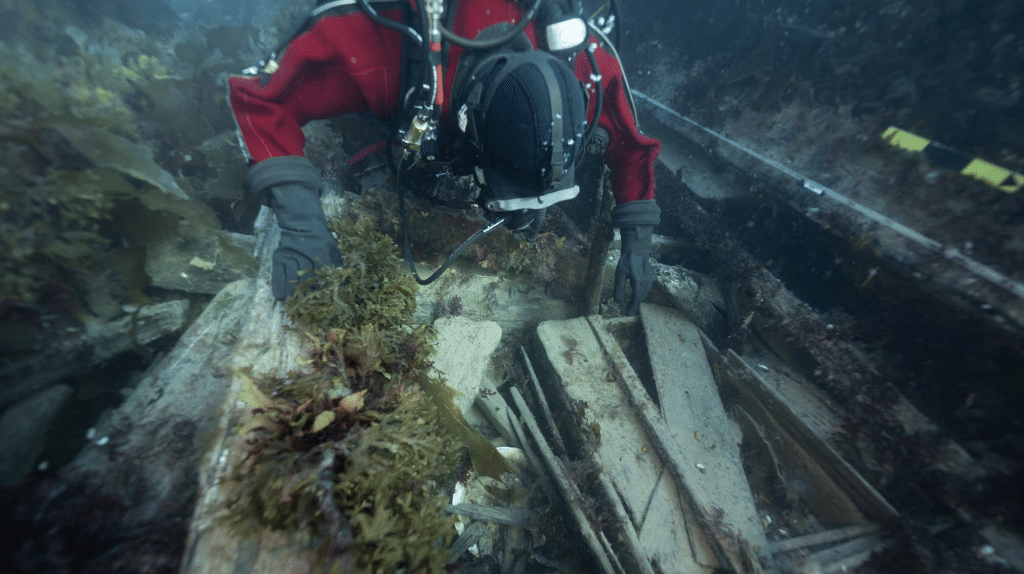
They used boats, aircraft, sonar equipment, underwater vehicles, divers, archival records, and archaeological surveys.
The Arctic remained difficult.
Weather could change rapidly. Ice could block search areas. Visibility underwater was limited.
Still, researchers continued.
Then, in 2014, the search produced an extraordinary discovery.
HMS Erebus Finally Emerged From the Arctic Sea
During the 2014 search season, archaeologists discovered artifacts that appeared to be connected to a nineteenth-century Royal Navy vessel.
Their location supported Inuit accounts of a ship in the southern search area.
The search effort shifted.
On September 2, 2014, sonar detected a large shipwreck beneath the water.
The shape was unmistakable.
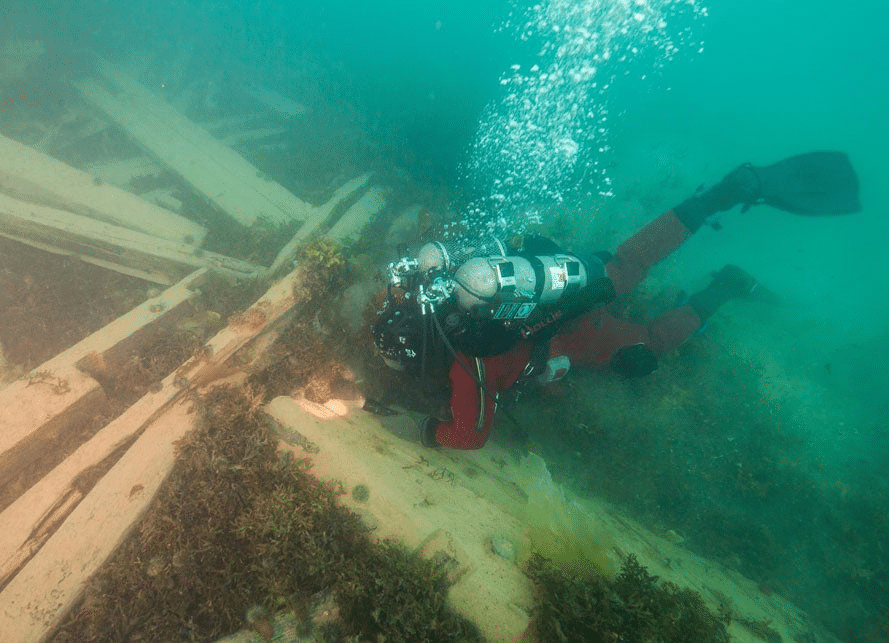
Archaeologists and divers began documenting the site, comparing its construction with historical plans of Franklin’s vessels.
The evidence eventually confirmed the identity.
It was HMS Erebus.
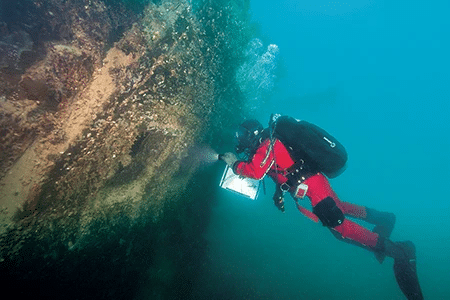
After disappearing in the nineteenth century, one of Franklin’s ships had finally been found.
Among the memorable discoveries was the ship’s bell, carrying the Royal Navy broad-arrow mark and the date 1845.
For historians, it was an extraordinary moment.
A vessel that had been missing for generations was sitting on the Arctic seabed.
Yet the expedition still had another ship.
Where was Terror?
The Second Wreck Was Found Somewhere Unexpected
After locating Erebus, researchers continued searching for Terror.
The obvious assumption was that the second ship would be near the location where the crew had reported abandoning both vessels in 1848.
But Inuit information suggested another possibility.
A ship had reportedly been seen in an area known as Terror Bay.
In September 2016, the Arctic Research Foundation searched the area and discovered a large wreck beneath the water.
Parks Canada archaeologists soon examined the site.
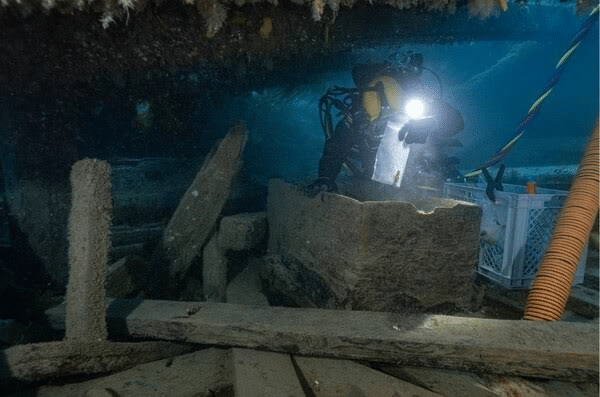
The wreck was remarkably well preserved.
Its hull remained largely intact. The ship was sitting upright, and important structural features could still be identified.
The evidence eventually confirmed what researchers had hoped to find.
Video: Underwater archaeologists exploring HMS Terror
It was HMS Terror.
The second ship had finally been located.
And once again, the discovery created another mystery.
The wreck was nowhere near the location where the surviving crew had reported abandoning the vessels.
How Did Terror Get There?
This question continues to fascinate historians.
The Victory Point Note indicates that Erebus and Terror had been abandoned in 1848.
Yet archaeological evidence shows that Terror eventually came to rest much farther south.
That means something happened after the original abandonment.
Perhaps members of the expedition returned to the ship.
Perhaps the vessel drifted with the ice.
Perhaps a small group managed to move it.
Researchers have not established a definitive explanation.
The wreck itself provides clues, but it does not tell its entire story.
Inside Terror, Time Appears to Have Stood Still
One of the most remarkable aspects of the discovery was the condition of HMS Terror.
Cold Arctic water helped preserve the ship.
In 2019, underwater archaeologists used a remotely operated vehicle to explore portions of the interior.
The vehicle entered cabins and compartments, recording shelves, bottles, plates, furniture, instruments, and other objects.
The images were extraordinary.
Instead of seeing only broken timbers scattered across the seabed, researchers saw rooms that still looked like rooms.
Some spaces remained enclosed.
Objects remained where they had been left.
The ship appeared almost as though it had been paused rather than destroyed.
That preservation creates enormous possibilities for future research.
If sealed containers, drawers, or other protected spaces contain documents, they could potentially reveal details about the expedition’s final days.
Nothing discovered so far has provided a complete explanation.
But the possibility remains.
Every Artifact Adds Another Piece to the Story
The wrecks contain much more than wood and metal.
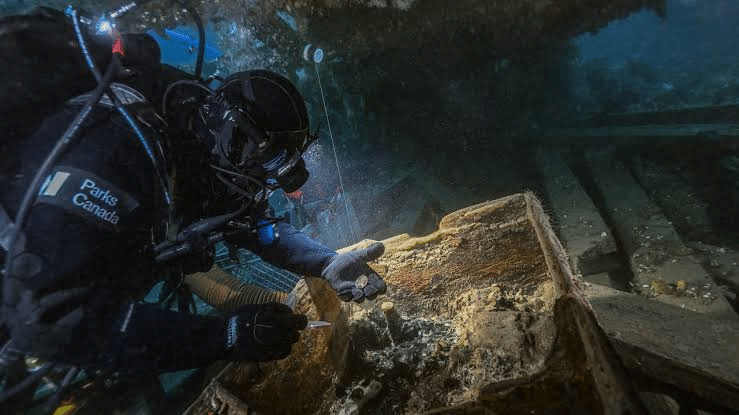
Archaeologists have recovered dishes, personal belongings, scientific instruments, weapons, clothing-related items, and equipment used aboard the ships.
Each object can provide information about daily life.
Its exact location can be just as important as the object itself.
A navigation instrument found in an officer’s quarters tells one story. A personal possession discovered elsewhere tells another. A collection of dishes or bottles can reveal something about how a room was being used.
Archaeologists carefully record an artifact’s position before removing it.
They then photograph, stabilize, conserve, and study the object.
This slow process may seem less dramatic than discovering a shipwreck on sonar, but it is where much of the real historical work happens.
A single small object can sometimes answer a question that a large piece of the ship cannot.
The Arctic Was Never an Empty Wilderness
Perhaps one of the most important lessons from the Franklin story is the role of Inuit knowledge.
For generations, Inuit communities lived, travelled, hunted, navigated, and observed environmental changes across the region.
Their knowledge included routes, landmarks, place names, sea conditions, animal behavior, and memories of encounters with European explorers.
When modern search teams began taking these accounts more seriously, the search strategy changed.
The discovery of both wrecks demonstrated that traditional knowledge was not simply a collection of old stories.
It contained practical geographical information that could help researchers locate historical evidence.
Today, Inuit and Parks Canada work together in protecting and studying the wreck sites.
That partnership has changed the way the Franklin Expedition is understood.
It is no longer simply a story about European explorers entering an unknown wilderness.
It is also a story about an expedition entering a landscape that was already deeply known to the people who lived there.
Two Wrecks Were Found, But the Mystery Remains
The discoveries of Erebus and Terror solved one enormous part of the Franklin mystery.
After more than 160 years, researchers finally knew where both ships had ended their journeys.
They could study their construction, recover artifacts, explore cabins, and compare archaeological evidence with historical records.
Yet the most important questions remain.
Why did the ships move after the crew reportedly abandoned them?
Did some men return?
How long did the survivors remain alive?
What route did they follow?
What happened during their final months?
And could the wrecks still contain documents capable of answering some of those questions?
Those mysteries may take years to resolve.
But the discovery of the two ships has already transformed one of the most enduring stories in Arctic history.
Conclusion: The Ships Came Back, but Their Final Story Is Still Waiting
For more than a century and a half, HMS Erebus and HMS Terror were little more than names attached to one of history’s great unsolved expeditions.
Today, both ships have been found beneath Arctic waters.
Their decks, cabins, instruments, personal belongings, and surviving structures have given archaeologists an extraordinary opportunity to reconstruct the final chapter of the Franklin Expedition.
The discoveries also reinforced the importance of Inuit knowledge, which helped guide researchers toward locations that earlier searches had overlooked.
Still, the Arctic has not surrendered every secret.
The ships can tell us where they ended.
They can show us how they were built and what their crews carried.
They may even preserve documents that have yet to be recovered.
But they cannot yet tell us exactly what happened to the 129 people who sailed north in 1845.
Perhaps another artifact will eventually provide the missing clue.
Perhaps a forgotten document will be discovered.
Or perhaps some questions will remain beneath the Arctic ice forever.
The ships disappeared more than 170 years ago.
Their wrecks have finally returned to history.
Their final story, however, is still being written.