For decades, the Bermuda Triangle has carried an almost magical reputation.
Ships vanished. Aircraft disappeared. Crews sometimes left behind no clear explanation. Stories of strange compass readings, sudden storms, missing wreckage, and unexplained radio messages turned an ordinary section of the Atlantic into one of the world’s most famous mysteries.
But there is a fascinating question hiding underneath all those stories:
Is the Bermuda Triangle even a real place?
The answer is more complicated than the legends suggest.
The disappearances themselves are real. Ships and aircraft really have been lost in the western North Atlantic. Some cases remain difficult to explain in complete detail.
But the triangle on the map?
That came later.
The Ocean Was There Long Before the Triangle
The western North Atlantic has always been a busy and challenging part of the ocean.
Ships travel between the United States, the Caribbean, Bermuda, and Europe. Aircraft cross the same broad region every day. Fishing vessels, military craft, cruise ships, and private boats have all passed through its waters.
That traffic matters.
When thousands upon thousands of vessels and aircraft regularly cross a large and sometimes dangerous ocean, accidents are inevitable.
The region also has plenty of natural hazards. Tropical storms can strengthen rapidly. Hurricanes can create enormous waves and dangerous winds. The Bahamas contain extensive shallow waters and reefs. The Gulf Stream can move debris considerable distances after an accident.
In other words, the area doesn’t need anything supernatural to be dangerous.
Yet several famous disappearances eventually became the foundation of a much larger story.
Video: What Scientists Are Beginning to Find in the Bermuda Triangle
Flight 19 Became the Triangle’s Most Famous Mystery
Few incidents are more closely connected with the Bermuda Triangle than Flight 19.
On December 5, 1945, five U.S. Navy TBM Avenger aircraft departed from Fort Lauderdale, Florida, on a routine training mission.
There were fourteen men aboard the five aircraft.
The mission was supposed to be straightforward: navigation training over the Atlantic and Bahamas before the planes returned to base.
Instead, something went badly wrong.
Radio communications revealed increasing uncertainty about the aircraft’s position. Flight leader Lieutenant Charles Taylor reported problems with navigation and became unsure of the group’s location.
As daylight faded, the aircraft never returned.
Search crews immediately began looking for them.
Then another tragedy occurred.
A PBM Mariner flying boat sent to search for the missing aircraft also disappeared.
Thirteen additional men were aboard.
No confirmed wreckage from Flight 19 was found.
The circumstances were frightening enough on their own. Later writers transformed the event into something even more mysterious.
What the Navy Actually Believed
The official investigation did not conclude that Flight 19 had encountered anything supernatural.
Instead, investigators considered navigational confusion, weather, fuel exhaustion, and the difficulties of flying over a largely featureless ocean.
The loss of the Mariner was treated separately.
A nearby vessel reportedly observed an explosion or fireball, consistent with known concerns about the aircraft’s fuel system.
The tragedy was real.
The uncertainty was real.
But the evidence did not require an unexplained force.
The USS Cyclops Disappeared Without a Trace
Another legendary case involves the USS Cyclops, a massive U.S. Navy cargo ship.
In March 1918, the vessel was traveling from Barbados toward Baltimore while carrying a large load of manganese ore.
Approximately 300 people were aboard.
Then the ship vanished.
There was no confirmed distress call. No substantial wreckage was recovered. The vessel and everyone aboard disappeared from the historical record almost completely.
That makes the Cyclops an especially haunting case.
But it also illustrates an important point.
The ship was operating in a dangerous environment while carrying an unusually heavy cargo. Its condition and mechanical problems have led historians to consider structural failure, cargo instability, and severe weather among the possible explanations.
Nobody can confidently reconstruct every detail.
Yet an unsolved maritime accident isn’t automatically evidence of an extraordinary phenomenon.
Sometimes the ocean simply keeps its secrets.
So When Did the Bermuda Triangle Appear?
Here’s where the story gets interesting.
The Bermuda Triangle was not an ancient geographic feature.
It wasn’t an officially designated danger zone.
And it didn’t appear on navigation charts because sailors had discovered some unusual force in the Atlantic.
The name emerged during the twentieth century.
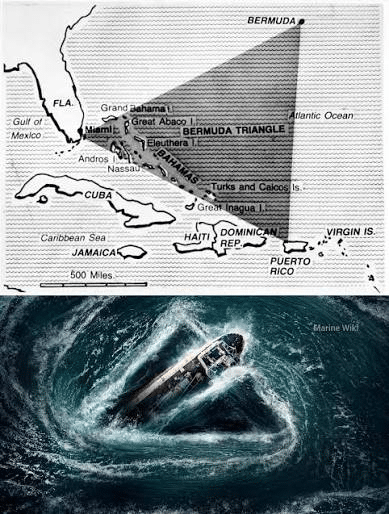
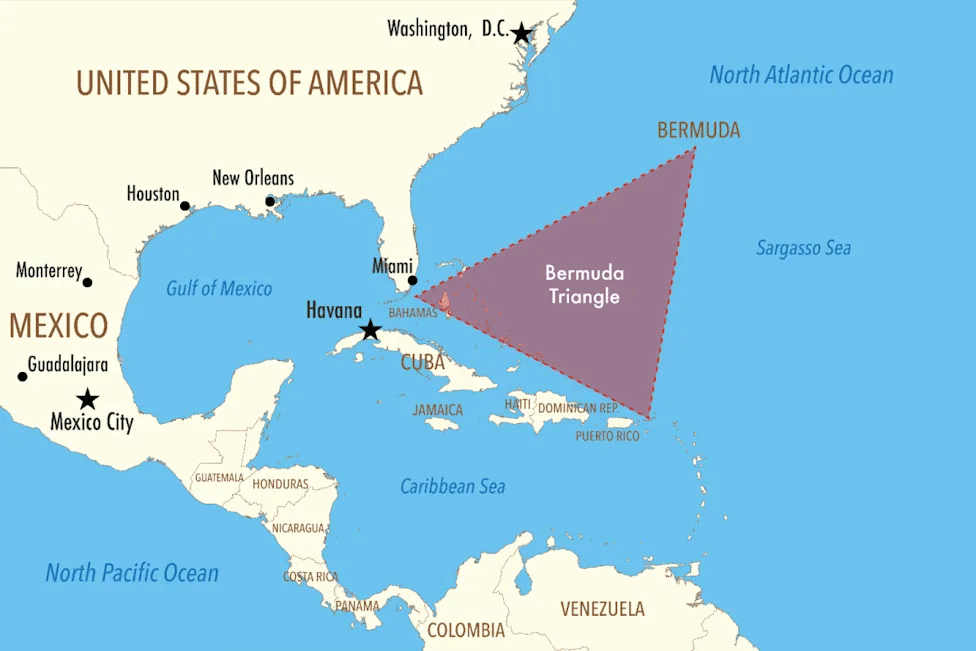
Writer Vincent Gaddis used the term “Bermuda Triangle” in a 1964 article published by Argosy magazine. He described a triangular area connecting Bermuda, Florida, and Puerto Rico and placed several mysterious disappearances within it.
The concept gained enormous popularity during the following decade.
Then, in 1974, Charles Berlitz published The Bermuda Triangle, a bestselling book that brought the mystery to millions of readers.
Suddenly, scattered maritime tragedies became part of one enormous story.
A Shape Was Drawn Around Old Disappearances
This detail is easy to overlook.
The accidents happened first.
The triangle came afterward.
Different authors also used different boundaries. Some versions stretched farther north. Others shifted the southern or western edges.
There has never been one universally accepted set of coordinates.
That creates an obvious problem.
If nobody agrees where the triangle begins and ends, how can anyone accurately calculate whether it has an unusually high accident rate?
The shape itself becomes part of the mystery.
Is the Bermuda Triangle an Official Place?
No.
Video: The Strangest Disappearances In The Bermuda Triangle
The U.S. Board on Geographic Names does not recognize the Bermuda Triangle as an official geographic feature.
It isn’t an officially designated maritime hazard zone, administrative region, or special area of the Atlantic.
NOAA has also addressed the subject and notes that there is no evidence that mysterious disappearances occur there at an unusually high rate.
That doesn’t mean the region is harmless.
Far from it.
It simply means its dangers are better explained by geography, weather, traffic, and human factors than by a mysterious force.
Why the Gulf Stream Matters More Than Most Legends Admit
One of the most important natural features in the region is the Gulf Stream.
This powerful ocean current can carry floating debris rapidly away from the original location of an accident.
Imagine dropping a piece of paper into a fast-moving river.
A search team arriving hours later wouldn’t necessarily find the paper where it entered the water.
The ocean works on a vastly larger scale.
If a ship breaks apart or sinks in deep water, its debris can spread over an enormous area. That makes recovery difficult and can create the impression that something simply vanished.
The depth of the Atlantic adds another complication.
In some locations, the seabed lies thousands of feet below the surface.
Finding a wreck in such conditions is far from easy.
What About the Strange Compass Stories?
Compass behavior has also played a major role in Bermuda Triangle mythology.
Some stories claim that compasses behave strangely in the region.
But magnetic variation is a normal feature of navigation.
A compass points toward magnetic north, while geographic north is a different reference point. The difference between the two varies depending on location and changes over time.
Experienced navigators know this and make appropriate corrections.
So while compass readings can certainly contribute to navigational confusion, there is no need to invoke an unknown force.
A navigation instrument behaving according to Earth’s magnetic field may sound mysterious if the underlying science isn’t understood.
The Bermuda Triangle Mystery Was Challenged
One of the most important challenges to the popular legend came from researcher Lawrence David Kusche.
In 1975, he published The Bermuda Triangle Mystery—Solved.
Kusche examined many of the incidents cited by Bermuda Triangle writers and compared popular accounts with original sources, including newspaper reports, official records, and maritime information.
He found numerous problems.
Some incidents had occurred during severe weather that later retellings barely mentioned. Some cases were described inaccurately. Others had been moved geographically or presented with incorrect details.
In several cases, the dramatic version of the story was considerably different from the original record.
The pattern became much less mysterious when the missing context was restored.
Why Does the Legend Still Feel So Convincing?
If the evidence is so ordinary, why does the Bermuda Triangle remain such a powerful mystery?
Because the individual stories are genuinely fascinating.
Imagine being one of the families waiting for Flight 19 to return.
Imagine watching the clock move forward while no aircraft appeared.
Imagine being aboard a ship that disappeared without leaving an obvious trace.
Those human mysteries remain powerful even after the supernatural explanation falls apart.
There is also something irresistible about drawing a shape around unexplained events.
The Atlantic Ocean is enormous.
A triangle gives the mystery boundaries.
It turns scattered tragedies into a single narrative.
That is powerful storytelling.
The Ocean Still Holds Genuine Mysteries
Rejecting the Bermuda Triangle mythology doesn’t mean every disappearance has been completely solved.
Some wrecks have never been found.
Some accidents remain uncertain.
Historical records can be incomplete, especially for incidents that happened before modern tracking systems, satellite communication, and sophisticated search technology.
The honest conclusion is not that every famous case has an easy explanation.
It is that there is no convincing evidence of a mysterious force operating inside a special triangular zone.
The difference is important.
An unsolved mystery is not necessarily evidence of a supernatural mystery.
Conclusion: The Triangle Exists on Maps of the Imagination
Ships and aircraft really have disappeared in the western North Atlantic.
Flight 19 was real. The USS Cyclops was real. Storms, navigational errors, mechanical failures, deep water, powerful currents, and difficult search conditions are all real.
What isn’t official is the triangle itself.
The Bermuda Triangle was created as a cultural idea after many of the famous incidents had already happened. Writers connected separate tragedies, drew boundaries around them, and gave the resulting shape a memorable name.
Over time, books, television programs, magazines, and the internet transformed that idea into one of the world’s most enduring mysteries.
Perhaps that’s why the story refuses to disappear.
The ocean remains vast. The records are sometimes incomplete. Some wrecks still lie somewhere beneath the waves.
But sometimes the greatest mystery isn’t what the ocean is hiding.
It’s how a simple line drawn on a map became powerful enough to make generations of people wonder what might be hiding beneath it.