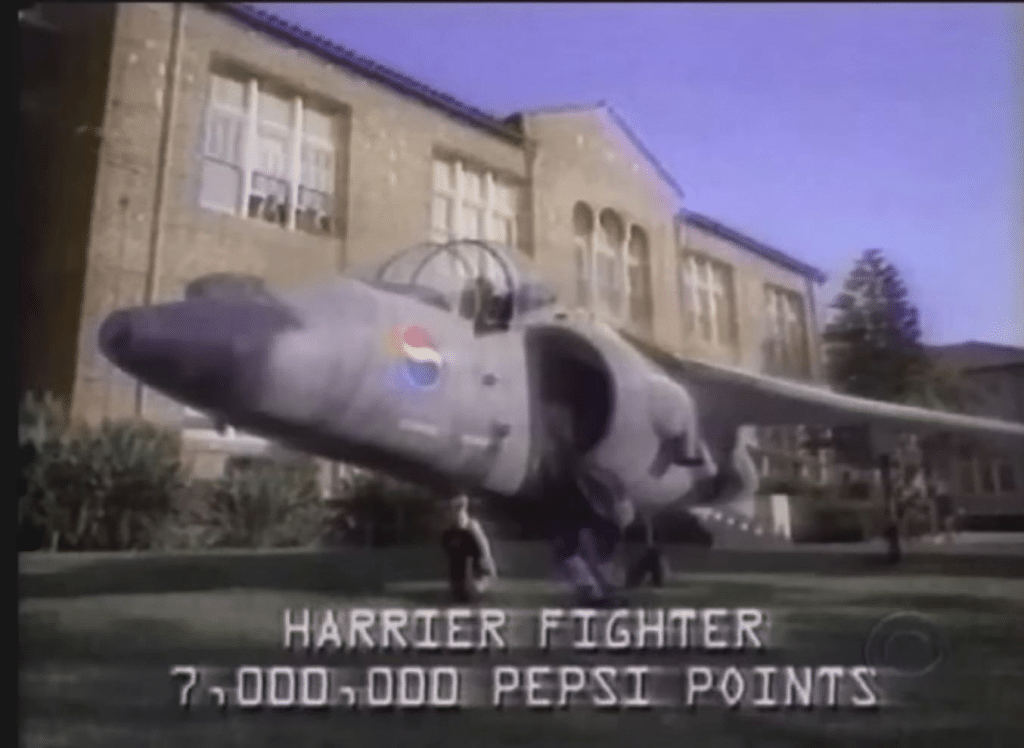
A teenager lands a military jet at school.
He steps out as casually as if he had just parked a bicycle.
Then the commercial reveals the price:
7,000,000 Pepsi Points.
For most people watching the Pepsi commercial in the 1990s, the joke was obvious. The fighter jet was an outrageous fantasy, deliberately exaggerated to make the advertisement memorable.
But one young man looked at those seven million points differently.
He didn’t laugh and move on.
He started doing the math.
What followed became one of the strangest advertising disputes in American legal history—and eventually forced a federal court to decide whether a soda commercial could actually amount to a promise for a military aircraft.
The Pepsi Promotion That Started It All
In the mid-1990s, Pepsi launched a major rewards campaign called Pepsi Stuff.
The concept was simple. Customers collected Pepsi Points from specially marked Pepsi and Diet Pepsi products and exchanged them for merchandise.
The rewards were typical promotional items: clothing, sunglasses, jackets, accessories and other Pepsi-branded products.
During an early test of the program in the Pacific Northwest, customers received catalogs explaining the available rewards and their point requirements.
A Pepsi T-shirt cost 75 points.
Sunglasses required 175.
A leather jacket cost 1,450 points.
Even a mountain bike, one of the more expensive rewards, required only 3,300 points.
There was also a way to buy additional points.
Customers could purchase Pepsi Points for 10 cents each, as long as their order included at least 15 points originally collected from Pepsi products.
That little detail would become extremely important.
Nobody at Pepsi expected someone to use the rule to go after a military aircraft.
Then the commercial aired.
The Commercial Ended With an Astonishing Prize
The Pepsi Stuff advertisement began like an ordinary teenage morning.
A young student prepared for school while energetic music played in the background. One by one, he collected Pepsi merchandise.
The commercial displayed the number of points needed for each item.
His clothing required a relatively small number of points.
His sunglasses cost more.
His leather jacket cost considerably more.
Then the commercial suddenly escalated.
The teenager arrived at school in a military-style aircraft.
A Harrier jet descended dramatically beside the school as students scattered and papers flew through the air.
The teenager stepped from the cockpit holding a Pepsi.
The joke was that Pepsi merchandise had become so valuable that the ultimate reward was a military aircraft.
Then appeared the final price:
HARRIER FIGHTER — 7,000,000 PEPSI POINTS
For Pepsi, it was an absurd punchline.
For 20-year-old Seattle college student John Leonard, however, it looked like a challenge.
John Leonard Started Doing the Math
Leonard initially considered the obvious approach: collecting seven million points through Pepsi purchases.
Video: Flashback 1996: Man sues Pepsi to win Harrier Jet
That plan quickly became unrealistic.
But then he noticed the promotional rule allowing customers to buy additional points for 10 cents apiece.
Seven million points would therefore cost about $700,000.
That was an enormous amount of money.
But Leonard discovered something else.
A Harrier aircraft was worth dramatically more than $700,000.
Suddenly, the commercial looked less like an impossible joke and more like a bizarre business opportunity.
Leonard began looking for investors who might finance the plan.
He eventually secured commitments totaling roughly $700,000.
Then he prepared his order.
The Order That Shocked Pepsi
Leonard submitted an official Pepsi Stuff order form along with 15 original Pepsi Points and a check for $700,008.50.
He also added something that wasn’t actually listed in the catalog:
1 Harrier Jet — 7,000,000 Pepsi Points
His attorneys were involved in the transaction, making it clear that this wasn’t simply a prank between friends.
Leonard expected Pepsi to take the order seriously.
The soda company soon discovered just how serious he was.
Pepsi Sent the Money Back
Pepsi rejected Leonard’s request.
The company explained that the Harrier wasn’t part of the Pepsi Stuff merchandise catalog. It wasn’t listed as an available reward, and the official order form did not provide a mechanism for ordering one.

Pepsi returned his check.
The company also sent him coupons as an apology for the misunderstanding.
That wasn’t enough for Leonard.
His lawyers sent Pepsi a formal demand arguing that the commercial had presented the aircraft as a reward for seven million points and that Leonard had fulfilled the requirements necessary to claim it.
Pepsi’s position remained unchanged.
The company argued that the Harrier was obviously part of the commercial’s humor.
Leonard disagreed.
And the dispute moved toward federal court.
Could a Commercial Really Be a Contract?
The central legal question was surprisingly serious.
When does an advertisement become an actual offer?
Generally, advertisements invite consumers to make purchases. They don’t automatically create binding contracts with everyone who responds.
But there are exceptions.
If an advertisement is specific enough—clearly identifying the product, price, quantity and method of acceptance—it can potentially create an enforceable offer.
Leonard argued that Pepsi had done exactly that.
The commercial named the aircraft.
It gave a precise price.
And Leonard claimed he had followed the stated point system.
Pepsi argued that nobody watching the commercial could reasonably believe the company intended to give away a military aircraft for the price of a consumer rewards promotion.
The court had to decide which interpretation made more sense.
The Judge Had One Big Problem With Leonard’s Argument
In 1999, U.S. District Judge Kimba Wood ruled in Pepsi’s favor.
Her reasoning focused heavily on how a reasonable viewer would understand the commercial.
The advertisement wasn’t presented like a serious aircraft sale.
Video: Pepsi, Where’s My Jet? | Official Trailer
The teenager was a school student.
The Harrier landed beside a bicycle rack.
The aircraft was treated like an ordinary school vehicle.
The entire sequence was wildly unrealistic.
That absurdity mattered.
The court concluded that the commercial was clearly intended as humorous exaggeration rather than a serious contractual promise.
The Pepsi Stuff catalog created another problem for Leonard.
The catalog contained the actual rewards customers could redeem.
The Harrier wasn’t there.
There were no instructions for ordering one.
There was no delivery information.
There was no discussion of aircraft ownership, registration, maintenance, insurance or any of the countless legal and practical issues involved in transferring a military aircraft.
The commercial simply wasn’t structured like a genuine offer.
The Price Made the Joke Even Clearer
The court also considered the economics.
Leonard’s method would have allowed him to obtain seven million points for approximately $700,000.
Evidence presented to the court indicated that a Harrier was worth many times that amount.
That enormous difference reinforced the conclusion that the commercial was not meant to be taken literally.
The court essentially asked a common-sense question:
Would a reasonable person really believe a major soft-drink company was giving away a military aircraft for a fraction of its value because someone collected points from soda?
The answer was no.
The Appeals Court Backed Pepsi
Leonard didn’t stop after losing in district court.

He appealed the decision to the U.S. Court of Appeals for the Second Circuit.
In 2000, the appeals court upheld the lower court’s ruling.
The judges agreed that the commercial did not constitute a serious offer for the Harrier.
The aircraft remained where it had always been: inside a television commercial.
Leonard never received the jet.
But his unusual legal battle became a famous example in discussions of contract law, advertising and the difference between an exaggerated advertisement and a genuine promise.
Why Pepsi’s Commercial Became a Legal Classic
What makes the story so memorable isn’t simply that someone tried to claim a fighter jet from a soda company.
It’s the fact that Leonard found a genuine loophole in the promotion’s numbers.
He didn’t simply demand something impossible and hope for the best.
He studied the rules.
He calculated the cost.
He found investors.
He submitted an order.
And he was prepared to argue his position in court.
From Pepsi’s perspective, however, the advertisement was never meant to be a literal catalog of available rewards.
The company had used absurdity as the joke.
The teenager didn’t just win an ordinary prize. He arrived at school in a military aircraft.
That was precisely why the commercial was supposed to be funny.
The Story Became Famous Again Years Later
The bizarre Pepsi dispute eventually became part of popular culture.
The story was revisited decades later in the Netflix documentary series Pepsi, Where’s My Jet?, which explored Leonard’s campaign and the legal battle surrounding it.
The documentary introduced the unusual case to a new generation that had never seen the original 1990s commercial.
And the story still feels strangely modern.
Why?
Because Leonard did something that many consumers occasionally dream about: he read the fine print and asked what would happen if the company actually had to honor the promise.
Usually, those questions lead to nothing.
In this case, they led to a federal lawsuit.
A Joke That Became a Lesson in Contract Law
The Pepsi Harrier case ultimately demonstrated an important principle.
Not every statement in an advertisement creates a legally binding promise.
Courts look at the entire context, including the wording, surrounding terms, realism of the transaction and how a reasonable person would interpret the message.
Pepsi’s commercial crossed into obvious exaggeration.
The Harrier was the punchline.
Leonard saw an opportunity.
The court saw a joke.
And the law ultimately sided with the court’s interpretation.
Conclusion: The Fighter Jet That Never Left the Commercial
John Leonard never took possession of a Harrier.
The $700,000 check was returned, the lawsuit ended in Pepsi’s favor, and the fighter jet remained exactly where it belonged—in a television advertisement.
Yet Leonard accomplished something almost as memorable as claiming the aircraft itself.
He turned a ridiculous advertising joke into a real legal battle.
The case became a reminder that clever mathematics can expose unexpected possibilities, but clever mathematics alone cannot turn every advertisement into a contract.
Pepsi wanted viewers to laugh when a teenager arrived at school in a fighter jet.
Instead, one viewer looked at the screen, saw 7,000,000 Pepsi Points, and thought:
“What if I actually tried?”
That single question turned a few seconds of 1990s advertising into a case that lawyers and law students would still be talking about decades later.