Denver International Airport has inspired an unusual amount of speculation since it opened in 1995.
Part of the fascination comes from the airport itself. It is enormous, visually distinctive, and filled with artwork that can feel unsettling. Then there are the underground tunnels, the strange blue horse with glowing red eyes, the mysterious-looking cornerstone and decades of stories about hidden bunkers.
So, what is actually beneath the airport?
The answer is less dramatic than an underground city—but perhaps more interesting because the documented story is already remarkable.
Denver International Airport Was Troubled From the Start
When Denver International Airport finally opened on February 28, 1995, the project had already attracted enormous attention.
The airport opened significantly later than originally planned, while its final price tag climbed far beyond early estimates. One of the biggest problems involved the automated baggage-handling system.
The original vision called for a sophisticated network that could automatically sort and transport luggage throughout the airport. In theory, it would make baggage handling faster and more efficient.
In practice, the system became one of the project’s biggest headaches.
Testing revealed repeated technical problems, delays and reliability issues. Parts of the ambitious system were eventually scaled back, but the underground infrastructure associated with baggage transportation remained.
That simple fact would later become fuel for a much larger story.
Why the Cost Overruns Became Suspicious
Think about how conspiracy theories usually begin.
A massive public project runs billions of dollars over budget. Construction takes longer than expected. Engineers encounter technical failures. Large underground spaces exist beneath the site.
None of those facts automatically indicate a secret operation.
Video: 7 Creepy Conspiracy Theories About The Denver Airport
But put them together, add some unusual artwork and a mysterious-looking sculpture, and suddenly the airport seems to invite questions.
That is exactly what happened.
The Underground Tunnels Are Real
One of the most important distinctions in the Denver airport story is this:
The tunnels are not a myth.
There really is underground infrastructure beneath Denver International Airport.
The airport required extensive transportation systems to move luggage and passengers efficiently between its terminal and concourses. The underground network includes baggage-related infrastructure and the airport train system.
Passengers actually use part of this underground environment every day.
That matters because photographs and videos of tunnels beneath the airport are sometimes presented online as if they prove the existence of a secret facility.
They don’t.
An underground tunnel is evidence of an underground tunnel.
It isn’t automatically evidence of a hidden city, government bunker or secret headquarters.
What the Tunnels Were Designed to Do
Large airports are complicated machines.
Baggage has to move from check-in counters to aircraft. Passengers have to move between terminals. Maintenance crews need access to infrastructure. Electrical, mechanical and transportation systems need protected routes.
Putting some of those systems underground makes practical sense.
Denver’s enormous footprint made such infrastructure even more useful.
The mystery therefore begins with something completely ordinary: a giant airport needed giant infrastructure.
The Murals That Made the Airport Look Even Stranger
If the tunnels created the mystery beneath the airport, the artwork helped create it above ground.
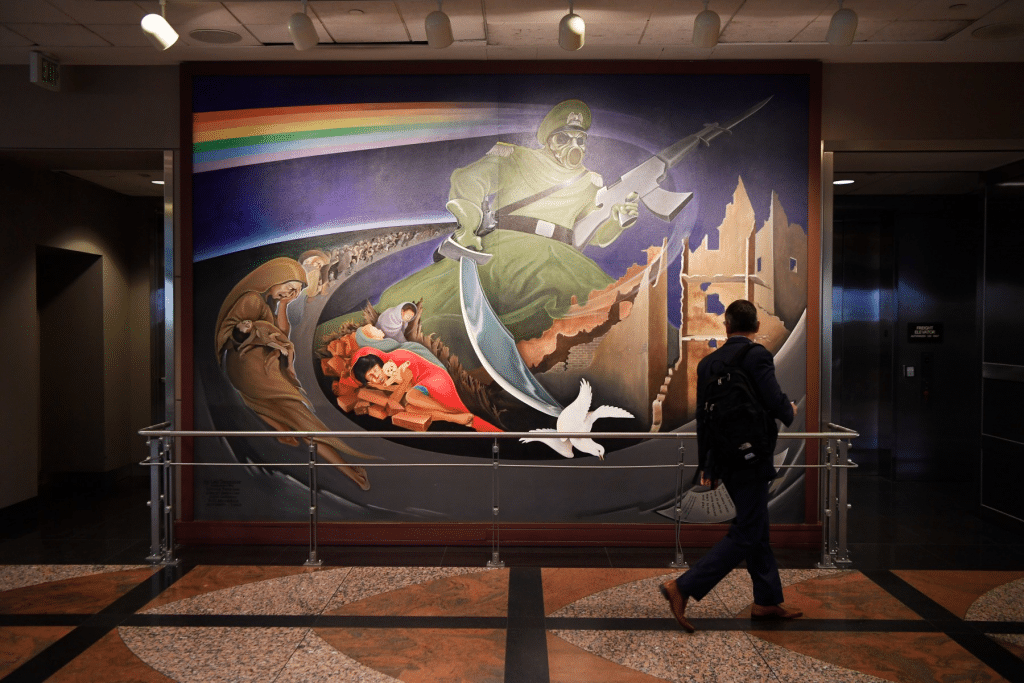
Denver International Airport commissioned large murals by Colorado artist Leo Tanguma.
The paintings are impossible to overlook.
They contain powerful scenes involving environmental destruction, conflict, suffering, children, military imagery and, ultimately, hope and peace.
For an airport, the subject matter is certainly unusual.
But unusual does not mean unexplained.
Tanguma has discussed the themes behind his work, describing the murals as reflections on war, environmental destruction and humanity’s ability to choose peace.
The paintings are deliberately dramatic.
They are supposed to make travelers stop and think.
Why People Saw Something More Sinister
Context can change how we interpret an image.
Imagine seeing a frightening mural inside an ordinary museum. You might interpret it as political or historical artwork.
Now imagine seeing similar imagery inside an airport that already has mysterious tunnels, construction controversies and conspiracy stories surrounding it.
Suddenly, the same painting can feel like a clue.
That is one reason Denver’s airport mythology became so powerful. Separate details began reinforcing one another in people’s minds.
Then There’s the Blue Mustang
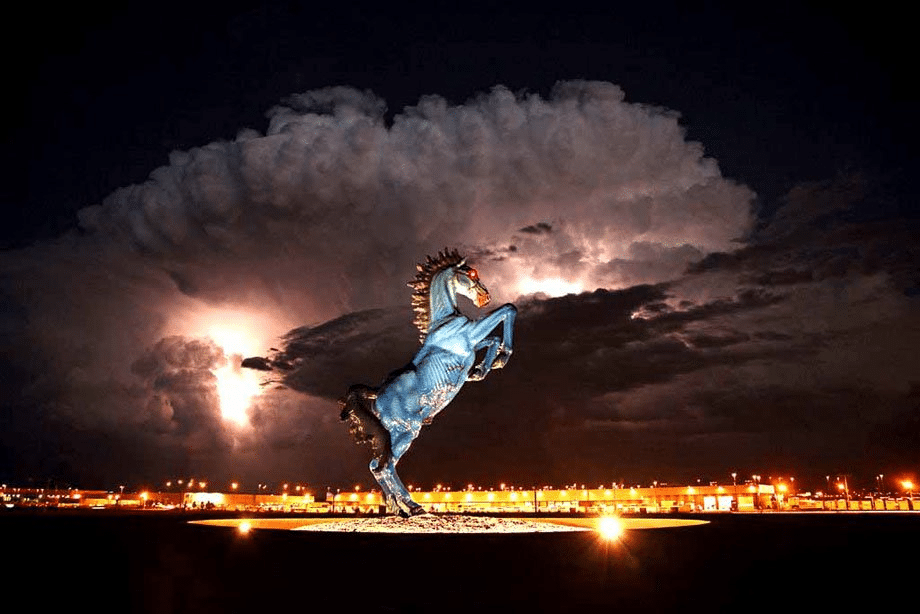
Outside the airport stands one of its most recognizable landmarks: Blue Mustang, a gigantic blue horse sculpture with glowing red eyes.
The sculpture is about 32 feet tall and was created by artist Luis Jiménez.
It is difficult to miss.
The horse’s intense blue color and illuminated red eyes give it an almost supernatural appearance, especially after dark.
There is also a tragic story connected to its creation.
During the sculpture’s fabrication in 2006, part of the massive structure fell on Jiménez in his studio. He suffered fatal injuries. The project was later completed with the involvement of his family and installed at the airport.
So the horse’s strange history is real.
But the supernatural interpretation is another matter.
Why Are the Horse’s Eyes Red?
The answer is remarkably straightforward.
The eyes were designed with internal lighting.
The glowing red effect is part of the sculpture.
It wasn’t added later as some hidden signal, nor does the documented history of the artwork establish any connection to secret organizations.
The horse is unsettling because Jiménez created an enormous, vividly colored public sculpture that was meant to command attention.
And it certainly succeeded.
The Mysterious Cornerstone Has an Ordinary Explanation
Another favorite detail in the Denver airport conspiracy story is the cornerstone located near the terminal.
The stone contains Masonic imagery and references the New World Airport Commission.
That combination sounds mysterious enough to attract attention.
But the context matters.
Masonic organizations have participated in cornerstone ceremonies for American public buildings for centuries. The presence of Masonic symbolism therefore isn’t unique to Denver International Airport.
The phrase “New World Airport Commission” has also generated speculation because people associate the words with the much broader “New World Order” conspiracy narrative.
Yet similarity between names isn’t evidence of a relationship.
The commission associated with the airport was a local organization connected to the airport’s development and opening. No credible documentation has established that the inscription represents a secret global organization.
How a Real Airport Became a Conspiracy Legend
The Denver airport mystery didn’t appear overnight.
Video: The true story behind the conspiracy-ridden murals at Denver International Airport
It developed gradually.
The airport opened after years of construction problems and public discussion about its enormous cost. Once visitors encountered the tunnels, unusual art, giant horse and strange-looking cornerstone, people began connecting the dots.
Then the internet accelerated everything.
A rumor that once might have circulated among a few curious travelers could suddenly reach millions of people.
Websites collected photographs.
Television programs repeated theories.
Books expanded the claims.
Later, social media turned individual observations into viral posts.
One person would point to the tunnels.
Another would mention the murals.
Someone else would highlight the cornerstone.
Then another person would add the runway layout.
Eventually, the separate details became part of a single enormous narrative.
The Runway Shape Added Another Layer
One of the most famous claims involves the airport’s runways.
From certain aerial perspectives, some runway arrangements can appear vaguely similar to a symbol associated with Nazi Germany.
That observation is real in the sense that the visual resemblance can be seen from particular angles.
But resemblance alone doesn’t establish intent.
Large airports need multiple runways positioned according to operational requirements, prevailing winds, safety considerations and surrounding development.
Aerial shapes can produce all kinds of apparent patterns.
Our brains are exceptionally good at finding meaningful shapes in complicated arrangements. Once someone tells us what we are supposed to see, it becomes even easier to notice it.
What About the Secret Bunker?
This is where the story makes its biggest leap.
There are documented underground facilities at Denver International Airport.
There is not comparable evidence establishing a vast hidden underground city or secret headquarters beneath the airport.
A facility of that scale would require enormous amounts of construction material, engineering work, ventilation, electricity, plumbing, maintenance and access.
Thousands of people were involved in building the airport.
Keeping a massive additional construction project completely separate from the documented infrastructure would be extraordinarily difficult.
More importantly, decades of public attention have not produced credible engineering documents, photographs or independently verified firsthand testimony establishing the existence of the legendary underground city.
That doesn’t prove that every inch beneath an airport is publicly accessible.
It does mean that extraordinary claims require stronger evidence than rumors and unusual photographs.
Why the Denver Airport Mystery Still Fascinates People
Perhaps the most interesting part of the story is that the airport doesn’t need a secret bunker to be fascinating.
The real history is already unusual.
A gigantic airport was built after a difficult construction process.
An ambitious automated baggage system encountered major problems.
The project generated enormous public scrutiny.
The building features provocative artwork.
A massive blue horse with glowing eyes stands outside.
There are genuine underground tunnels.
And the airport itself has acknowledged the conspiracy culture surrounding it.
That’s a pretty compelling collection of facts without adding an underground civilization.
The Airport Even Plays Along With the Mystery
Over the years, Denver International Airport has embraced some of its conspiracy mythology with humor.
The airport has acknowledged popular theories and incorporated playful references to the mythology into its public image.
That approach makes commercial sense.
Why fight a story that attracts attention when you can turn the attention into tourism, merchandise and publicity?
But it creates an amusing paradox.
The more the airport jokes about the conspiracy, the more some people interpret the jokes as confirmation.
A wink becomes evidence.
A denial becomes a cover-up.
A joke becomes a clue.
At that point, the theory becomes extremely difficult to disprove because almost any response can be incorporated into the narrative.
What Is Actually Beneath Denver International Airport?
Strip away the speculation and the answer becomes much clearer.
Beneath Denver International Airport are real transportation and infrastructure systems designed to support one of the world’s major airports.
There are tunnels.
There are baggage-handling facilities.
There are passenger transportation systems.
There are utility and maintenance spaces required by a complex airport.
What the available evidence does not establish is the existence of an enormous secret underground city, an Illuminati headquarters or some other fantastical facility described in popular conspiracy stories.
That distinction is important.
The tunnels are real.
The horse is real.
The murals are real.
The cornerstone is real.
The construction problems were real.
The conspiracy is the interpretation layered over those facts.
Conclusion: The Truth Beneath the Mystery
Denver International Airport became famous for something far beyond flights and baggage.
Its troubled construction, underground infrastructure, striking artwork, Masonic cornerstone and unforgettable blue horse created the perfect ingredients for a modern American mystery.
But the most fascinating lesson may be that reality doesn’t always need embellishment.
The airport really does contain tunnels. Its construction really did encounter major problems. Its artwork really is unusual. And Blue Mustang really does stare across the approach road with glowing red eyes.
Those facts are enough to explain why visitors remain curious.
What the evidence does not provide is a documented underground city or secret command center hiding beneath the airport.
In the end, Denver International Airport may be mysterious—but not necessarily for the reasons conspiracy theories suggest.
Sometimes the most intriguing story is simply the one hiding in plain sight: an enormous, complicated piece of American infrastructure whose real history became stranger than anyone expected.