Sometimes the most remarkable treasures are not found behind museum glass.
They are sitting quietly on thrift-store shelves, surrounded by mismatched dishes, old decorations and forgotten household items. Most shoppers walk past them without a second thought.
Jessica Vincent almost did the same.
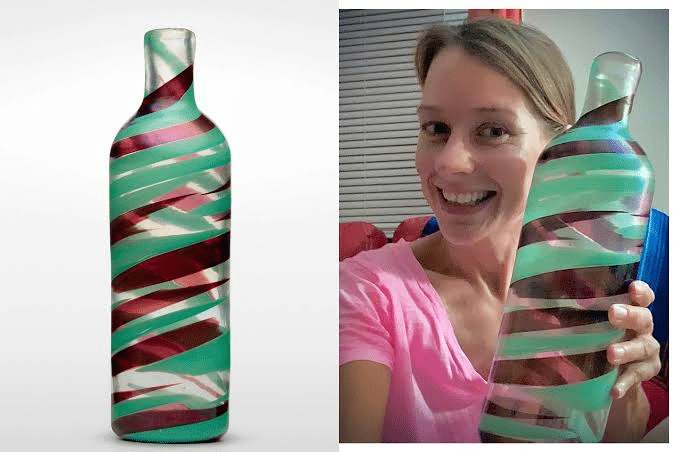
During a June 2023 visit to a Goodwill store outside Richmond, Virginia, Vincent noticed a colorful glass vase that looked different from the ordinary objects around it. It had an unusual bottle-like shape, considerable weight and flowing ribbons of aqua green and purple that gave the surface an almost painterly appearance.
The price tag made the decision easy.
$3.99.
Vincent bought the vase simply because she liked it. She had no idea that the inexpensive purchase would eventually become a six-figure discovery.
Just six months later, the vase appeared at auction and sold for $107,100.
So how did a $3.99 thrift-store decoration become a rare piece of Italian design?
The $3.99 Vase That Didn’t Look Ordinary
Vincent was already familiar with thrift stores, yard sales and estate-sale finds. Years of browsing had taught her that unusual objects sometimes hide among ordinary merchandise.
Still, she was not searching that day for a valuable antique.
She had been training horses with her partner and stopped at Goodwill afterward. Among the shelves filled with inexpensive household goods, the glass vase immediately caught her attention.
Its shape was distinctive.
Its colors were unusual.
And it felt heavier and better made than many of the pieces surrounding it.
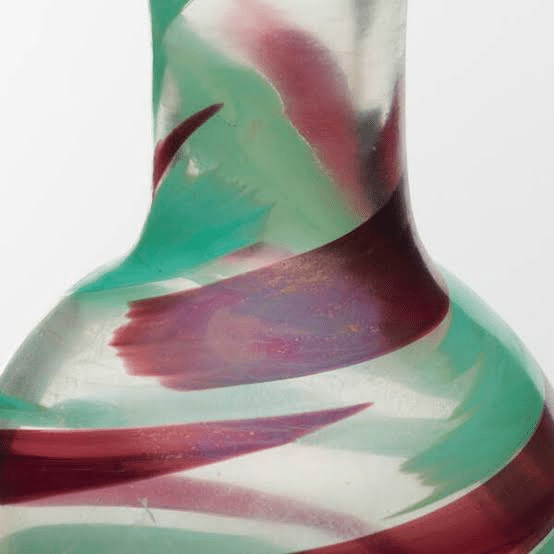
The vase stood approximately 13.5 inches tall and featured transparent glass decorated with sweeping trails of opaque color. Rather than looking like a pattern painted onto the surface, the colored ribbons appeared to flow through the glass itself.
That detail would eventually become one of the clues to its remarkable history.
At the store, however, none of that mattered.
The vase was simply marked at $3.99.
Vincent paid for it and took it home.
A Thrift-Store Find Becomes a Mystery
The story might have ended there if Vincent had never turned the vase over.
But underneath the piece was a small marking that changed everything.
She noticed what appeared to be an “M.”
For someone familiar with Italian glass, that single letter could suggest Murano, the Venetian island famous for centuries of glassmaking.
Vincent began looking more closely.
Faint markings on the bottom appeared to contain references to Murano and Italy. Suddenly, the vase no longer looked like an anonymous decorative piece.
It looked like something that might have a history.
And that history was worth investigating.
The Tiny Mark That Pointed Toward Murano
Murano glass has long attracted collectors because of its craftsmanship, distinctive techniques and connection to generations of Venetian glassmakers.
But simply being associated with Murano does not automatically make a vase valuable.
Vincent needed to determine exactly who had made the piece.
She photographed the vase and began asking questions in online communities devoted to Murano and Italian art glass. Collectors recognized characteristics that seemed connected to the work of Venini, one of Murano’s best-known glassmaking companies.
That was the first major breakthrough.
The vase was not merely Italian-looking.
It appeared to carry a genuine connection to an important Murano manufacturer.
The complete marking would prove even more useful.
According to the later auction catalog from Wright, the underside carried a three-line acid stamp reading:
“Venini Murano Italia.”
That small inscription transformed the search.
Now there was a manufacturer to investigate, a location and a body of historical design work that could be compared with the vase.
Video: Virginia Woman Sells $3.99 Thrift Store Vase for $107,000 at Auction
Vincent reportedly even received a private offer of around $10,000.
She declined.
Instead, she wanted professional confirmation.
That decision would prove extremely important.
Experts Connect the Vase to Carlo Scarpa
Vincent eventually contacted Wright, an auction house specializing in modern design and important works of Italian glass.
When Richard Wright saw photographs of the vase, he recognized something unusual.
The shape, colors and distinctive decoration appeared to match a rare design associated with Carlo Scarpa, the celebrated Italian architect and designer.
Further examination confirmed the connection.
Wright cataloged the vase as model 3664 from Scarpa’s Pennellate series, produced by Venini in 1942.
Suddenly, the $3.99 purchase had a name, a designer, a manufacturer and a date.
Why Carlo Scarpa’s Glass Was So Special
Carlo Scarpa became one of Italy’s most influential architects and designers, but his work with Venini during the 1930s and 1940s also produced some of the country’s most inventive art glass.
The word Pennellate refers to brushstrokes.
That name makes sense when looking at the vase.
Its ribbons of opaque color appear almost as though someone had swept a paintbrush across the surface. Yet the effect was achieved through the demanding process of hot glassmaking rather than ordinary surface decoration.
Glassworkers had to apply colored glass while the vessel remained extremely hot and continue manipulating the form without allowing it to collapse.
The result was delicate, controlled and seemingly spontaneous at the same time.
That combination is part of what made Scarpa’s designs so attractive to collectors.
Video: $4 Vase Sells for $107,000 at Auction
Why This Particular Vase Was Worth So Much
Finding a famous designer’s name is only the beginning when determining the value of a collectible.
Collectors also consider rarity, condition, provenance, craftsmanship, design and comparable auction results.
The Goodwill vase performed remarkably well across those categories.
Wright identified it as a particularly scarce example of the Pennellate series. The auction house reportedly knew of only one other example with the same form and color combination, and that piece was held in a private collection.
That level of rarity can dramatically affect the value of collectible design.
Condition Made a Huge Difference
The vase had another advantage: its condition.
Glass objects can suffer damage surprisingly easily. A small chip around the rim, a crack or significant surface wear can reduce the desirability of a collectible piece.
This vase had survived remarkably well.
Its strong condition helped preserve the qualities that collectors were looking for—the unusual shape, the vivid colors and the original glassmaking details.
Richard Wright noted that even relatively minor damage could have significantly changed the vase’s value.
In other words, Vincent had not simply found an authentic Scarpa design.
She had found a scarce example in unusually good condition.
The Auction Estimate Was Already Extraordinary
By December 2023, the vase had traveled a remarkable distance from the Goodwill shelf.
Wright included it as Lot 106 in its Important Italian Glass auction on December 13.
The estimate was already astonishing compared with Vincent’s original purchase price:
$30,000 to $50,000.
For someone who had paid $3.99, even the low end of that range represented an extraordinary return.
But the bidding did not stop there.
The vase reached a hammer price of $85,000.
Once the buyer’s premium was included, the reported total sale price reached:
$107,100.
The anonymous buyer was a private European collector.
The numbers were remarkable enough to turn an obscure thrift-store purchase into an international collecting story.
From Goodwill Shelf to Six-Figure Auction
The most fascinating part of Vincent’s discovery is the chain of events that connected the ordinary to the extraordinary.
First came curiosity.
She noticed something unusual and decided to take a closer look.
Then came the tiny marking.
The possible Murano connection led to Venini.
Venini led to Carlo Scarpa.
Scarpa led to the Pennellate series.
Finally, professional examination confirmed that the vase was an exceptionally rare example.
Nothing about the vase’s appearance at Goodwill guaranteed its value.
The store’s price reflected what was known about the object at the time—not what specialists would later determine it to be.
And that distinction explains why stories like this continue to fascinate people.
A valuable object does not always announce itself.
Sometimes it looks like an ordinary piece of glass sitting between candle holders and kitchenware.
What Happened to the $107,100?
Vincent’s unexpected windfall also had a practical side.
According to reporting about the sale, she planned to use some of the proceeds to install proper heating and cooling in an old farmhouse she had recently purchased.
That detail gives the story an especially human ending.
The discovery was not simply about owning a rare piece of design history. The money could improve an actual home and change everyday life.
A vase that had once cost less than the price of a casual restaurant meal had suddenly become a major financial asset.
The journey was almost impossible to predict.
Why the Story Matters Beyond the Price Tag
The final auction figure is certainly eye-catching, but the real lesson lies in what happened before the bidding began.
Vincent did not discover the vase because she had a secret catalog of expensive Italian glass.
She noticed it because she paid attention.
She recognized that the weight, colors and construction looked unusual. Then she turned it over. She searched for markings. She asked collectors. And instead of accepting an early private offer, she pursued professional authentication.
That process turned suspicion into evidence.
The Tiny Mark That Changed Everything
There is something wonderfully old-fashioned about the discovery.
In an age when people can instantly search millions of images from a phone, the crucial clue was still something incredibly small: a maker’s mark on the bottom of a vase.
The marking did not shout.
It did not come with an appraisal.
It did not say, “This is worth six figures.”
It simply provided a starting point.
From there, experts connected the piece to Venini, Carlo Scarpa and the rare Pennellate collection.
The vase’s story also offers a reminder about the objects people pass along without knowing their full histories. A piece can move from a designer’s workshop to a collector, from a home to a donation box and eventually onto a thrift-store shelf.
By the time Vincent encountered it, its original story had disappeared.
Only the glass remained.
Conclusion: A $3.99 Purchase Became a $107,100 Discovery
Jessica Vincent walked into a Goodwill store looking at ordinary household objects and walked out with something far more significant than she realized.
The vase she purchased for $3.99 turned out to be a rare 1942 Pennellate design by Carlo Scarpa for Venini.
A tiny marking pointed toward Murano. Further research connected the piece to Venini. Expert examination confirmed Scarpa’s design and established its rarity and strong condition.
At Wright’s December 2023 auction, the vase carried an estimate of $30,000 to $50,000, but competitive bidding pushed the hammer price to $85,000. With the buyer’s premium, the reported final price reached $107,100.
The story is a perfect reminder that remarkable objects do not always come with remarkable price tags.
Sometimes they sit unnoticed on a thrift-store shelf.
Sometimes the difference between a $3.99 decoration and a six-figure work of art is nothing more than a tiny mark on the bottom—and someone curious enough to turn it over.