For generations, Niagara Falls has represented motion.
The roar never seems to stop. Water pours over the edge, mist rises into the air, and millions of visitors gather each year to watch one of North America’s most recognizable natural landmarks.
But in 1969, something happened that sounds almost impossible today.
The American Falls stopped.
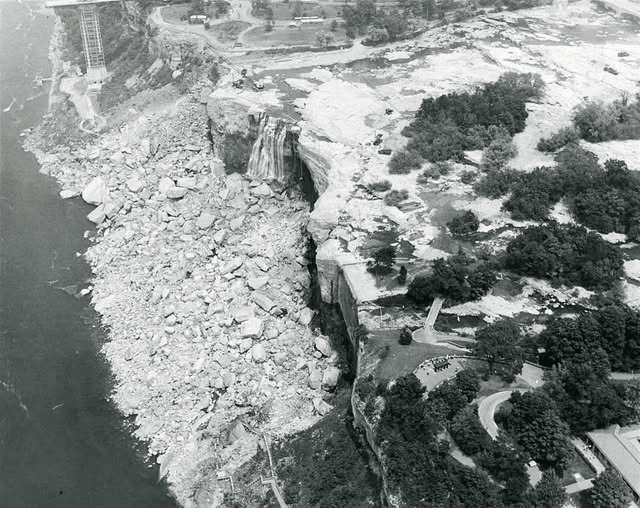
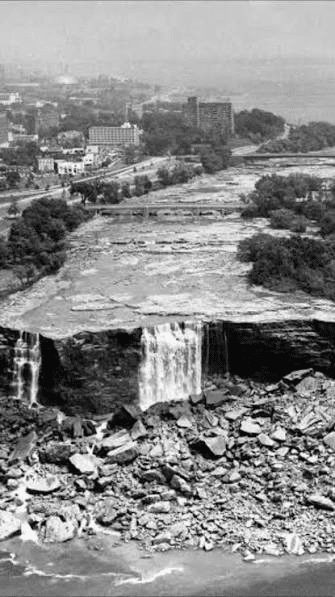
For roughly five months, visitors standing near the falls could look toward the normally roaring curtain of water and see exposed rock instead. The riverbed was visible. The mist was gone. The familiar thunder had been replaced by an eerie silence.
This was not an accident.
Engineers deliberately diverted the river away from the American Falls so scientists could examine the exposed cliff and investigate growing concerns about erosion and fallen rock.
The project became one of the most unusual engineering operations ever carried out at Niagara Falls.
Why Did Engineers Shut Down the American Falls?
The decision began with a geological problem.
Niagara Falls is not simply a waterfall sitting on an unchanging cliff. It is a landscape constantly being reshaped by water.
As the river flows over the edge, it gradually wears away weaker layers of rock beneath the harder cap. Eventually, sections of the upper rock can fracture and collapse.
By the 1960s, engineers and geologists were increasingly concerned about the amount of broken rock accumulating beneath the American Falls.
This material, known as talus, had built up over decades.
Large blocks had fallen from the cliff and collected at the base. Some observers worried that the accumulation could eventually alter the appearance of the falls or interfere with the way water moved over the edge.
But how could anyone properly examine the problem while millions of gallons of water were crashing down the cliff every minute?
There was only one practical answer.
Stop the waterfall.
A Natural Landmark Became an Engineering Project
The U.S. Army Corps of Engineers worked with the International Joint Commission, the organization responsible for addressing shared water issues between the United States and Canada.
The objective was not to redesign Niagara.
Instead, engineers wanted to understand what was happening beneath the water.
They needed access to the exposed rock face.
They wanted to map cracks, inspect the cliff, measure the accumulated talus and determine whether intervention was necessary.
That meant creating a temporary barrier capable of redirecting the enormous flow of the Niagara River.
The Cofferdam That Redirected Niagara
The key piece of engineering was a structure called a cofferdam.
A cofferdam is essentially a temporary barrier used to keep water away from an area where engineers need to work.
In this case, the structure had to withstand the force of one of the world’s most famous rivers.
Construction began in 1969.
The temporary barrier stretched approximately 600 feet across the river and required roughly 27,800 tons of rock and earth fill.
That is an extraordinary amount of material for something that was never intended to become permanent.
Once the cofferdam sealed the channel feeding the American Falls, the water had to go somewhere else.
It was redirected toward the Canadian Horseshoe Falls.
The Horseshoe Falls already carried the majority of Niagara’s flow, so the Canadian side absorbed the additional water.
From the Canadian side, the change was relatively modest.
From the American side, it was astonishing.
Video: Scientists Drained Niagara Falls in 1969 And Made an Amazing Discovery
June 1969: The American Falls Went Silent
On June 12, 1969, the final flow disappeared from the American Falls.
For the first time in modern records, the famous waterfall stood dry.
Imagine arriving at Niagara expecting the familiar wall of white water and instead seeing a massive exposed cliff.
There was no continuous roar.
No cloud of mist.
No river pouring over the edge.
Just layers of rock, cracks, debris and an empty plunge area.
The sight attracted enormous public interest.
Visitors came specifically to see the unusual landscape. People stood at viewing platforms and stared at a place that looked almost unrecognizable without its defining feature.
Some compared the exposed falls to the skeleton of a living thing.
The comparison makes sense.
Water normally hides much of Niagara’s physical structure. Once the flow disappeared, the underlying geology suddenly became the star of the show.
Scientists Finally Had a Clear View
With the water gone, engineers and geologists could examine areas that were normally impossible to reach.
They mapped the exposed cliff.
They studied fractures.
They measured the talus.
They documented the different layers of rock.
For the first time, specialists could inspect the American Falls almost like an enormous outdoor geological laboratory.
The exposed surface showed evidence of the natural processes responsible for shaping Niagara.
The upper layers contained hard dolomite, while softer rock beneath it was more vulnerable to erosion.
Water gradually exploits weaknesses in the softer material. As those layers disappear, sections of harder rock above them can lose support and eventually collapse.
Video: Niagara Falls National Heritage Area Year-End Review
That process happens slowly, but over thousands of years it has helped create the Niagara landscape people recognize today.
What Was Hiding Beneath Niagara Falls?
The inspection confirmed that the talus problem was real.
Large quantities of fallen rock had accumulated below the American Falls.
Some pieces were enormous.
The exposed cliff also revealed cracks and structural weaknesses that could contribute to future rockfalls.
But the investigation produced a surprising question.
Should engineers remove the fallen rock?
At first glance, removing the debris might seem obvious.
If erosion threatens the appearance of the falls, why not clear away the accumulated material and reshape the area?
The answer was more complicated.
Why the Fallen Rock Was Left Alone
Removing the talus would have required a huge construction effort.
Engineers would have needed to excavate massive quantities of rock from beneath the falls. The work would have cost considerable money and could have altered the natural appearance of the landmark.
More importantly, removing the debris would not necessarily stop the geological process that created it.
Water would continue eroding the underlying rock.
Eventually, more material would fall.
The International Joint Commission therefore faced a philosophical question as well as an engineering one.
Was the goal to preserve Niagara exactly as nature had shaped it—or to intervene in order to make the waterfall look the way people preferred?
In the end, officials chose restraint.
They recommended leaving the talus where it was and allowing the American Falls to return to its natural condition.
The enormous engineering project had produced a remarkable amount of information, but its conclusion was surprisingly simple:
Don’t reshape the waterfall.
November 1969: Niagara Falls Returned
After approximately five months, the experiment was over.
On November 25, workers began dismantling the cofferdam.
The process had to be carefully controlled.
Engineers could not simply remove the entire barrier and allow the river to rush back unpredictably.
Sections of the temporary structure were gradually taken apart, allowing water to reclaim its original route.
At first, only a small flow appeared.
Then the water increased.
Slowly, the familiar curtain began returning across the American Falls.
The sound returned too.
The silence that had lasted for months disappeared beneath the growing roar of Niagara.
Eventually, the American Falls looked almost exactly as visitors remembered it.
The dry cliff vanished beneath the water again.
The Strange Photographs That Survived
Today, photographs from the summer of 1969 remain some of the most fascinating images ever taken at Niagara Falls.
They show the landmark without its most obvious feature.
People stand where tourists would normally see rushing water. Workers move across exposed areas of the cliff. Huge piles of rock sit where the plunge pool would normally dominate the view.
The images are almost unsettling because the location is instantly recognizable and yet completely unfamiliar.
That is what makes the photographs so powerful.
The waterfall did not disappear.
It was simply switched off.
For a few months, people could finally see what existed underneath the spectacle.
A Rare Look at Niagara’s Geological Structure
The project also demonstrated something important about famous natural landmarks.
What looks permanent from a distance may actually be changing all the time.
Niagara Falls appears timeless because human lifetimes are extremely short compared with geological processes.
But the exposed rock told another story.
Cracks, fractures and fallen blocks showed that the waterfall is still evolving.
Water continues to shape the cliff.
Rock continues to break away.
And the landscape continues its slow transformation, even when visitors see only the same familiar waterfall year after year.
Why Engineers Didn’t Permanently Alter the Falls
The 1969 project could have become the beginning of a much larger transformation.
Engineers could have removed the talus.
They could have attempted to reshape portions of the cliff.
They could have tried to slow erosion through large-scale construction.
Instead, officials ultimately chose observation over permanent intervention.
That decision reflected an important principle in environmental engineering: sometimes the best solution is not to control nature more aggressively, but to understand it and monitor what happens next.
The American Falls was returned to its natural flow.
The rock remained.
And the geological processes continued.
The Only Time the American Falls Was Shut Down
The 1969 dewatering remains one of the strangest chapters in Niagara Falls history.
For approximately five months, engineers successfully redirected the river away from the American Falls.
They built a massive temporary cofferdam, diverted the water toward Horseshoe Falls and exposed the underlying cliff to detailed scientific inspection.
The investigation confirmed substantial talus accumulation and revealed important information about the structure and erosion of the falls.
But perhaps the most surprising conclusion was what engineers decided not to do.
They left the fallen rock in place.
They did not permanently reshape the waterfall.
They simply restored the river and continued monitoring Niagara’s natural evolution.
Conclusion: The Day Niagara Stopped Roaring
For five extraordinary months in 1969, one of North America’s most famous waterfalls became something else entirely.
The American Falls became a dry cliff.
Tourists saw exposed rock instead of rushing water. Engineers walked across areas normally hidden beneath the river. Geologists studied fractures, erosion and enormous piles of fallen stone.
The project was an impressive demonstration of engineering, but its final lesson was surprisingly modest.
After all the construction, surveying and debate, officials decided that nature did not need to be redesigned.
The cofferdam came down.
The Niagara River returned.
The American Falls began roaring again.
And the exposed geology disappeared beneath the water, leaving behind an extraordinary photographic record of the one summer when Niagara Falls was deliberately turned off.